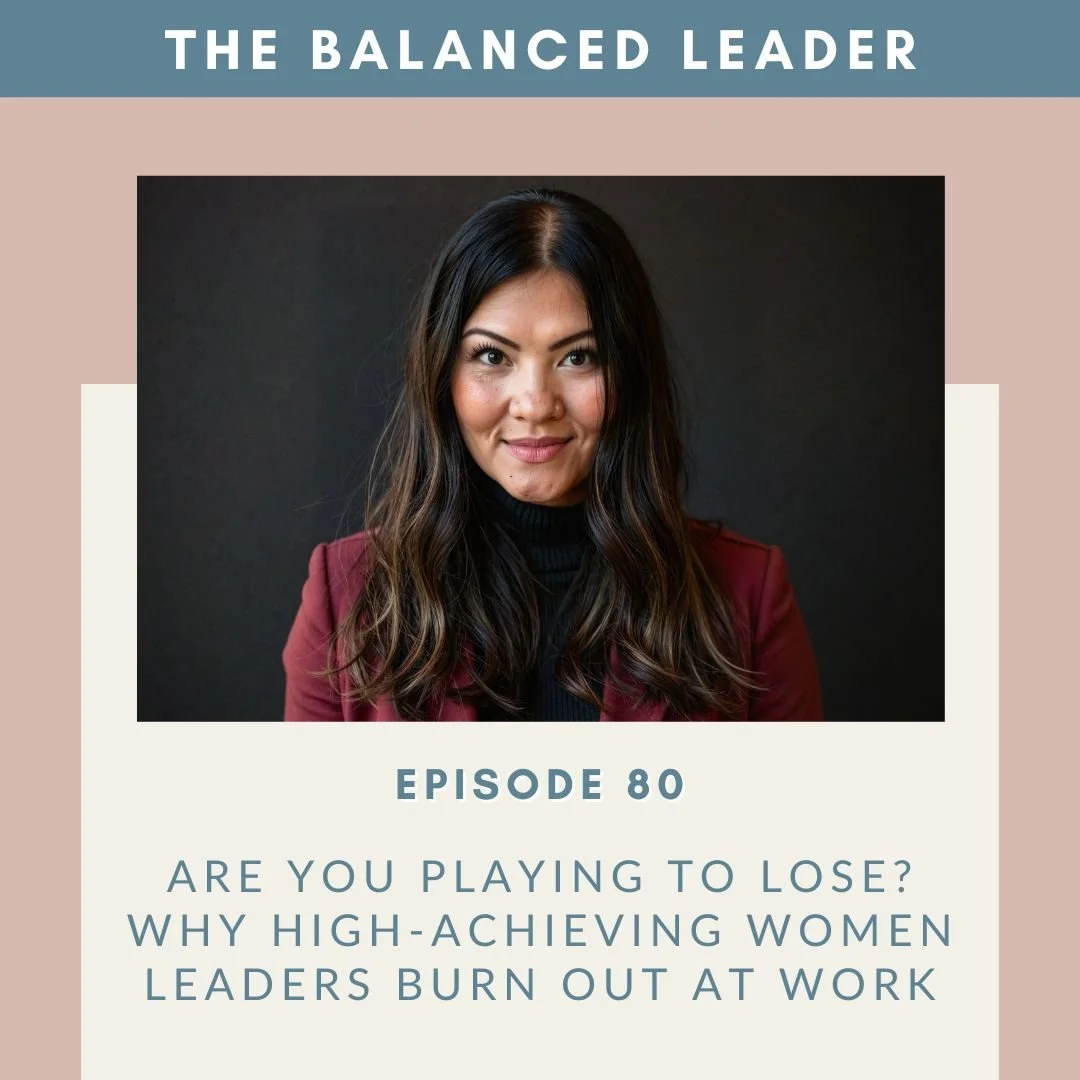
80. Are You Playing to Lose? Why High-Achieving Women Leaders Burn Out at Work
You’re in a meeting. You have the answer. You can feel it. It’s clear. And then… you don’t say it. Or you soften it. Or you wait. If you’ve ever walked out of a moment like that wondering why you held back, this episode will challenge how you’re approaching leadership.
Tune in to hear actually means to be playing not to lose versus playing to win. I walk you through the patterns I see in high-performing women who are smart, capable, and respected, but still not the ones people rely on in high-stakes moments. This isn’t about skill or intelligence. It’s about identity and how you show up when the pressure is on.
You’ll learn how to recognize where you may be softening your authority, delaying decisions, or prioritizing being liked over being trusted. I’ll show you how to shift internally so you can start speaking with ownership, moving conversations forward, and building the emotional capacity to take action before it feels comfortable.
Interested in working with me? Book a free 1:1 consultation here!
What You’ll Learn from this Episode:
The difference between playing to win and playing not to lose.
Why high-performing women still hold back in high-stakes moments.
How softening your message trains the room not to take you seriously.
The cost of delaying decisions and missing leadership moments.
Why being liked can hold you back from being trusted.
What’s actually happening internally when you hesitate to speak.
How to start taking imperfect action and move the room forward.
Listen to the Full Episode:
Featured on the Show:
If you haven’t already, please follow the podcast and leave a rating and review to let me know what you think. Find complete instructions here!
Watch my TEDx talk: Reclaiming anger: A woman’s birthright
Get the free guide, The 5-Minute Reset to Own the Room, here!
Episodes Related to Why High-Achieving Women Leaders Burn Out at Work:
Full Episode Transcript:
Welcome to The Balanced Leader, hosted by Yann Dang, a Leadership and Life Coach with over 20 years of corporate experience. Drawing from her journey as a former global finance leader and second-generation immigrant, Yann understands the unique challenges women face in male-dominated workplaces.
Each episode offers insights on balancing masculine and feminine energies, mastering soft skills and building emotional intelligence. Join us to transform frustration into empowerment and unlock your authentic leadership potential.
Hey podcast listeners, today's episode is all about how you may inadvertently, accidentally, not even know on purpose that you are playing not to lose versus playing to win. And you've probably listened to the last few episodes. I do a lot of episodes that are on the mindset that's needed to speak up. I do a lot of episodes on what is needed to step into visibility, into velocity. And I'm going to share more about this with you as we unpack today's episode.
But I want you to know, if you're listening to some of these podcasts and you're like, this sounds familiar, it is on purpose. I have been on purpose writing and talking about these topics that are very similar, but shared with you in different ways because I want it to land with you. And I know a lot of different people are listening to this podcast. And there's going to be some episodes that you may feel are a bit more abstract, and then others where you're like, this nailed it, you hit it home. I am going to school on this and I'm going to school myself and I'm going to take some action.
And as a coach, part of my job is to support my people in where they're at and to hear these messages, not just hear them to learn and to be insightful, but to actually take action. For me, as a coach, this is my mission. I do not want a lot of fan girls just being very excited about my work. I want women that are standing with me side by side doing the work. I want to lead these women. I want to support you to actually change your life forever.
So, if you are like, this episode feels a little familiar, I want you to stay with it because what I noticed with the coaches that I follow, oftentimes, they are saying it again and again in a more clear way with more details, with words that land better with me for some episodes versus others. And so, this is why I am talking about this same subject. But I wanted to bring it up because my client recently, a woman in Command, said, "I just realized I am not playing to win. I am playing a defensive game. I am playing not to lose." And it hit home for me. You know, and I've talked to a lot of different women about this.
But I think those words, if that feels like you, and I'm going to unpack what that looks like and feels like and why this is an underlying problem for so many women. I want you to really take it for yourself and think about how it is playing out in your life because most women I work with are incredibly smart. They are subject matter experts. They are technical experts. They know their stuff and you know what? They are also phenomenal leaders, particularly when it's their direct team. Most oftentimes really good with peers, but it's this level of senior level leadership, these authority figures where you're learning to challenge that they start hitting a bump of like, "Whoa, what do I do here?" Right? Because the stakes are higher.
So, most of the women have done their work. They know their stuff and they're pretty well respected. But they are not always the ones that people look to in high stake moments, especially when it's a lot of other senior leaders, right? And it's not because they don't have the answer. It's because they haven't built the identity of someone who moves the room forward, especially in these senior level rooms that are high stakes. And here's the shift. Leadership is not about being right. It's about being relied on. And people don't know what you stand for if they don't feel your clarity, if they don't actually know, you know, what you stand for. They stop looking to you. They look for you maybe to execute and to support the plan, but they don't look to you for leadership. So that's subtle and that's where so many women get stuck.
Now, when I talk about strategic influence and architecting that for yourself as you think about your career, I oftentimes talk about how there are three different pillars. There's value, the work you do, the execution, the value you create in the moment. And then there's visibility, elevating your plan, letting people know who you are, personally and professionally, right? This is the visibility piece. And then velocity is really speaking up in the room or having the conversations with these senior level people, these power players. And so, most women spend a majority of their time in value instead of visibility and velocity because why? It feels safer. And we get these dopamine hits by getting things done and feeling good and like, hey, we're adding value. But we're not adding value to the way that we could be at our seniority and at our level, right? Of what's expected.
And I have a lot of women who come to my containers and they're like, there's just men around me. They love their own voice. They are so good at advocating for themselves, taking up space, saying things even if it's not amazing or genuine. Men have a way of giving themselves permission to just take up space. And some women are very triggered by this and annoyed by this. Why? Because, you know, it might also be something hard for them to do. Take up space just to take up space. To say, I'm valuable no matter what. And I'm going to say what I think and feel even if it's not, you know, totally important at this moment, right? And so I always tell the women, it's not about being inauthentic, but it is a way of allowing yourself to step into more of these spaces where you don't feel as comfortable, right?
And yes, we can spend a lot of time judging these men or we can spend time focusing on how we want to step up into more of this playing field, this playing ground that works for us, that supports us. We don't want to be sitting on the sidelines just judging other people. We want to go out there and play and figure out what feels authentic to us and how to take up space in a way, again, that is expanding and is impacting how we are leading, right? Expanding our own leadership and impacting the organization in this way.
And I'm going to talk to you about the patterns that oftentimes you are not maybe even aware of that are causing you to play defense versus actually playing to win, playing that offensive game, right? Because these are the things that, you know, I think when we are in our minds and we're overthinking, we're justifying all of these things. So, let's look at pattern number one. It's softening your authority. You know what you think, but instead of saying it cleanly, you say, I just thought, or I could be wrong, or maybe we should consider this.
And listen, this isn't about never collaborating or inviting input. But when you consistently dilute your own thinking and you outsource that power to somebody else, you're training the room not to take you seriously. You're using disclaimers, right? Because if you don't back your own perspective, why would they, right? Why would they want to listen to you? Powerful leaders don't speak more. They speak with ownership. This is the direction I recommend and here's why. And then they let it land.
Number two, you delay visible decisions. You're thoughtful, you process deeply, and you take your time to make sure your decision's right. You think, you analyze, and you weigh it. But here's the problem. Leadership moments don't wait for perfect clarity. They move. And by the time you're ready to speak, the room has already moved on, which is really you missing your leadership moment. This is where so many high performing women confuse thoughtfulness with effectiveness. But in leadership, speed of decision matters, not reckless speed, but clear, clean, grounded decisiveness. Because opportunities don't go to the most prepared. They go to the person willing to move the conversation forward.
And the next pattern is you prioritize being liked over being trusted and respected. This is a subtle one. You read the room, you adjust, you manage how you're coming across. You don't want to come off too strong, too direct, too much. So you calibrate. And again, this is a strength, right? This is why some of this work feels confusing because you're like, well, I've learned how to do these things, right? But when we overuse our tools, sometimes they work against us. Just like in this way, it becomes a pattern because you're constantly managing perception. You're not shaping outcomes. You're protecting how you're received. That's defensive play. And here's the truth. People don't look to leaders because they're the most likable. They look to them because they're clear and convicted, because they're willing to take a stand, because they move things forward.
Right? Usually, if you even look at it in society, the people that are most loved are also most hated because they have a frequency, a stand, a conviction about them. And that causes other people to feel something, do something, activate in some way, positive or negative, right? And sometimes women are so scared of having somebody react to us in a negative way, we just dilute our own power in the moment.
So now here's where we go deeper because this isn't about communication skills. It's not about learning better phrases or scripts. It's really about what happens internally when the moment is on you. When the room is watching, when the spotlight is on you, when the stakes feel high, when your voice actually matters. Your brain is scanning. Is this safe? Will I be judged? Will I lose credibility? Will this land the way I want? And so you hesitate. Not because you don't know, but because you're trying to control how it will be perceived. And that's the real thing. You're not afraid of speaking up, actually. You're afraid of what it might cost you if it doesn't land perfectly, right?
As women, we are always like having lots of scenarios, right? And we scan for threats. And until you shift that, no amount of strategy will change how you show up. If you are trying to play from the fear of having what you're saying land imperfectly and fear of the doomsday on the other side of it, that is the type of thinking and feeling in your body that is going to have you playing small versus going out and playing big.
So, let's shift and talk about what is the shift? How do you do this, right? It's not about being louder. It's certainly not about forcing confidence or faking it. It's not about becoming someone you're not. Right? This is all the things your brain is telling you that it is because it wants you to stay stuck where you are. But it is about this. You stop playing not to lose and you start playing to win. And that happens internally first because externally, you already know what to do. You know what you would say. You know what you would decide. You know where you're hesitating. The question isn't strategy. The question is, what would it actually look like for me to play to win in this moment? Pause there. Let it be uncomfortable.
This is why I ask women, if you were really focused on your visibility and velocity, what comes up for you? Right? This is actually playing to win because your answer will be very clear. It might sound like, I would say this thing directly. I would make this recommendation instead of waiting. I would move forward on this decision. I would stop over explaining and just let my truth land. Right? It's almost like asking the same question. If that doesn't land for you, what would it actually look like for me to play to win in this moment?
The other question would be, what would it look like to move forward if you didn't have any fear, if there was nothing to lose? That's another really powerful one. I have a lot of women who I'm like, wow, how did you do that? What were your thoughts? You know, when we're unpacking some powerful move, they literally will tell me, I had nothing to lose. I decided I have nothing to lose and so I was going to step into it. I was going to step forward into it, right?
And then the deeper question is, what would I need to be willing to feel in order to do that? Because the reality is that feelings are going to come up, right? I have a whole episode on what empowerment actually feels like and it doesn't feel that great. You usually feel guilty, you usually feel embarrassed, second guessing yourself. This is the power of moving out of the way we've been operating and into a new operating system that is designed for you to play to win. So you have to be onto yourself and you have to ask yourself, what would I need to be willing to feel in order to do that?
Because this is where everything changes. Not at the level of the action, but at the level of the capacity, this emotional capacity. What would you need to be willing to feel? Exposed, uncomfortable, uncertain? You know, I just had the episode about crossing the line, right? Is there the misunderstood? Would you need to be willing to feel seen? Most women don't hold back because they don't know what to do. They hold back because they haven't built the capacity to feel those things and be on their own side while they're feeling it and still move forward. Oftentimes, we have these feelings and we're like, this must mean something terrible versus, actually, this is working and this is what it feels like to play to win.
Instead of asking yourself, what should I say? Ask this, what am I avoiding feeling? Because that's the real edge. It's usually the emotional piece that has us not executing, right? Sometimes we want to call it the execution gap. It has some feeling in our body that's holding us back from really showing up strong and big and convicted and certain and very clear. So then take one step, not a perfect step, not a fully thought out step, but you want to figure out a step that will help you move things forward, right?
This is one of the biggest assignments in my Command group that blew women's minds. I had them for a week do this assignment, which I was like, you can do it for multiple weeks because this is going to help you so much. Take imperfect action. Give yourself permission. Of course, use your discernment. That's your judgment, right? There's a difference between using your discernment to decide what is the imperfect step I'm going to take versus spinning out in all of the scenarios, right? So I want to be very clear. You know, take imperfect action with discernment, but take the action. Say the thing, make the call, say and share your perspective, move the conversation forward. Let it be slightly uncomfortable. Let yourself feel exposed. Let it not be perfect. This is what it's like to play to win, especially in the boardroom, especially in your corporate landscape.
Because the women who advance aren't the ones who waited until they felt ready. They're the ones who built the capacity to move before it felt comfortable. And shifting and embracing that discomfort is your becoming. You don't become powerful by avoiding discomfort. You become powerful by expanding what you're willing to feel and moving anyway.
All right, that is today's episode. I want you going out there playing to win. And if there's another woman in your life that could use this podcast, send it to her immediately and share it with her. This is how we empower each other to move forward, to embrace discomfort, to win at a game that oftentimes we don't even realize we're playing, right? But this is how you win. This is how you move forward and expand your leadership.
All right, I'm with you. Go out there, share what it is that's on your mind. Take imperfect action and evaluate it, right? Evaluate it. Don't replay it and punish yourself, evaluate it and celebrate your wins. You are doing it. You are stepping on the playing field. You are no longer sitting on the sidelines judging yourself and other people. Go out and play. All right, take care. Bye.
Thank you for being a part of The Balanced Leader community. We hope you found today's episode inspiring and actionable. For more resources and to connect with Yann, visit us at aspire-coaching.co. Until next time, keep leading with confidence and purpose.
Enjoy the Show?
Don’t miss an episode, follow the podcast on Apple Podcasts, Spotify, YouTube Music, RSS, or wherever you listen to podcasts!