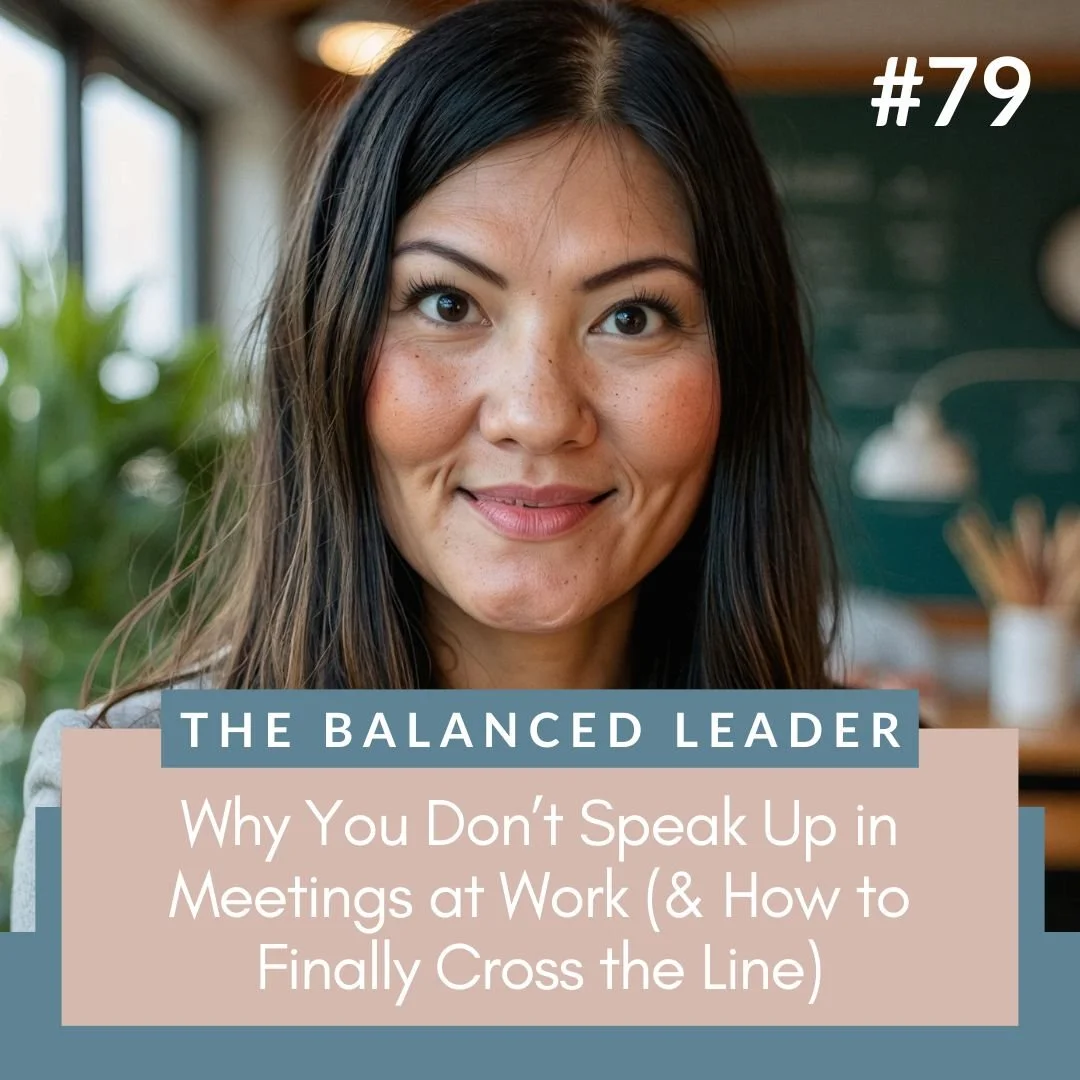
79. Why You Don’t Speak Up in Meetings at Work (& How to Finally Cross the Line)
There’s a moment in meetings that almost no one talks about, the one where you know exactly what needs to be said… and then you don’t say it. You feel it in your body. You hesitate, second-guess, or tell yourself to wait. And over time, those moments add up. Not just in missed opportunities, but in the quiet way you start disconnecting from your own voice.
In this episode, I’m breaking down what I call “the line,” that invisible edge between holding back and speaking with conviction. I share what’s actually happening in those moments when you stay quiet, why it’s not about confidence or communication skills, and how this pattern slowly drains your energy. I also walk you through a real example from my own leadership experience where I chose to cross that line, and what shifted as a result.
You’ll learn how to recognize when you’re standing at that edge, what it takes to move through it, and how to start expressing truth with clarity instead of managing perception. This isn’t about being louder or more aggressive. It’s about identity. When you learn to cross the line, you don’t just change the conversation, you change who you are inside of it.
Interested in working with me? Book a free 1:1 consultation here!
What You’ll Learn from this Episode:
Why you don’t speak up in meetings, even when you know what needs to be said.
What “the line” is and how it shows up in real-time leadership moments.
The hidden cost of holding back and how it leads to burnout over time.
The difference between managing perception and leading with conviction.
How to shift from playing defense to influencing the room.
The identity shift that allows you to speak with clarity and authority.
Practical phrases you can use to express your perspective in the moment.
Listen to the Full Episode:
Featured on the Show:
If you haven’t already, please follow the podcast and leave a rating and review to let me know what you think. Find complete instructions here!
Watch my TEDx talk: Reclaiming anger: A woman’s birthright
Get the free guide, The 5-Minute Reset to Own the Room, here!
Episodes Related to why you don’t speak up in meetings:
Full Episode Transcript:
Welcome to The Balanced Leader, hosted by Yann Dang, a Leadership and Life Coach with over 20 years of corporate experience. Drawing from her journey as a former global finance leader and second-generation immigrant, Yann understands the unique challenges women face in male-dominated workplaces.
Each episode offers insights on balancing masculine and feminine energies, mastering soft skills and building emotional intelligence. Join us to transform frustration into empowerment and unlock your authentic leadership potential.
All right. Hey, podcast listeners. Welcome to today's episode. This one is one that is about crossing the line. I'm gonna give you lots of context for this, but I want you to notice if this has been you in the past.
You are in a meeting. You hear people talking. You want to chime in. Part of your body is like, let's go. Let's ask this question. This question is so important. And then you were gonna go and make your move. And then you decide, actually, maybe I should wait for my boss to talk. Or you decide, actually, maybe I should get more data before I chime in. Or you tell yourself you shouldn't interrupt right now.
And then later you tell yourself the moment has passed. So I just want you to notice if there is a holding back in your body when you're in these meetings, it is very normal. I used to leave meetings with my jaw would be super tense because I'd wanna speak up, but a part of me was, like, holding myself back. And I would be having almost this inner conflict to speak up or not speak up. And over time, right, over time, I learned that those body sensations that were going on, how to actually notice them and move through them versus allow them to hold me back.
And I know what it feels like. And I have to share with you that this still happens to me. Sometimes I get off of consultations with clients and I notice this is what I should have said, or this is where I held back. Like, there's always that, like, 10%. I wouldn't say always, but when I notice it in my body and I'm like, there was something that I didn't say.
And this actually gives me good data because it keeps showing me where am I not pushing myself? Where am I, you know, still scared to cross that line? What I wanna share with you is there is always a proverbial line. There is always your next level. And if you can make friends with that line and learn how to cross it again and again and notice when you don't, right, This is where leadership is really showing up.
This is where you really get to fine tune your leadership and where you get to move with more and more conviction if you pay attention to that. Right? So the line is not about being louder. It's not about being aggressive. The line is truth expressed with conviction.
This is what it means to cross the line. And I think people have heard this before, like what it means to kind of like risk the relationship, tell the truth, not be so scared of disrupting or interrupting somebody else's emotions, but really focused on being truthful in the moment, leading and trusting yourself to speak up. So that's what I'm talking about because there's always this line that we have. Right? I say it's a line because that's what it feels like.
It's like, oh, can I cross that line? Am I being pushy? Am I too much? Right? And the cost of this not crossing the line isn't just that you're not heard. It's that you start losing yourself. You start losing your vitality, your activation, your energy. Right? Because part of it is, like, we have energy in us when we're like, oh, let's go for it. Let's win that game.
Right? You know when you're playing a sport and you're all in it. It's like your body's in it, your mind's in it, you want to win. And it's, like, not about you. It's the team. It's about going for it and being present in the moment. Well, what happens a lot of times is that we are not prepared for that. Right? And so in those meetings, when that happens, we don't notice where we quietly shrink back or we edit ourselves. Right?
But then after a while, the more editing you do, the more holding back you do, what happens is that it's not that you're tired from the work. You're tired from managing yourself in the work. You're tired of suppressing yourself. And this is actually what causes burnout. Right?
Not being able to really show up with your leadership presence telling your truth. So there's a part of you that is really, you know, wants to be activated, wants to go for it. Right? That's usually that prefrontal cortex that's like, let's go. Let's win this thing.
And that part of you feels free. That part of you feels expansive. And then there's another part that's like, this is super scary. We can't rock the boat. Let's just stay quiet. And that's the part of us that over time, if you keep listening to that voice, that survival voice that says, no, we can't say this. No. We can't ask that question. Nope. You better just, you know, be quiet.
This is just what it's like. Right? That part of you has you quietly disconnecting from yourself, has you quietly holding yourself back. And that's energy and that's life force being shut down inside of you. And that's actually what leads to burnout.
So I'm gonna share just a story of what happened to me in this situation and how I learned to like I said, I'm still onto myself. Where am I crossing the line? Where am I not? Because if I don't know where the line is and I'm not conscious that there's a line at all, I'm not as activated and I'm not as excited about playing the game. It's like, I almost like don't even know what's happening because I'm not on my leadership edge.
I'm so far from it and I'm not as activated in my body. So I will give you a more tangible example of what this really looks like in action. And I know this moment intimately because there was a time I almost didn't say it. Right? There were many times in my leadership moments that I almost didn't say it.
But now I have a lot of examples of where I did cross the line, where I made calculated risk, where I decided. So I was in a conversation with my CEO and other C suite level members preparing for a board meeting. And I had the thought, we're solving the wrong problem. And I felt it. Right?
Everybody was talking about how to make sure we are answering the board's questions. We were looking at what the board members were asking. And I remember thinking to myself, this is not the way we should be leading. Right? And I did have these thoughts that came up that said, Am I overstepping?
Am I wrong in this? Like, I have been through a couple of the board meetings so far, but I also, you know, had this thought like, should I go with it? And then instead, right, instead of allowing those thoughts to hold me back, I crossed the line. I decided I'm just going to go for it. What's the worst that's going to happen?
Maybe my CEO shuts me down. Maybe my C suite level members judge me, but whatever. I'm going to go for it because I'm trusting myself in this moment to move past the line. That's exactly what I was doing. Right?
And I actually said out loud, I think we're solving the wrong problem here. We're trying to please the board instead of using this board meeting to influence them. And I shifted and shared with them that this is our opportunity to lead the narrative and not just respond. I felt like we had been playing like defense with the board for so long. We're just answering their questions.
We're giving them what they want, but I'm like, we are the leaders here. We should be guiding them. They're in and out of our business, like, you know, every quarter. They don't know our business as intimately as we know it. And we keep complaining that we're not getting funding and that we have a lot of things that need fixing, but we're not actually putting what we need out there in a way that is consumable, bringing it to a storytelling, being able to shape the conversation, not just address and answer questions.
Right? And so that wasn't being pushy. Was me leading. That was me shifting the energy of the whole room. But that's because I decided crossing the line is not a skill. It's an identity.
I decided that I was a member of the leadership team and what I thought and felt mattered. I could see that what we were doing over and over with the board was trying to gain their trust by answering their questions versus trying to gain their trust by actually influencing them and leading them. So those were the bigger questions that I had on my mind. I want you to notice, who are you in that moment when you're like, you want to speak up?
Because there's some cha cha in your mind that is telling you to hold back, and you're still managing how you're being perceived versus are you owning who you are in the room? So for me, it was like, I'm gonna choose to own my leadership. I have a voice here and I have an opportunity to lead this group of people. So real leadership begins the moment it stops being about you. All right.
So that's really what helped me. Cause I was like thinking like, is this about me? Do I want to win? But I was like, it doesn't matter. People could say that this is not a great idea, but I was really thinking that like, no, it's more than that. Like, this is a deeper thing. I know that what we've been doing has been okay, but what we can do would be even greater. And I thought about it as us of a leadership team, as us leading the business and really answering the call of what the business needed, not just what the board wanted to see. So I've taught this thought before. Right?
And it matters. The thought is I am valuable. It still matters. But this is even deeper. Right? I think I am valuable helps a lot of women in these moments when we're, like, struggling. But I think that this other thought grounds me now, which is even more. It's more expansive. It's bigger. And it has me taking more bolder risks because I can see who I am in this.
It's an identity thought. And it helps me to release my own ego. It helps me to think about success and opportunities and expansiveness for like systems. Right? The greater good, like the bigger organization. You know, that's how I kind of thought about it. So here's the thought. I am full of goodness. I know that might seem like a strange thought to you, but I want you to practice it. I am full of goodness.
And what it means when I say it to myself is I trust my intent. I trust that I'm here to contribute. I trust that it's not about me. This is not about my ego. This is not about me being rejected. This is about leadership. And this is about me being a vessel for greater leadership and greater outcomes. If that's my train of thought, I might have a lot of cha cha about why I shouldn't speak up. But when I can really connect to why this is important, it not only has me really connected to myself, but it has me giving greater context to the rest of the room. And I'm no longer questioning myself.
I'm no longer questioning if the idea is good enough. I'm no longer questioning whether I'm worthy to do this or that. I'm just saying to myself, I'm full of goodness. And if that's true, I'm going to speak up and I'm going to share with context and clarity about why we should make this move. And it becomes more about us as a business making decisions and it becomes more about leading people versus protecting myself or protecting my perception or watching out.
I know this takes a lot of training and it also takes a lot of creating safety inside yourself because you may not feel super safe in your groups of people, right, in your leadership team sharing. You might've seen people get shut down. But the thing is, if you keep allowing yourself to think about the ways you're going to get shut down, you start shutting yourself down and you start playing that defensive game versus playing to win. I was telling my teammates, right? Let's play to win.
Let's play this offensive game where we're starting to seed our ideas and ask for what we want in a powerful grounded way instead of just answering people's questions and playing defense and trying to gain people's trust by being good. I was like, we can be great because we are leading and we are asking important questions and we are expecting this board to answer these questions for us because that's what we need. And that's really how I shifted things. So I wanna share this with you. Confidence gets you in the room, but integrity is what crosses the line.
Is true for me too. When I talk to all these clients, these high achieving women, and they want my support and they want my help. Right? I oftentimes have to sell them on the vision of themselves, sell them on why this is so important to them. And it may feel pushy to me sometimes, and I may not want to put it on the line, but the reality is I don't want to let them stay small.
I would rather them being upset with me for pushing me towards their goals, towards their dreams, than having them believe that they cannot do it and buying their story that they cannot move themselves out of the place that they are in because that is not leadership. And for me, when people come to talk to me about getting coaching, I am leading them. I am helping them lead themselves into their next level of leadership. And I cannot do that if I hold myself back and if I have myself just teetering the line and saying, Okay, well think about it later. Like, I need to be there.
Right? And there's a difference between, you know, being pushy versus being powerful. Right? There's a version of pushing that comes from need, needing to be right, needing to be liked, needing to be validated. And then there's a version that comes from truth.
And when you push for truth, when you're that convicted, when you're unconflicted, right? This is a big one, right? When I feel unconflicted about something, I'm like a force of nature. I will push for something and I will intend on getting it. Right? I will intend to be heard. I will intend to make a difference. I will intend to lead and make a big impact. Right? And that's a different energy. That's powerful. Right? And I know sometimes in our mind we could be like, oh, it's too pushy. People don't like it. Right?
But if you carried yourself with that and you believed I'm full of goodness and it's not about me, right? It's I'm good and I'm leading people and I will allow that force to come through. That is what has you moving and crossing that line and having you be really connected with yourself at the same time.
So I want to give you some practical language to practice because sometimes we just need a little bit of the language to push ourselves in the line, right? Push ourselves to that next level.
So here are some ways that you can present this. I see this differently. I don't think this is the best direction. We're solving the wrong problem. Right? These are all ways that you can calmly, cleanly, directly shift into this. Let's address the real problem here. Right? Like, you want to have different ways of saying it because the line will always be there. The moment will always come.
The thought will always be available to you. The question is, are you still playing small, or are you ready to own yourself in the room? Because when you cross that line, you don't just change the conversation. You change who you are inside of it. This is identity expansion.
And this is exactly what I do in my containers to support people, to push themselves because they know that they're full of goodness and their leadership matters and their voice matters and their ideas matter. Not because of their ego, but because it's the best thing for the organization, for people, the women that, you know, come on calls with me and want to work with me. You know, part of my job is to challenge them and part of my job is to support them to see themselves and see their problems in totally different ways. This is expansive. This is powerful. This is leadership.
Alright. So go out there. Find your line and learn to cross it. Use this episode. If this episode hit you, listen to it again and keep doing it. Right? Keep crossing that line and share with me. You can find me on LinkedIn. You can DM me directly.
I love to hear from my podcast listeners and the transformations they're making. But you've got to notice where is that line and where do you keep holding yourself back? This is where you can use that thought. I am full of goodness. And shift yourself and find yourself on the other side of it and celebrate yourself. I'm celebrating with you. I know you can do this. I'm here for you. And I can't wait to hear how this episode lands with you. All right.
Have a beautiful day and I will talk to you soon. Bye.
Thank you for being a part of The Balanced Leader community. We hope you found today's episode inspiring and actionable. For more resources and to connect with Yann, visit us at aspire-coaching.co. Until next time, keep leading with confidence and purpose.
Enjoy the Show?
Don’t miss an episode, follow the podcast on Apple Podcasts, Spotify, YouTube Music, RSS, or wherever you listen to podcasts!