67. The “You Should Smile More” Trap
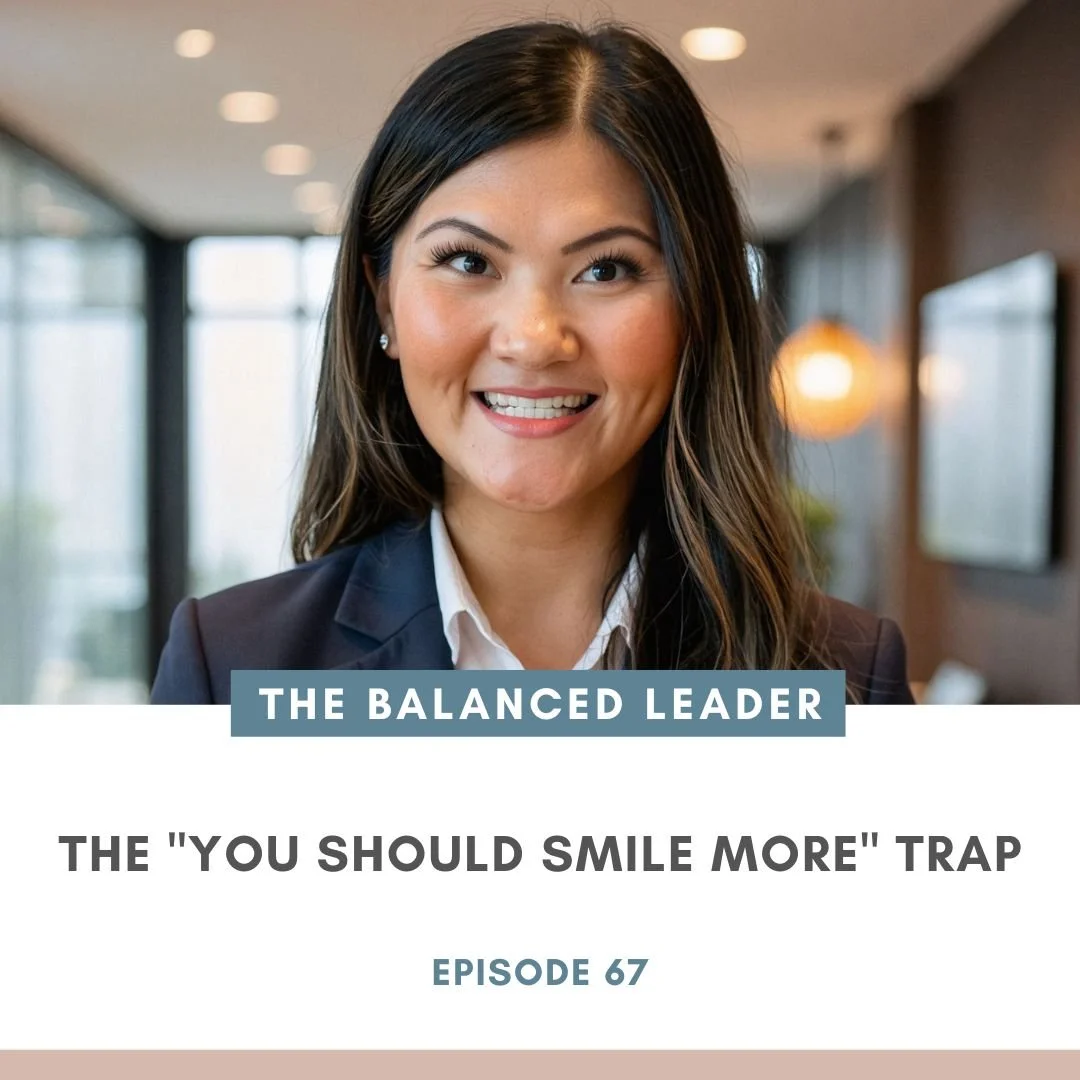
"You should smile more." We've all heard it, usually said like a compliment but landing like a command or even a demand. Sometimes it comes when you're giving hard feedback, holding someone accountable, or just being neutral.
This episode isn't about convincing you to smile. It's about the empowerment that comes from smiling when it's chosen by you, not demanded by others.
Tune in this week discover the significant difference between smiling because someone told you to and choosing to smile for yourself. You'll learn how to discern when feedback about smiling is someone trying to diffuse your power versus when it comes from genuine goodwill, the neurological research behind a chosen smile, and my own story of how letting myself be more human, more playful, and yes, smiling more, didn't weaken my authority but made me more trusted, more connected, and gave me way more fun in my leadership role.
Interested in working with me? Book a free 1:1 consultation here!
What You’ll Learn from this Episode:
How to discern whether feedback to "smile more" is about diffusing your power or genuine goodwill.
The research showing that smiling releases endorphins, dopamine, and serotonin, helping your nervous system relax.
Why a forced smile doesn't soothe but a chosen one does.
How leaders who smile are perceived as more approachable and trustworthy while still being seen as competent.
The difference between performing positivity and giving yourself permission to enjoy your life while leading it.
Why the power isn't in smiling but in choosing when to be direct, playful, or serious.
Listen to the Full Episode:
Featured on the Show:
If you haven’t already, please follow the podcast and leave a rating and review to let me know what you think. Find complete instructions here!
Episodes Related to the “you should smile more” trap:
Full Episode Transcript:
Welcome to The Balanced Leader, hosted by Yann Dang, a Leadership and Life Coach with over 20 years of corporate experience. Drawing from her journey as a former global finance leader and second-generation immigrant, Yann understands the unique challenges women face in male-dominated workplaces.
Each episode offers insights on balancing masculine and feminine energies, mastering soft skills, and building emotional intelligence. Join us to transform frustration into empowerment and unlock your authentic leadership potential.
Hey listeners, welcome to The Balanced Leader. Today we have a juicy episode. I am sure at some point in your career or in your life, somebody had said to you, you should smile more. Maybe it was a parent who saw your face frowning or maybe it was a colleague or even a boss that felt like you should, you know, relax and smile more.
I want to offer to you that this episode is not here to convince you to smile but to share with you the empowerment that comes from smiling, but only when it's chosen by you, not when somebody tells you to do something. I want you to really take this in and share this episode with other women who have been told to smile more as well, so that you can discern the difference for yourself and they can discern the difference for them, and so that they can be empowered to lead the way that they want to, not the way people tell them to.
I want to share this story because one of my senior clients, she's a leader of a big nonprofit, and she recently got feedback from her board that she was too serious and that she should relax more. Not because she wasn't competent, not because she wasn't respected, but because her presence felt closed. It wasn't because they didn't think she was capable. They actually thought she was very capable and very serious and very competent. But the fact that she didn't seem relaxed in her skin, often times when we're around people and they're not that relaxed, they're like very tense, right?
Think about an interview where you're interviewing someone and you can tell that they're like sweating and they're really serious and you start feeling like this emotional vibration and this energy shift like, whoa, this got very serious and got very heavy fast. And sometimes it doesn't need to get that way. Sometimes we consciously want that to be the way that we handle things, especially in a high stakes boardroom meeting. But if you are going to that state being super serious all the time, being super tense and direct all the time, then it can feel exhausting for people to be around you, and it can feel draining and exhausting for yourself.
So, I want to share that this feedback a lot of women get to smile more. Often times, there is ways of looking and thinking about it that are not helpful for us as empowered women. And there is a way of thinking about it and looking at it that can really empower us, right? So, that feedback that my client got, she actually got it from a woman board member. So it wasn't another man, it was another woman that said, "Hey, you should just relax more. You're doing a phenomenal job." And of course, it comes from a woman who probably takes herself quite seriously as well and has learned over the years that like, hey, you can kind of relax into your skin when you feel, you know, comfortable. And you've been doing this job for a while, you can feel comfortable.
But often times, women take this feedback in different directions. And I think it's just important for you as a female leader to decide how you want to take the feedback and what context the feedback was given in. Sometimes the feedback lands for so many women that, you know, you're not wrong, but you're too much of something, too serious, too intense, too direct. And the questions become, is this feedback asking you to become smaller or is it pointing towards something about connection and ease? And this is where it's really important to get the context of the situation and discern, right?
That's where this all gets really interesting because on one hand, if you are holding someone accountable and you're delivering hard feedback, it doesn't make sense to smile. It actually would be super weird if you were smiling and super inauthentic if you were smiling and giving really hard feedback. It's like there's a lack of coherency between the emotions that you are displaying on your face and how you sound and, you know, the feedback that you're getting, right?
Like, if I were to give feedback to my direct report and I would be super happy in my tone of voice and super bubbly, it wouldn't land. It'd actually sound super weird. It would be something like this, "Tom, you are doing a terrible job. I really want you to understand this, but you know, I want this to be a really productive conversation." If you can hear in my voice, I'm smiling. I'm almost laughing. It doesn't sound like authentic. It actually seems really weird, you know? Versus more of a lower pitch grounded, you know, tone, which would be something like this, "Tom, we need to talk about your performance. There are things that are not meeting expectations and I want to be very clear about what these things are." So again, you can hear in my tone, I'm being serious. I'm grounded. I'm being calm, but I'm not all smiley and bubbly. Because that's confusing for people.
So, you want to know the difference because sometimes people can give you the feedback because they feel uncomfortable with the way you're delivering something or they can notice maybe some anger in you and they want to deflect that and they want to diffuse it in some way. And so they tell you, "Hey, you should smile more. You should relax. This isn't that serious." And this is where it's important for you, right, as the leader of you to say, "No, this is serious. This is your job. And this is my job. And this is us working together and I expect you to take this matter seriously." So, you want to notice when that happens. Okay, so that's one scenario. And let me tell you about the other scenario because there may be genuine people in your life that literally are like, I think you need to relax more. I think you need to smile more. I think this would be good for you. And here's the research behind that side of it, right? But it needs to come from a person that you trust that you don't think they're trying to manipulate you or deflect or have you diffuse your power in some way or manage your emotions, right?
They're actually coming from a goodwill place of like, I want you to have more fun at work. I want you to play. I want you to engage. I want you to be present. I want to see you enjoying the work you do. And the honest truth is when we're working with people, imagine working with someone who's super serious or super grumpy or, you know, super uptight versus when you work with somebody and you can feel like you're flowing together, you're on the same page, you can laugh, you can make some jokes, you can get lots of stuff done, but without this heavy, heavy energy.
It's like, let's go. We're gonna work really hard and get this done together and it's going to be fun or we're going to try to make it fun even if it's not fun. I used to tell people, you know, on my team like, we always have an opportunity of how we approach things. Sometimes we don't get to choose our deadlines. Sometimes we try to push back and sometimes we just have to do the late nights, especially in finance.
But we can choose how we do it. We can choose to be activated and engaged with ourselves. We can connect with each other. We can do it as quick as we can and double check each other's work. We can make it into a team activity. Like these are the choices we have to do. And part of this smiling more is an opportunity to dive into the way of being for you. There is actual science around what happens when you smile. So let me be clear, this isn't about emotional manipulation. This isn't about allowing other people to judge us and tell us to do things or to soften our holding others accountable. This is about you choosing consciously how to take feedback, who you're taking it from, and what the context of that feedback was from.
And there is a lot of research that shows that when you smile, your brain releases endorphins, dopamine, and serotonin. These chemicals reduce stress, elevate mood, and help your nervous system relax. So smiling isn't just social, it's neurological. It connects you to the rest of your body. A chosen smile literally tells your body you are safe. But here's the key, a forced smile doesn't soothe. A chosen one does, right? So you cannot smile and pretend and perform and to smile instead of cry or, you know, smiling through things just to make other people feel comfortable. There is power in your smile. There is power in the smile you choose to authentically have for yourself.
If there's kids listening, you know, maybe tune this part out, but resting bitch face is a thing, right? I have it too, or I had it. At least I try to be really consciously aware of it, right? Sometimes we don't realize our facial expression and we don't realize like when we're watching something or listening to something. You know, I've had pictures of me facilitating stuff where I just look downright mad and I don't know what was going on in that moment, but it's something that I am consciously aware of. It's something that when I am leading groups or when I was, you know, speaking at a town hall, when I'm in large groups of people, new people, I really amp up my smile. I amp up the inclusivity that I'm trying to create, right?
So, you can use it for you, right? It needs to be chosen, not something you do as a performance, but for you. Research also shows that leaders who smile are perceived as more approachable, trustworthy, and collaborative, while still being seen as competent. Warmth and authority are not opposites. They can actually go together. And when leaders allow themselves to be human, expressive, warm, relaxed, it doesn't make them weak. It makes them accessible, trustworthy, and more effective, right? Imagine a leader of yours coming into the room being super grumpy, being super angry, you're going to have some sort of probably nervous system reaction to that versus if they come in, they have a big smile, that seems really genuine. This does matter a lot because often times many women are socialized to be serious, to be taken seriously, especially in rooms full of men, in spaces that weren't built for us. But seriousness alone doesn't build connection or psychological safety.
I actually remember once I was at a wedding in Italy and I was seated next to this woman who was beautiful. Like she was just a gorgeous woman, but she seemed so alone. She seemed so serious and so alone and she could have been carrying a lot of other emotions, but she just didn't have the energy that I was like really into. I was at my friend's wedding. I wanted to feel very light. We were in Rome. We had this beautiful view of the city. It was gorgeous.
And I tried to make some small talk with her, but her energy was very heavy. It was very serious, you know? And so I just want to share that with the women listening here because sometimes we don't realize the heavy energy that we're carrying and how that heavy energy repels people from us. And sometimes I know we do that on purpose, right? Sometimes I do it on purpose. I don't always want to socialize and I also there are certain people I don't want to socialize with. Like if I'm on a, you know, in a bus with like a lot of men and there's just people trying to chat me up, I may want to give that serious look. I want to give that signal that I do not want to be talked to.
But this is when we want to notice when it's conscious, right? It's a conscious choice. It's not something that happens to us. And we get to choose when to use this with big awareness, right? And so this is where I'm inviting you into really thinking about, you know, when you would want to smile, why you would choose to smile. Maybe it's when you wake up in the morning and you want to fill your body with ease and you want to welcome your day in for yourself with a smile, right? Or when you look into the mirror for the first time in the day and you want to smile at yourself or when you see your children for the first time when they wake up and you want to smile and hug them because you want them to feel your energy and your love and care for them. Again, you consciously choosing the smile, right? Is super important.
And the reason why I also want people thinking about this is oftentimes we use feedback against us, right? When somebody says, "Hey, you should smile more." We may, you know, with our survival brain instantly go to, oh, somebody's trying to control me or manage or manipulate me when they actually could have a lot of goodwill for you, right? So, if this is landing for you, if you're realizing how often you've managed your expression, your energy, your presence just to be easier for others, or maybe where you're unconsciously holding on to too much seriousness and carrying too much, I want you to do something right now. I want you to share this episode. Text it to a woman you respect, a colleague, a friend, a sister, a daughter, because this is one of those conversations that can quietly change how women treat themselves and each other and that really matters.
What I want to share here is that my own story around this, right? There was a period in my leadership where I was very composed, very polished, very controlled, very serious, right? I think a lot of you know from my background and my history, I was often times the only woman in the room, the only person of color, and the youngest, right? So sometimes I would consciously amp up my seriousness and almost have like an armor around me so that I could show up strong and powerful.
But here's the thing, over time, you become unconscious that you're wearing all this armor and it becomes draining too. And I started realizing it when I was like, "Well, I've been in this leadership position for a while now, but I notice I'm still scared of sharing and revealing things about myself and could I have more fun?" I actually got coaching on having more fun at work. My coach called it pay for play, right? You're actually getting paid to play. And when you talk about play, play is really actively engaged in something, which I was. I was actively engaged, but I wasn't having as much fun. I carried myself very rigidly, right? And not because I was unhappy, but because I thought being taken seriously meant being serious and needing to protect myself.
But over time, when I created more of my inner strength and I started validating myself more and a lot more of my power came internally versus externally, I knew I was respected. I knew I was trusted, but I wasn't fully known and that was a me problem, not the people around me, right? I wasn't trying to belong anymore, but I also didn't feel like I did. So, even though I'd been working with this senior leadership team for a while, I just knew that there was more for me, more belonging, more fun, you know, more joking, because I could see all the other guys, they would joke around with each other. They just seemed more relaxed and I wanted that for myself. And I was like, "Nothing is really in the way of me doing that. I've proven myself here. I have earned the seat at the table."
So I actually made a conscious effort, a conscious choice, not to be smaller, not to be softer, not to be less powerful, but to be more human. I was always good at still holding people accountable when I needed to, being serious when I needed to be, and showing up with a very logical, clear points when I needed to have those things. But there was room for me to be more human. I started joking with my leadership team.
When we would have, I actually remember there was a turning point because we had one of these like meetings where you talk a little bit about yourself and I literally stood up and I said, "Hey, this is what I do. And what's been on my mind lately is puppies and babies." And most people on the leadership team knew I was single and most of them were married and I think this really allowed them to joke with me more and to have more conversations about my dating life and what I cared about. And I was just really so comfortable in myself that I started letting them know me and see me in different ways, right?
Letting them see me enjoy things, letting them know things about me that they wouldn't obviously see when I'm in my CFO role asking them lots of powerful questions, right? But in those places where I didn't need to be the CFO, where I was just colleagues, where we were on a leadership team trying to make the company better, I could let myself relax. I could be known in ways that they didn't know me. And really, I smiled more. I laughed more. I joked more, not because someone told me to, but because I wanted to feel more alive in my own life. I wanted to feel known in that way.
And here's what surprised me. It didn't weaken my authority. It didn't make me a doormat. It made me more trusted, more connected, more human, and I had way more fun. People actually saw that I wasn't just this robot or this enforcer of numbers. They could see that I was a 360 live person with lots of other things going on in my life than just work. My identity was bigger than that, and they wanted to know me. So smiling wasn't about image for me. It was about permission. And that reframe, it is not about ego, it's not about performing positivity, and it's not about making others comfortable. It's about self-respect. And it's about saying, "I'm allowed to enjoy my life while I lead it. I'm allowed to be warm and strong. I'm allowed to be serious when it's serious and relaxed when it's not."
That's not weakness. That's integration. That is the power of choice. The power is not in smiling, the power is in choosing, choosing when to be direct, choosing when to be playful, choosing when to open your heart, choosing when to hold the line. That's leadership. And I want you to know that because the more you as a woman can take yourself off of this performance pedestal, the more powerful you will be. And the more people will want to naturally connect to you. You will become more magnetic, more human, and more trustworthy in their eyes when they can see the 360 you. And smiling is part of that, right? So, you know, when people ask me, "Do you think I should smile more?" I say, "You should smile more if you think you should smile more. If you think it will serve you and you alone."
And then, of course, I share with them the research around it so that they know that smiling is not just a performance, it's actually has a neurological impact on you and can help you to feel more relaxed in your body, in your nervous system. And what I say is test it out, try it on, see how you feel when you smile, see what works for you, see what you like, what you don't like. Don't just write something off as somebody trying to manage you. Of course, if there's context around it and you know somebody's trying to diffuse or manipulate you, then don't do it. But do it when you want to do it. Do it because you choose to do it. Do it because you love how it feels in your body, on your face. Do it because you love seeing your kids smile back at you when you're so happy and your, you know, partner sees you and you're so full of life and you get to connect in this way because your nervous system is calming down.
Let me say this clearly. This is not a cute episode. This is not a nice episode. This is a life-shifting reframe for a lot of women. I want you to give yourself permission to smile and choose it for yourself because so many of us are taught silently to manage others instead of know ourselves deeply. To soften instead of choose, to perform instead of belong. And it costs us joy. It costs us truth. It costs us our lives.
So if this episode named something in you, don't just nod and move on. Share it. Use it. Send it to another woman who needs permission to stop performing and start belonging to herself, for herself. Post it, text it, share it forward, not for me, but for those women in your life that deserve to hear this message. Because this might be the first time she hears, you don't owe the world a smile. You owe yourself a life that feels true. And that life that feels true, that is one of the most important messages you'll hear all year long.
All right, I hope you go out, try on that smile for yourself, choose it for yourself, see what it reveals, and tell me how this episode has impacted you. Find me on LinkedIn or drop a message. I would love to hear from you. All right, have a beautiful day ahead. I am here smiling at you and thinking of you. Take good care. Bye.
Thank you for being a part of The Balanced Leader community. We hope you found today's episode inspiring and actionable. For more resources and to connect with Yann, visit us at aspire-coaching.co. Until next time, keep leading with confidence and purpose.
Enjoy the Show?
Don’t miss an episode, follow the podcast on Apple Podcasts, Spotify, YouTube Music, RSS, or wherever you listen to podcasts!