66. Powerful Storytelling for Women Leaders: How to Own Your Narrative with Sonali Fiske
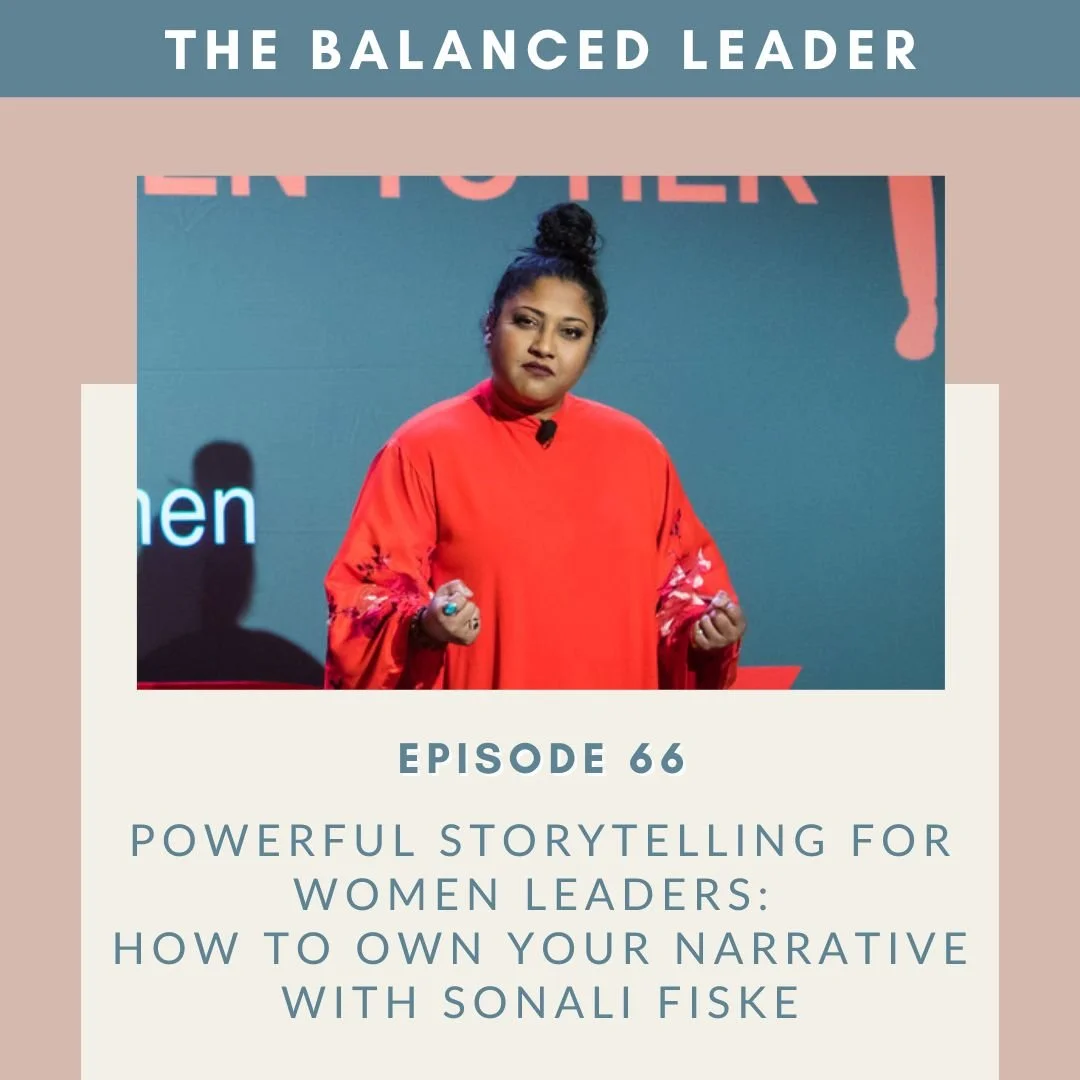
If you're a woman who's ever felt invisible in a room where decisions are being made, this conversation is for you.
In this episode, I sit down with Sonali Fiske, master storyteller and my TEDx speaker coach, to explore why the people who shape rooms, cultures, and futures aren't always the loudest or most credentialed. They're the ones who can move people, and nothing moves people like story.
Listen in this week as Sonali and I discuss why storytelling is a power skill for women leaders. learn why owning your internal narrative is the foundation of powerful external storytelling, and what happens when women stop minimizing their stories to make them professional enough. We explore how leadership doesn't begin with visibility but with authorship, and why the cost of women not telling their stories is that culture gets shaped without us. If you've been waiting until you're ready to share your story, this episode will challenge that thinking.
Interested in working with me? Book a free 1:1 consultation here!
What You’ll Learn from this Episode:
Why story gives people meaning while logic only gives them information.
The difference between performing insight and embodying it on stage or in the boardroom.
Why leadership begins with authorship, not visibility.
What happens when women minimize their stories and how it diminishes their influence.
How to speak from lived experience instead of from the neck up.
The cost of not telling your story.
Listen to the Full Episode:
Featured on the Show:
If you haven’t already, please follow the podcast and leave a rating and review to let me know what you think. Find complete instructions here!
Sonali Fiske: Website | Email | Schedule a Call
Reclaiming Anger: A Woman’s Birthright - Yann Dang’s TEDx talk
Women’s Entrepreneurship: Interrogate Your Discomfort - Sonali Fiske’s TED talk
Episodes Related to powerful storytelling for women leaders:
56. Strategic Influence: The Feminine Way to Build Power Without Politics
63. How High‑Achieving Women Can Build Internal Safety Through Self‑Validation
64. How to Build the Fortitude to Lead in Male‑Dominated Spaces Without Burning Out
Full Episode Transcript:
Story is how we make meaning. It's how we transmit truth faster than logic. It's how we bypass defenses and go straight to the human. And that's why storytelling isn't a soft skill. It's a power skill. Today, I'm here with Sonali Fiske, master storyteller, story architecture, narrative builder for revolutionary leaders. And we're not here just to talk about how to tell better stories, but we're here to explore why story has the power to change how we lead, how we're seen, and what becomes possible when we speak from truth instead of performance.
Welcome to The Balanced Leader, hosted by Yann Dang, a Leadership and Life Coach with over 20 years of corporate experience. Drawing from her journey as a former global finance leader and second-generation immigrant, Yann understands the unique challenges women face in male-dominated workplaces.
Each episode offers insights on balancing masculine and feminine energies, mastering soft skills, and building emotional intelligence. Join us to transform frustration into empowerment and unlock your authentic leadership potential.
Yann Dang: Hey podcast listeners, welcome to today's episode. I have a very special guest here. Her name is Sonali Fiske, and she was my TEDx speaker coach. As many of you know, I did a big thing last year. I did my own TEDx talk, and Sonali walked me through the whole process. But we're here today to talk about the power of storytelling. And I want to introduce you to Sonali. Sonali, welcome to the show. How are you doing?
Sonali Fiske: Oh, thank you. I'm doing really good. Happy to be here with you and talk about this is one of my favorite topics. So, let's, I'm ready.
Yann Dang: You're ready to dive in.
Sonali Fiske: So ready to dive in.
Yann Dang: So, Sonali, if you remember, you had shared with me this really powerful stat about how when people are communicating, when they are talking with story and logic, that people remember 22 times more than if it's just logic itself. And of course, me as an executive, senior leader, I have just been amazed by the men and women who I have seen lead and share stories and really bring people along. So I've always been intrigued by this power of story, but I think also a lot of women are intimidated by it because there's a personal part of it, there's an emotional part of it, and you're kind of stepping out of this like very logical, masculine way of communicating, which we're very used to, right, in the corporate world. But tell me more about that, and I'd love to hear what your experience has been.
Sonali Fiske: Wow, love this beginning. Boy, you know how to dive right in, don't you? Like, that's absolutely true. And I remember when we started this conversation around, you had so much data and research about anger, or the lack of expressing anger in an authoritarian way, and I did talk, I remember talking about that with you, how research shows that when information is delivered through story, people retain it up to 22 times more than when it's just presented through facts and case studies and statistics alone. You're right. So logic because logic gives people information, whereas story gives people meaning.
And it breaks my heart when I see such valuable, powerful info that's shared leaving out the storytelling piece because when the data backs this up, when facts are woven into story, people will remember it 22 times more likely. They'll remember what they've heard 22 times more likely. And that's why most influential leaders don't choose between data and story. They use story to carry the data.
Yann Dang: And I think is it there's like that emotional connection, right? And I think there are studies that show like when you have an emotional connection to something, you remember it more. It's just more memorable. It's not just a number or something. And I think today's, when we have so many facts, right, when they're just at our fingertips, it's oftentimes that context, that meaning that gets lost in translation. And anybody, like especially from a finance perspective, like you can spin whatever story you want with data.
Sonali Fiske: Oh my God. We're drowning in data, Yann. You know what I mean? We're drowning in it. We're overstimulated with data or data, however you want to say that.
Yann Dang: Yeah. Yeah.
Sonali Fiske: But the storytelling piece, I feel that's missing, especially in the leadership world. We see it in Hollywood, we see it, you know, in the art spaces, but I'm not sure why it's still left out a lot in becoming a stronger spokesperson for our business and for our work. We've been taught that storytelling is optional, something you add on once you've earned authority. But in reality, Yann, storytelling is authority. You know, because stories are how we as humans decide who to trust and who not to trust. Because data informs, like I said, but stories move people to action.
I feel like leaders who can't articulate their story lose influence, even if they're super brilliant and smart and super educated and well-read. The story is what stays with us. That's what makes us keep coming back. I mean, it's the same reason we love Netflix and chilling, you know, or watching movies, because it's not because we agree with everything we see on the screen. Hell no. We keep coming back because we love a juicy story. And that's why, Yann, I think platforms like TED are so powerful, not because they're prestigious, but because they force clarity.
Yann Dang: And I think the format, a few minutes, right? You get into that story. Because I think sometimes, you know, I have some clients and women have been accused of this too of getting lost in their own story when they're not like super connected to themselves. And, you know, I'll probably say I've done it too, right? Like where you're like, "Oh," you're taking somebody on a journey, but it's not a curated, very clear journey. You're not really sure yourself. And so sometimes there's that thinking, right? But I think what we're talking about here is that that storytelling where we are stepping back, creating meaning, really thinking about the audience.
And when I think about story, right, it's like people often think story is about communication, but I think it's more than that. It's about regulation, right? If you're feeling emotionally regulated and you can really take in that story, it's also about identity. Like who's this person in front of me? How do they think? How do they feel? How do they treat their kids? How do they think about the world, right? And it's also about belonging, and you're kind of, as you're hearing somebody's story, you're like, do they belong with me? Do I trust them just as you said? But from your perspective, what is really happening inside people when a story lands for them? And I mean, you've coached so many successful speakers. You know, so I want to hear from you, why does story move us in the way facts never can? You know, how does that show up for you?
Sonali Fiske: Oh, what a beautiful thing to say. Thank you for sharing that with me. You're making me think harder and deeper too. I think also what's beautiful about that storytelling piece, Yann, is that if you can't tell your story simply and truthfully, then the world will tell it for you and not always accurately. You know?
People love that. I think the emotional specificity of storytelling, people eat that up, right? The personal truth over the polish. I think mostly, Yann, where we are right now, culturally speaking, we're kind of over the veneer, right? The polished keynote type speaker. People want honesty, they want vulnerability, right? They want to feel like they've gone on the same learning journey as you, right? Where it's not this hierarchical structural thing where I'm up here, I'm the speaker up here and the rest of the audience is down here. They want to feel like there is some, you know, some common thread there, right? They want to feel humanity in you.
Yann Dang: Yeah, and what I'm also, you know, thinking about is that mutuality, right? That belonging piece. And if you're like a leader, right, on stage, but you can appear approachable in your language and people can start, you know, hearing what, you know, you have to say and connecting to who you are outside of work, right? That just expands, you know, that level of connection.
Sonali Fiske: And it can be very simple, yeah. You know, it's a lot simpler and more closer to the heart than we think it is because I think, Yann, people are exhausted by performative leadership. You know? Audiences, what I find in my years of doing this is that audiences crave truth, not branding. You know? And as women, I know you work with a lot of women. I know that women, that's your space, so to speak. Women, I find especially, or those of us that identify as women, have been conditioned to wait until we're ready.
Yann Dang: Yeah, I think that is like this, like somehow we feel safe if we know the rules and we perform well, and we get that check mark. You know, it's kind of like, you know, when you're told to act a certain way, ladylike, or those types of things.
Sonali Fiske: Oh God, I know.
Yann Dang: And you think like, okay, this is what it's supposed to be like. Or like with me, one of the things that I've shared in my past of what kept me from leadership when I was younger was like, I thought I had to be even more masculine than I already was. You know, as like a finance leader. I'm like, well, how do I have to be even more masculine? You know, I have to be a man. But I also realized when I started ascending into different levels of leadership, how much more there was, right? When I see masculine leadership in my mind, it was very different than actually the men that I was surrounded by. Like where they would share about their stories, where they actually held a lot of feminine values. So it's like you don't see it, you know, and then you like have your societal view of it. But once you're in the room, often times I would be like, "Oh, I know why this person's in the room." They actually have so much more skills, so much more emotional awareness. And often times they weren't very polished, but that also made them much more human and you can connect to that.
Sonali Fiske: I love that. You know, to your point, you know, speaking your truth doesn't mean being louder or more aggressive or being more ladylike. It's simply as being clear, even when it's costing you something. You know? Because like I said, this is not the era of perfect speakers. I believe this is the era of honest ones. People want honesty more than anything. So, get out there and say the thing. You know, speak your truth to power. Be the one that stands up in a room and say, "This happened to me and this is why I had to share it with you." So, it's time.
Yann Dang: Yeah. Well, and you talk to so many people with their own TEDx journey, right? And I do think like I felt like I went through sort of my own identity shift, like those different levels of vulnerability, standing up for things, saying things. How do you support people through that journey? And what was that journey like for you? I mean, you have your own TEDx talk as well.
Sonali Fiske: You know, at first it's exciting and then it's terrifying, right? Because a TED talk, you know, that the thought of it, the concept, the, the vision of it, watching these extraordinary people stand up there and speak, you know, and go go viral and and speak to millions of people around the world, it's enticing. It's beautiful to witness and then the dread comes over you like, "Oh my God, what was I thinking?" And that's my job to help calm people's nerves, and bring them back to their why, you know? A TED talk is not a highlight reel, right? It's a reckoning. You know, what most people get wrong, I find, Yann, is that they focus on credentials instead of insight. So it's my job to keep them coming back to that insight, that idea. You know, that they try to teach instead of reveal. And they hide the very moment that would make them unforgettable. So this applies whether you're on a TEDx stage or in a board room or pitching to investors or whatever. You know, your story isn't your biography. It's the moment you stop being who you were and became who you are. And that's the power of the work I do and why I love it so much because I get to find out who you are. I get to be the first witness of that piece in your story before the rest of the world. And I tell you, there's nothing greater. It's the best feeling in the world to work with people and help pull that out of them, to excavate that.
Yann Dang: I'm about to ask a very vulnerable question. I'm putting you on the spot, but myself too.
Sonali Fiske: Give it to me.
Yann Dang: Tell me, I mean, obviously we worked together for months. What was it for you to see me that way? And like, you know, what did what was that the difference that you saw?
Sonali Fiske: Well, you came with a very clear, it doesn't always work this way. You were very clear that you wanted to do this TED talk. This was something that was placed in your heart. You know, I mean, you were strong, emotionally intelligent in your idea. You were focused. You know, and you were pretty certain how intimate you wanted to go, you know, especially with that anecdote with your daughter. You know, but what struck me most, Yann, was how fully you were in yourself. You weren't performing insight. You were embodying it. That's the key. And as someone who works with speakers all the time, that's rare. So, you know, personal, not flattering fluff. You know what I'm saying? That's why I love you so much. It it's so real. You know? And it positions you. Here's why that's so cool. It positions you as a discerning expert, right? And it makes, it allows you to be seen and not just praised. So your story, your energy, your message, it was just so profoundly real.
Yann Dang: Well, that's what I I remember when I was, you know, rehearsing my speech at one point and you're like, "Oh, I really felt it. I felt it from your body." And I felt it too as I was saying it. Like it wasn't just memorizing the words. It's like that it lands in your body. You can feel that like emotional groundedness.
Sonali Fiske: And I see that in your talk. I see it in the video, Yann. So many people, Yann, speak from the neck up. Yeah. And what struck me about you was that you were speaking from lived experience. That kind of truth is magnetic, especially right now. So that's why I take you through a process of embodiment because if you're not in your body, if you're just up here in your head, then you're going to lose the moment, you know, and rob yourself of that beautiful connection to your audience. So the embodiment piece, yeah, that's important and you you did that beautifully.
Yann Dang: Well, and I think it just to your point, right? That the realness, right? That people are craving, they want to feel that frequency, that emotion from people. And it's story as leadership, but not like performative, right? And I think you get away from that performative when it feels really grounded, and you can tell with the tone, the emotion, the body language of somebody, because most women I work with have incredible stories to tell. But they've been trained to hide them, minimize them, or make them professional enough, and that actually diminishes a lot of the power of that story, right? So from where you sit, what is the cost of women not telling their stories?
Sonali Fiske: Well, I think our current leadership landscape, you know, speaks to this so profoundly and powerfully. That's a big, important question you just asked. Okay? When we don't tell our stories as women, we don't just lose individual voices, we lose context, we lose wisdom, we lose the roadmaps for what's possible. You know, the cost is that culture gets shaped without us. That's the biggest cost. You know, decisions get made, policies get you know, finalized, narratives get written, standards are set without the lived experience of us in the room.
So, it's critical that we share our stories. You know, when women minimize their stories, they also minimize their influence. And that means like companies, organizations, governments, movements, lose leaders who could have changed the direction of the room, right? So there's a lot at stake right now, Yann. There is so much at stake. You know, the cost is that women who are one chapter behind, never get the story that would have helped them, you know, trust themselves.
Yann Dang: Yes. And I think this is like a powerful truth too. Oftentimes women are so caught up in other people's stories, about them, about what's right or what's wrong, and they don't spend enough time on their own story, their own internal story. So sometimes when they go to tell their story, it's not concise. It's not clarified. They get lost in it themselves. And you know, when you get lost in a story yourself, you often lose other people. So, you know, I also think, right, I do a lot of work with the women that I coach like, we need to own our internal narrative so that we can own that external story because like you said at the very beginning, if you don't own your story, somebody else is going to tell your story for you. And you may not like you, right?
Like, you want to be the person in the room advocating for yourself or sharing about yourself so that the frequency is so powerful that somebody just can't be like, "Oh, Sarah's not that good," right? Like, that's just somebody just saying it, right? But if you're consistent, if you know your story, if you know what you stand for, I think that leadership vibration, even in a corporation outside of that is really powerful because there is just more of it and you are really clear, right? You're not questioning, you're not, you know, sort of positioning yourself. You know, like this sort of fakeness that you're like, "Oh, they're in one room, and that's how they're in another room."
Sonali Fiske: Yeah. Oh my gosh. And you're speaking to me directly because I had to go through that process myself. You know, when I wasn't owning my own internal narrative like you said, I disappeared. I fragmented. You know, I became many versions of myself depending on who I was with. And that is exhausting.
Yann Dang: Yes.
Sonali Fiske: Am I allowed to swear on this show, by the way?
Yann Dang: Yeah, that's okay.
Sonali Fiske: I was about to drop an F bomb, but I didn't. But you know what I'm saying?
Yann Dang: Yeah.
Sonali Fiske: It's no wonder we're exhausted.
Yann Dang: We're carrying a lot of other people's stories. We're not being clear about our own emotions, how we truly feel about things for ourselves, and we keep, you know, changing our story to fit somebody else's narrative until it becomes exhausting. We're burning out.
Sonali Fiske: This is so powerful. And you know why this is also powerful what you just said, Yann? Because as you know, you and I both work with a lot of women in leadership. Leadership doesn't begin with visibility and we put too much emphasis on the visibility piece, but leadership begins with authorship. And until you and I claim our internal story, then the outer world will keep casting us or putting us in roles that we never choose. You know what I'm saying?
Yann Dang: So, yeah, and I think this is what's really key here, right? If you focus on visibility without that authorship, then it becomes a performance game.
Sonali Fiske: That's it. Period. And no wonder it's going to constantly feel off, like we're off our game or, you know, or that nervous energy, the butterflies keep showing up when we're not ready for it. We're feeling ungrounded. We never land.
Yann Dang: We're always like bracing ourselves for the rug to be pulled under us because we're not grounded in ourselves, right?
Sonali Fiske: Yeah. The women who struggle the most on stages or in big moments aren’t - I find it's not that they're unprepared, Yann. It's that they're unclaimed. They haven't fully decided what their story means to them yet. You know, so we're in a moment where everyone is reacting to everyone else's narrative out there, especially on social media. Oh my gosh, you know, online, in business, in politics. So owning your internal story is not a luxury anymore. It's how you stay sovereign in a very loud world. You know, the sovereignty, that's powerful. That's what we need to claim our sovereignty. If that makes any sense.
Yann Dang: Yeah. I mean, here's what, this is what I'm hearing, right, underneath everything you're saying. That stories aren't about being seen. They're about seeing yourself first and owning that identity. And when a woman finally tells the truth of who she is, not the polished version, not the acceptable version, the real one, she doesn't just change her own life. She gives other women permission to come out of hiding too, right, with that vulnerability.
Sonali Fiske: Beautiful.
Yann Dang: Yeah. How does that hit you? I mean, I think that…
Sonali Fiske: That's a foundational truth. That is a foundational truth of storytelling right there, girl. Yes.
Yann Dang: I'm like such a big proponent of people doing this journey to tell their story, to tell it on stage, not because I want them to be on stage. I mean, I think that's a beautiful way of spreading your message, but I want it for themselves, to reclaim themselves, to have that identity. You know, it's like more about your own transformation and journey, and everything else is just like the cherry on top where that gets spread, right? But I think if you really love yourself and want to give yourself something huge, like being able to say, "My story matters. I own my story. I want to stand tall and say my story." And that may take many iterations, right? But that is powerful.
Sonali Fiske: That's okay because seeing yourself doesn't mean branding yourself or polishing an identity, right? It means telling yourself the truth about who you are, what you've lived, and what it's cost you to become this person. You know, that keeps it embodied and not just like heady and conceptual. So many of us chase visibility, like I said, before self-recognition. So when you haven't fully witnessed yourself, it took me a minute to get there, Yann. That's why I'm doing this work, right? Took me a long minute to witness myself first. And otherwise, you'll keep adjusting your voice based on how other people react to you, and people feel that instability when you're on stage or in a board room. It's a beautiful journey and it's worth every moment of it.
Yann Dang: All right. So I'll leave everyone with this. What is the story you've been carrying that's actually been carrying you towards you becoming the next you? And what might shift in your leadership, in your relationships, in your life, if you finally let it be heard? All right. I will leave the listeners with that powerful question. And I wanted to thank you so much, Sonali, for being on today's show, for sharing your wisdom and sharing all of the experiences that you've had. And I love to share with the audience out here, people that want to do their own TEDx talk. How can they reach out to you? How can they work with you?
Sonali Fiske: Oh, thank you, Yann. This was a joy. I could go on for another hour with you, to be honest. But I would love to hear, you know, I've brought over 49 women and a couple of dudes onto the TED stage. It's my joy and my jam. So people are most welcome to reach out to me at support@sonalifiske.com. Or I'd be happy to share a link where they can book an actual, you know, TEDx discovery call with me, and I happy to take them through that process to start the conversation.
Yann Dang: We'll definitely link all of this in the show notes. And I don't know if I ever told you this, Sonali, but I, you know I interviewed. I I do my due diligence, just like all of my listeners, they they do their due diligence too, right? As a high-achieving woman, you do that. And I had interviewed like three other people before I met you. And I had just decided, like I after meeting you, I was like, "Whoa, she is way more like emotional and relational than I'm usually comfortable with." But I also knew that's the relationship I wanted to have with this talk. It wasn't going to be transactional. It's not logistical.
By the way, if anybody's listening, you don't just do a TED talk and make tons of money. This is like from your heart. You want to do it, right? This, of course, it builds your audience, it builds your credibility, but it's, it's a labor of love. I that's what I think about it. And for me, I was like, who do I want to be, you know, on this journey with? And it was you, Sonali, because I was like, "Okay, she is going to push me to my edge of my relationship with myself and my emotions." And you were just so not logistical, which is exactly what I needed.
Sonali Fiske: Bless you for saying that. You made my whole day. Thank you. It's why I do what I do. I'm very maternal and instinctual and emotional with my approach to this. So, and I think that's the only way, Yann, you know? It takes, you know, intellect and heart. That's the winning combination. So thank you for trusting in me. It was an absolute joy, and I wish I could do it all over again with you.
Yann Dang: Well, there may be more when I have the next one. We're going to be promoting this one for a while. But yeah, so this is exactly the balanced leader is about merging logic with heart. And thank you so much for being on the show today.
Sonali Fiske: It's my pleasure. Thank you for having me.
Thank you for being a part of The Balanced Leader community. We hope you found today's episode inspiring and actionable. For more resources and to connect with Yann, visit us at aspire-coaching.co. Until next time, keep leading with confidence and purpose.
Enjoy the Show?
Don’t miss an episode, follow the podcast on Apple Podcasts, Spotify, YouTube Music, RSS, or wherever you listen to podcasts!