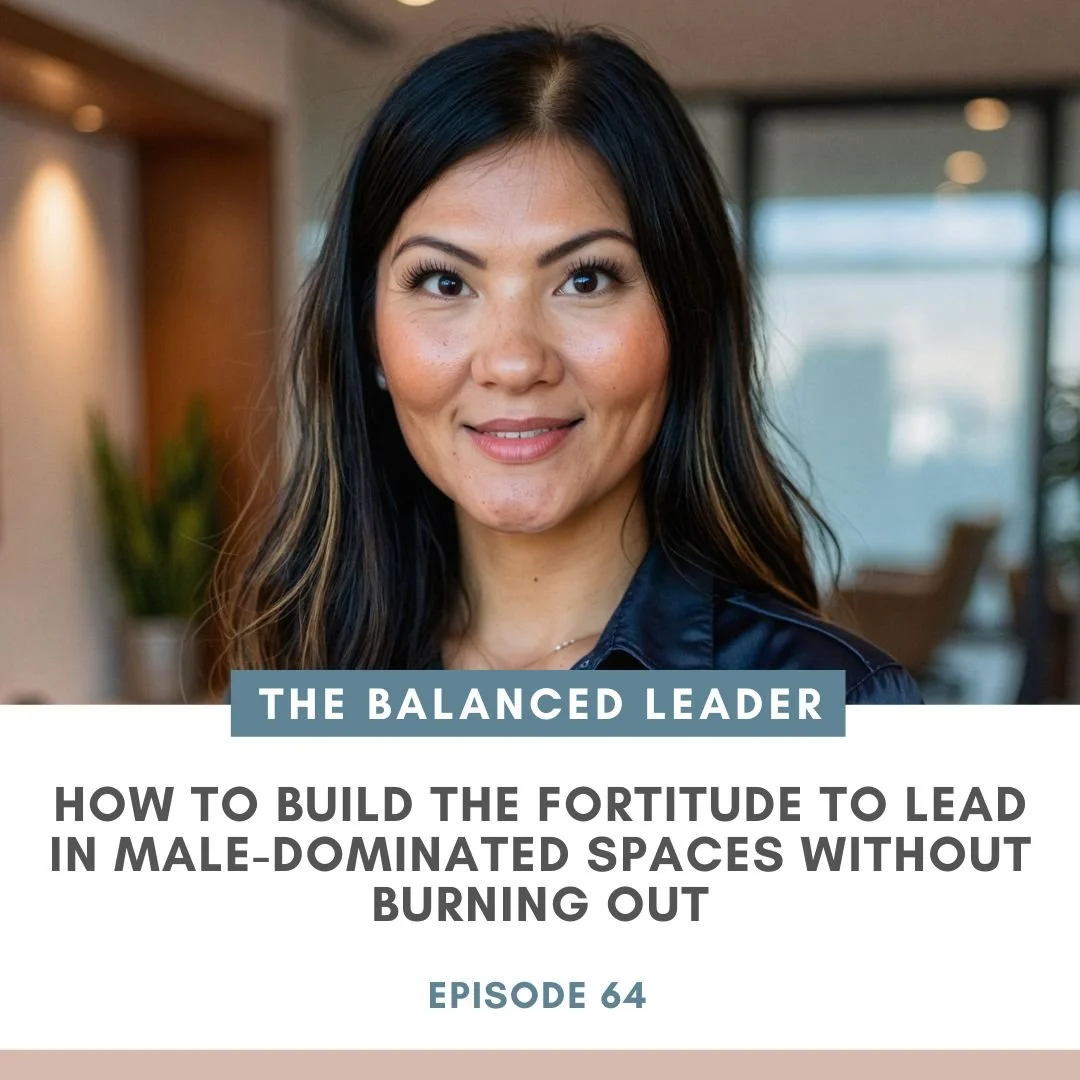
64. How to Build the Fortitude to Lead in Male-Dominated Spaces Without Burning Out
You've broken ceilings. You've navigated power dynamics. You've proven yourself time and time again. Yet somehow, you wake up asking yourself, “Why am I so tired when I've done everything right?”
Here's a truth that might surprise you: you're not burnt out because you're weak. You're burnt out because your nervous system never learned that you win. Think about it. When was the last time you truly savored a victory? When did you last let your body feel the power of what you've accomplished?
This week, I dive into why so many brilliant women leave the game right before they win, and how to build the fortitude to stay. You’ll learn what fortitude is all about in leadership, why burnout isn’t actually about your workload, and how to teach your nervous system what power feels like through celebration and integration.
Interested in working with me? Book a free 1:1 consultation here!
What You’ll Learn from this Episode:
Why your nervous system needs to rest, savor, and integrate power to prevent burnout.
How fortitude includes emotional restraint, recovery capacity, meaning-making, and nervous system regulation.
The difference between performing power and actually feeling powerful in your body.
Why celebration teaches your nervous system what power feels like and creates leadership intelligence.
How to shift from drama and emotional looping to strategic restraint and mastery.
The critical connection between savoring wins and building the muscle memory of authority.
Why most women fail not from lack of skill but because no one taught them how to integrate pressure into identity.
Listen to the Full Episode:
Featured on the Show:
If you haven’t already, please follow the podcast and leave a rating and review to let me know what you think. Find complete instructions here!
Episodes Related to the fortitude to lead:
25. Pain vs. Suffering: The Leadership Skill No One Talks About
60. How High-Achieving Women Advance Without Burnout: Commanding vs. Coping
63. How High-Achieving Women Can Build Internal Safety Through Self-Validation
Full Episode Transcript:
And the answer is simple, but one you might not have thought of. It's because your body never got the memo that you're powerful. Today's episode is on the fortitude to fight and why so many brilliant women leave the game right before they win. It's not because you couldn't lead, but because no one ever taught you that your nervous system needs to rest, savor, and integrate power. Let's dive into today's powerful episode.
Welcome to The Balanced Leader, hosted by Yann Dang, a Leadership and Life Coach with over 20 years of corporate experience. Drawing from her journey as a former global finance leader and second-generation immigrant, Yann understands the unique challenges women face in male-dominated workplaces.
Each episode offers insights on balancing masculine and feminine energies, mastering soft skills, and building emotional intelligence. Join us to transform frustration into empowerment and unlock your authentic leadership potential.
Hey podcast listeners, welcome to today's episode. We are talking about the fortitude to fight. And I'm going to define what fortitude is for you. So, fortitude is not hustling. It's not aggression. It's not burnt out in a prettier outfit. Fortitude is the emotional discipline to stay in the game long enough to change it without losing yourself in the process. Listen, I coach a lot of women in male-dominated spaces, and I have to tell you, it's not easy, right? Of course, it's not easy. But is it powerful? Is it meaningful? Is there sweet victory at the end of every conversation that goes the right way? Yes, there is. Yes, it feels great.
For me, it felt amazing when I could speak up in a room full of men, be heard, and make an impact. For me, it felt amazing when other women would say, "Yann, you were standing at the front of the room. You were so powerful and confident. I was so glad to have witnessed you." That feels so good. I had to allow that stuff to sink in, right? Let me tell you about this more because this is really what keeps women from being burnt out and advancing powerfully to those that burn out, feel tired, and even though they've got a lot of accomplishments under their belt, they don't have the fortitude to continue fighting.
So, let's talk about what fortitude includes. Fortitude includes emotional restraint, recovery capacity, meaning-making, nervous system regulation, the ability to fight strategically instead of reactively. I want to share a quote from Paulo Coelho, who wrote The Alchemist and The Pilgrimage and other very inspiring books. He said, "When you want something, all the universe conspires in helping you achieve it." But here's the part no one talks about. The universe only helps those who can endure the process without abandoning themselves.
A lot of the process to overcome something, to achieve something, to go on a brave hero's adventure, requires obstacles. And one of my coaches used to say that part of how the universe conspires to help you achieve what you want is it puts obstacles in your way so you can get tougher, so you can get more strategic, so you can become more powerful by overcoming those obstacles to get to where you want to get to.
So leadership is really an endurance sport. And I know I've probably talked about this in some podcasts before, but I want you to think about this. Leadership is repeated self-command. It's repeated emotional regulation. It's repeated moments of, I will not disappear here. It's repeatedly coaching yourself to say, stay here, be with me, don't hide away. This is not bravery once. This is relational strength over time. I always talk about this as building a muscle because this is really what we do, right? And it's so important when you're building muscles, when you're an athlete and you're in an endurance sport, to give yourself time, right? No endurance athlete trains without recovery. But women in leadership are expected to emotionally sprint forever. And this is truly what causes burnout over time.
This disconnection, this continual hamster wheel running. This is why it's so important to understand that your long-term leadership game is really about enduring and creating fortifying parts of you that help you stay in the game. So, let's talk about what happens when women don't savor their wins, because savoring your wins is a big piece of creating this fortification for yourself. Seeing yourself on a journey where you are overcoming the obstacles, where you are actually making a difference, where you are activated and engaged in the impact that you're making, right?
It sounds simple, but it's actually not because our brain is wired to look out for threats. Our brain is wired to want to move towards safety, right? Especially when it's under high stress. This is why creating internal safety for yourself, having regulating activities to manage your stress is really helpful, right? It helps us keep out of burnout because we are taking care of ourselves.
So, I want you to hear what some of these symptoms are if you are noticing yourself not savoring the wins. This is a big piece of being onto yourself when you are noticing any of these behaviors. And this will help you identify yourself. And I want to share with you, I've been there with you. I am in and out of this all the time. But me understanding that this is part of the game, that this is part of learning how to create fortification for myself and take care of myself, when these things happen to me, I don't make them about the symptoms. I actually understand that the deeper problem is that I need to take care of myself and savor my wins and reconnect with myself. So here are some of the symptoms: resentment, irritability, over-functioning, emotional flatness, or this thought of, why do I even try?
If this comes up for you, right? In your when you think about your job, when you think about your leadership, even if you think about your marriage in this way, then this is a key reframe that I want you to hold for yourself. Burnout isn't about workload. It's about the absence of emotional replenishment after effort. I'm going to say it again because this is super important, right? Burnout isn't about workload. It's about the absence of emotional replenishment after effort. I want you to think about this because when kids play sports, as parents, we're often really good about celebrating the effort and saying, way to go, I know that was hard. But as adults, we're really crappy about doing that for ourselves. Oftentimes, we're just onto the next thing and the next thing and the next thing, right? We actually don't spend time savoring our wins, cheering ourselves on, creating this space for ourselves to say, wow, that was super hard.
Being a parent is super hard. Being married is super hard. Being a leader in this organization is super hard. Being heard in a room full of men is super hard. And I did it. Do you see there's this satisfaction to saying, I did it, right? Oftentimes, women get stuck at the complaining piece, and they don't move into the celebration. And the celebration is where we tell the universe, we're ready for more. We're meant for more. We want to win. We want to move ahead. We know we're making a difference and an impact, and we give ourselves that emotional relief in that moment because we're really sitting with the celebration. Your body is built to metabolize stress into strength, but only if you let it feel the win.
So when you're stressed out, instead of allowing that stress to give you a big story about why you can't do it and why this is super hard, it's super important to allow yourself to validate your emotions, but also realize that you are a badass and you are doing hard things, and that you connect to the winning part of you, the part of you who is making a difference because all of this is not for nothing.
But here's what I want you to hear because oftentimes, people think that celebrating is indulgent or if I celebrate, the other shoe's going to drop and something bad's going to happen. It keeps women in this cycle where they're continuing to perform versus actually feel powerful. So it's like performing power, performing power, but never allowing yourself to rest and feel and be powerful in the moment. So, the next piece of this is about celebration is really calibration. It's not indulgence. This is where we calibrate and allow our bodies and our minds to realize and our nervous system that we are powerful. This is your nervous system leadership authority moment. Really allowing celebration teaches the nervous system what power feels like.
Without it, the body can't recognize power the next time it's needed, right? You don't have that muscle memory. Memory becomes leadership intelligence, courage memory, boundary memory, authority memory, voice memory. If your body never remembers power, every room will feel dangerous again and again. And so it makes that fight, that fortitude to keep fighting harder because you've never allowed that savoring, allowed it to sink in.
Listen, when I feel scared, when I'm having moments where I'm like, I don't know if I can do this, I draw memories. I draw memories of me doing incredible things. I remember there was a time I had so much on my plate that I was like, I can't do it. But I didn't allow that voice to really dampen my capacity. Instead, I saw myself as somebody going through an adventure and opening up new levels of energy for myself. I remember I got on a plane, I was on a phone call with my coaching group, I was cheering people on, I was celebrating my own wins, and I was getting on a plane after doing a big budget review, doing big presentations, being with my team in London, and I was going straight into a three-day weekend of coaching people, training people, being part of this coaching group.
And you know, part of my brain would be like, that's a lot, you can't handle that. But another part of me was like, this is who I am. I had the muscle memory, I had the authority in me, right? And so when I think, wow, there's so many things on my plate, I think back to that person, that woman at that time who was able to do that. And I remember the level of focus, the level of intentionality, and I remember cheering myself on so powerfully that comes back to me. And then I remember, and I get out of my own way, and I sink into that celebration. And that celebration gives me capacity, and my body remembers we can handle this. It's not scary. It's not overwhelming. We can do this.
But if we're not actually sitting with that, like if you're not sitting with the awkward, uncomfortable conversations you've had to be heard, to push conversations forward, to repair relationships with other people, then you are not giving your nervous system that intelligence to say, "Hey, remember we did these really hard things? But remember those outcomes. Remember what happened at the end of it."
I can remember this in my mind, so many moments in my career and even in my personal relationships where I had really tough conversations, where I felt really fearful about the conversations, but I had the courage to have those conversations. And every time I learned something about myself. I showed up for myself in a different way. And that is a memory that comes back, and when I'm having tough conversations now, I remember that. Whoa, I had that tough time, but remember, we celebrated. We savored in our ability to transform those relationships. To tell a boss that they said my name wrong in front of, you know, 10 people. To ask a boss of mine to have a conversation with me about something that I wanted to totally avoid. But because I had that conversation, we had more trust and rapport with each other, and I didn't allow that incident to impact the rest of our relationship. This is powerful. You need to remember these things.
Why so many brilliant women stay stuck in drama instead of mastery, because I want you to understand what the drama is and how it ensues and why in our society, there's this almost like this mindset that women are just full of complaints and drama. So your uncomfortable truth is oftentimes what is holding you back from your next level of growth. So notice this for yourself. And I notice this with myself too. It's not like I'm just one and done, but because I am able to catch myself quicker and because I understand the stories I tell myself, I'm able to shift from this drama and move forward in a powerful way.
So, drama is really a reaction to things, and it's story. You're telling these stories because you want people to feel you and understand you, but oftentimes you get lost in that story and you're not actually being present with yourself. It may be complaining without expecting any specific outcome. And I'm not saying you shouldn't be able to vent. You want to notice, am I complaining more than I'm actually allowing myself to have other thoughts and opinions? Sometimes when we complain endlessly, it actually just indulges and it keeps us in our stuck, our own story and pattern.
I remember when I was telling my coaching ally, somebody in my coaching group, this story, and she listened to me and then she asked me, "Yann, who are you beyond your story?" And first, I felt offended. I wanted to be offended. But I realized that she was actually an ally of mine. She was actually wanting to help and support me. And she knew I was in this drama story and indulging in it. And she actually quite kindly asked me that question, right? I took it as kindness, not as defensiveness or some way that she was trying to undermine me. I actually was really open to it and I said, "Oh, I know, I'm in a story." And it didn't feel great, but it felt really good to be able to notice it and to have power over it versus just letting it autopilot run the show.
So you also want to notice when you're emotionally looping and you're telling yourself and feeling the same emotions again and again and you don't feel like there's anything shifting in you. I want you to listen to Pain Versus Suffering because this is really where I talk about the difference between feeling pain and processing emotions versus staying in a story and a cycle that involves emotions that keep us stuck, that keep us in victimhood. And how we move from drama to mastery is, number one, awareness, being onto ourselves, right? And having people in our lives that will call us out on our own BS and be like, listen, you're in a story. Do you want to be in the story at this moment? I actually have a client that I'm working with right now, and every time we're in a coaching session, I am asking her with all of my compassion, what is the bottom line of this story?
Because she notices herself spinning out in story and it's almost like an autopilot thing. She loses herself, she loses me. And this is a critical skill because a lot of women do that. They lose themselves and they lose rooms full of leaders that are trying to follow them. But it's like almost like a nervous system reaction where they're like, "Okay, I'm just talking," right? Instead of getting to the point, getting clear, being focused, being intentional. It is really about mental discipline and emotional mastery.
So, let's talk about some of these mastery pieces, right? Strategic restraint. Just as I was saying, right, with the story, when we allow ourselves to be in a story or we're noticing ourselves listening to somebody's story but not really being part of it, right? You've got to strategically restrain yourself, right? From jumping into the pool, jumping into gossip with other people. Or as I'm coaching this person, I need to say, "Hey, listen, what is it that you want to tell me?" I'm noticing myself feeling disconnected to you in this moment, right? And the strategic restraint comes in because part of me is like, "Oh, I want to hear the story. Let's go into the story." But actually, when I'm noticing myself disconnecting to myself, I need to speak up, right? Because I'm helping her to be more connected to others as she's building trust and rapport, and I'm helping her to also be more connected to herself. So I have to also strategically restrain myself from just going into the pool with someone.
The next piece is regulation. That emotional regulation piece. There's a few different types of regulations here. There is the emotional regulation allowing yourself to be grounded in your emotions, naming them, slowing them down. There's also mental regulation. I think our brains, you've heard of the phrase monkey brain, right? It's jumping from here to here, here, here, here. We're so distracted these days. I'm super distracted as a mom, I will say. I'm distracted as a business owner, I'm distracted. And there is mental restraint and regulation that I need to practice in order to focus, in order to be intentional.
And the next piece is meaning, creating meaning out of things. Why am I doing this? What is this for in the here and now? Being really clear about that. Because oftentimes when we lose the meaning, our bigger why, we get stuck in more of these cycles that spin us out. Integration is another huge thing. Really integrating and understanding what it is, how are you're learning, and being onto yourself. One of the biggest things that I help women do that coach with me is to integrate their power moves, their learnings, how they are showing up differently in their life, in their brains, in their internal, you know, system, their ability to navigate and make choices that are very different. They're subtle, but they're very different than what they were maybe a month or two months before we started coaching together.
You need to learn how to really be aware of those things that you're doing that actually are moving the needle on your expansion because it will have you playing a game where you're like, I feel like I'm winning at this game. I see how I'm showing up differently versus getting consumed by the game and feeling lost.
The next thing is recovery, right? Really giving yourself some rest time. And in our culture, in our day and age, I think a lot of people are like, you know, feel like rest is being lazy. But there is this recovery piece that's needed to build fortitude, to not burn out, right? And this recovery might mean different things for different people. But for me, recovery is working really hard at my day and spending really quality time with my kids. Is it always quality time? Not always, but the moments that I can look at their little faces, the moments that I can really savor being in the moment with them, the moments that I can really have a chance to connect to myself and to journal with myself, a chance for me to connect with my husband.
So you're hearing like there's a lot of connection with people. And this is part of that recovery, right? We allow ourselves to recover when we can feel comfort in the people around us, in the surrounding areas, maybe in your house, maybe looking around your house and really feeling like, oh, I feel safe here. This is a peaceful space for me. That's part of recovery.
And then, of course, celebration. Really pushing yourself to celebrate, sharing in that celebration, and allowing that celebration to sink into your bones, into your body. Listen, I hadn't really shared this with you all, but when I got the call to speak at this TED Talk event in TEDx Union Women, I really sat with the emotions. I really let myself, instead of texting a bunch of people saying, "I did it, I got it, I was asked to speak," you know, I really just sat with the meaning for me. For me, it was meaningful to be asked to speak by this particular curator, Lucinda is her name, and it was also super meaningful for me what the talk was about and all of the thousands and millions of women that would hear this talk someday.
I really allowed my nervous system to sit with it, to be with it. I allowed the tears to come out. I didn't even think that I would cry, but I really savored the moment because I had been working hard on this. I had wanted to do this TED Talk and I had set my mind seriously on it since May of last year, and within five months, I did it. I wrote the talk, I applied, I was asked to speak, I prepared the talk, I committed it to memory. There were a lot of steps, you know, in it. But it was all for a reason. There was a meaning and a celebration of saying, "I set out to do this, and I freaking did it. I did it. I was the one who made it happen." Yes, a lot of people helped me along the way, and I'm so grateful. But I made it happen, and I decided to make it happen. And I allowed it to really sink in and sit with me. Why is this important to me? This anchoring, right? Really allowing it to anchor in your body, this understanding power structures without being consumed by them. This takes fortitude. That's the real fight, right?
Our power structure, our system that we're working with is like we are, you know, up against a lot of things, especially being parents, especially being women who are trying to speak up in these spaces, especially, you know, our way of living is so different than it had been many years ago where you'd live in a village and there wasn't that much expected of you. In today's day and age, there's a lot expected of us. And if you can take the time to really inventory that, to really go to school on the ways that you're showing up powerfully and allow that power to sink into your body, to really feel it in your bones, this creates the fortitude. Fortitude is really about you having the energy to continue the fight and enjoying the fight, and doing it in a way that is for you, not for anyone else, for you. And when it's for you, you will have more energy.
So, let me talk to you a little bit about this because I also think it's something that men do better than women. They're very good at being laser-focused on one task. And there are actually studies that show that when men are reading something, they're actually like deaf because they can just really zero in and focus. Whereas women's brains are more like circular and we're thinking and we're looking at scenarios and we can multitask, but it also has us getting away from ourselves. It also has us feeling not so powerful or not so energized because there is us spreading ourselves kind of unconsciously to everyone else, right?
So most women don't fail because they lack skill. They fail because no one taught them how to integrate pressure into identity. If you think about it, a lot of boys were taught to play hard, to hit and fight and keep going, right? And yeah, it's not all good, right? Because boys have feelings too, and boys should have their emotions. But they're almost taught to be like, go do whatever you need to do, and you're rough, and you can handle it, right? But you want to notice where it is for you. Like where are you not allowing yourself to fight powerfully and to embrace this fight in a meaningful way?
And I think a lot of girls have this idea in their minds of like, you know, we should be nice. Things shouldn't be so rough and messy. But the truth is life is rough and messy a lot of the time. And when we pretend it's not, it's actually not allowing us to really track how powerful we are in these systems that we are trying to fight against. We're always pretending that things are easy-breezy when they're not. Say it's hard. Be real and own it and have that fortitude within you. It's hard and I'm doing it, right?
So let me just ground all this into the self-empowered leadership formula because this is how it all relates to it. The integration, the pathway for fortitude is, firstly, really noticing that context and curiosity, number one. Understanding what we were conditioned to survive, so you stop making survival for leadership. Notice where your brain wants to go, complain or go into drama or not really celebrate. Have that context for yourself. And then the choices interrupting the default reaction and choosing power consciously instead of reflexively.
So just like I shared when I got that TED Talk call, there's a part of me that just wanted to go and tell people, yay, I checked the box, like let's go. But it would have been a really surface-level celebration. Me interrupting my own programming was to sit with what was so. To sit with the celebration. So I made a choice. I made a conscious choice to sit with myself and make meaning out of this moment and to allow the emotions in my body to come up, to really savor and metabolize and digest this powerful thing that was happening to me.
And then the third one is commitment. Practicing identity until power becomes your nervous system baseline, not your performance costume, right? This is the more you allow yourself to feel powerful in your body, this is where you embody it and where you stop performing power. You just are powerful because you choose to be and it feels like it's part of your bones. And this is the fortitude that I'm talking about. This is how fortitude becomes embodied, not just theoretical, not just a surface-level thing, like I felt powerful for a moment. It's like, no, I am powerful, and I feel it in my bones. And I want you to savor those moments because you're going to need it, right? You're going to need it. This is just the truth about life. You're going to need it and you can handle it.
So ask yourself, I want you to just notice yourself asking yourself these questions and what comes up. Where are you still fighting without recovery? Where are you winning but not letting your body feel it? Where are you staying in drama because mastery feels too vulnerable? You don't leave leadership because you're weak. People don't leave leadership because they're weak. They leave when they're burnt out. You leave when your nervous system no longer believes it's safe to stay. If your nervous system is constantly saying, okay, we're onto the next, the next, the next, and they never, it never gets a chance to rest, it never gets a chance to embody power and it's just doing more and more, then you won't feel powerful and you will want to leave.
So this building fortitude to fight the good fight for you, for you. I'm always telling the women that I'm working with, it's always for you. What we do is for you, right? You are making choices for yourself. You are doing this. You are stepping into your authority. You are stepping into this leadership moment because something matters to you. And understanding what that is and really celebrating it is the difference between you creating a career where you step back and you feel powerful, you feel proud, and you savor those fights where you're actually looking back and being like, wow, that hard thing happened and I am so damn proud of myself. And that's seriously how my clients talk about themselves, and that's how they think about themselves because of the work we do together. And it's a practice. It's a nervous system practice. It's a mental practice, and it creates mastery over time. This fortitude creates this mastery within yourself so that you can do virtually anything. I teach my clients that you can do anything, but it's hard to believe unless you start doing the work and allowing yourself to feel it in your bones.
All right, so that was today's episode. Let me know how this lands with you. Let me know what came up for you and how you're starting to see and feel yourself differently. Use the self-empowered formula to zoom out and see yourself and make those conscious choices. All right, it was great to be with you. I want to hear from you. Feel free to DM me on LinkedIn. I read every message personally. And I hope you have a beautiful week, and I'll see you again soon. Take care.
Thank you for being a part of The Balanced Leader community. We hope you found today's episode inspiring and actionable. For more resources and to connect with Yann, visit us at aspire-coaching.co. Until next time, keep leading with confidence and purpose.
Enjoy the Show?
Don’t miss an episode, follow the podcast on Apple Podcasts, Spotify, YouTube Music, RSS, or wherever you listen to podcasts!