65. How to Redefine Power as a Woman Leader (So You Stop Playing Someone Else’s Game)
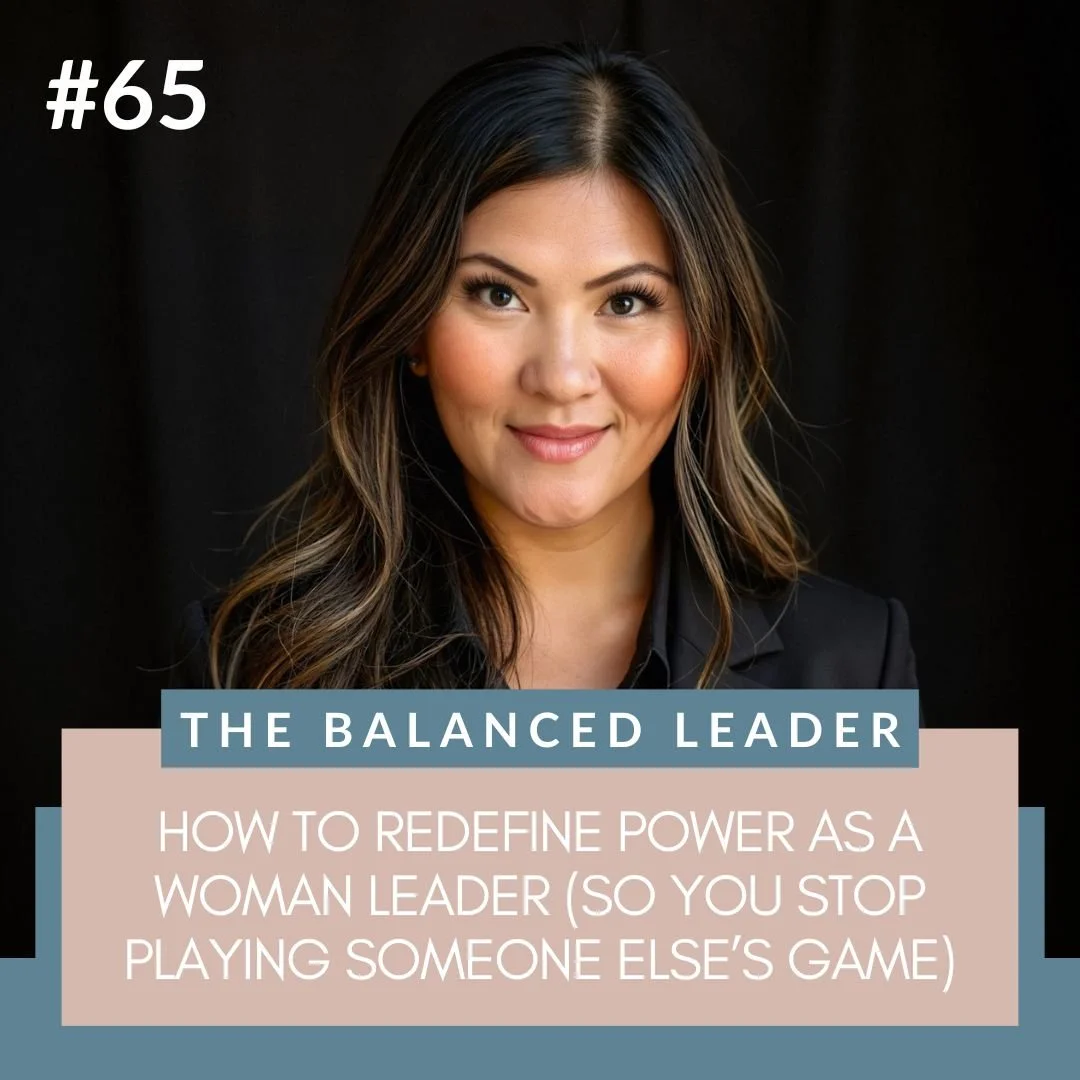
There is a moment in every powerful woman's life when she realizes something quietly devastating: she's been playing someone else's power game. Power as force, power as control, power as dominance, power as being the hardest working, smartest person in the room.
Maybe that worked once, but not anymore. In this episode, I'm exploring why the old definition of power no longer fits, and what happens when you finally see that power isn't who dominates, but who defines the game.
Tune in this week as I draw from Tracy Goss's work in The Last Word on Power to break down what power actually is. You'll learn how to use my Self-Empowered Leadership Formula to step into your power through context, curiosity, choice, and commitment, and how to stop performing the woman you were conditioned to be and start leading from the identity you are becoming.
Interested in working with me? Book a free 1:1 consultation here!
What You’ll Learn from this Episode:
How most women confuse power with compliance moves and survival strategies they've outgrown.
Why power looks different depending on the context and outcome you're trying to achieve.
What the Self-Empowered Leadership Formula entails.
How understanding your emotional triggers connects to cultivating your internal power.
Why context-based power gives you freedom from distortion.
How to stop relying on external validation and claim power for yourself in the present moment.
Why impossible goals force you to become someone new and reshape your identity.
Listen to the Full Episode:
Featured on the Show:
If you haven’t already, please follow the podcast and leave a rating and review to let me know what you think. Find complete instructions here!
The Last Word on Power by Tracy Goss
Episodes Related to redefining power as a woman leader:
15. Power Dynamics in Corporate: Dr. Bob Wright on the Two-Way Glass Ceiling
45. From Nice to Powerful: How to Lead with Authority in High-Stakes Rooms
56. Strategic Influence: The Feminine Way to Build Power Without Politics
Full Episode Transcript:
And suddenly, the old definition of power doesn't fit. This is when it hits you in the chest. Power isn't who dominates. Power is who defines the game. And the moment you see that, and feel that, and really allow yourself to see it, your entire leadership identity cracks open.
Today, we're talking about power in a way you've probably never heard before. Power through context, power through curiosity, power through choice, power through commitment. This is the definition of power that doesn't make you harder. It makes you clearer. And clarity is what makes you unstoppable. Let's go.
Welcome to The Balanced Leader, hosted by Yann Dang, a Leadership and Life Coach with over 20 years of corporate experience. Drawing from her journey as a former global finance leader and second-generation immigrant, Yann understands the unique challenges women face in male-dominated workplaces.
Each episode offers insights on balancing masculine and feminine energies, mastering soft skills, and building emotional intelligence. Join us to transform frustration into empowerment and unlock your authentic leadership potential.
Hello, welcome to The Balanced Leader. Today's episode is all about redefining power, the identity shift that changes everything. This episode is near and dear to my heart, and it's been a concept and topic that I have been sharing with all of the high-achieving women I've been coaching because it is so important that we as women are very clear on what power is and how we define it for ourselves.
What I often see when I talk to women who come to me and they feel really disconnected from themselves, they are really unsure of themselves, they don't feel confident, they don't feel powerful. Oftentimes what I'm helping them do from the very start is really understanding what they define as power and what context they're seeing their world through. And the reason why this is super important is when we're unclear about the lens that we're viewing the world through, we can often find ourselves very lost, very confused, very down on ourselves because we feel like we're not winning.
And oftentimes what I help women do is just understanding some of these unconscious rules that we associate power with. So I want to bring back Tracy Goss's work from the book The Last Word on Power because I think she does such a beautiful job identifying and calling out what power is and how it's so different than what we've been taught, and definitely what I've been taught, right?
So the way she talks about power is that power is not moral, it's not emotional. Power is the ability to take action in a context to produce a desired outcome. Context shifts into action and produces that outcome. That's it. There's no good, no bad, no nice, no mean, no right, no wrong, right? And I think oftentimes as women, we get caught in ourselves trying to be nice and trying to fit a mold, trying to be good, trying to be morally superior sometimes, trying to be that emotional glue for people, and we lose out on the bigger game of what power could be to us, right?
So, in this context, what you're really asking yourself is, what's needed here? But you're rooted in what that context of power is, that definition of power. And can you do it, right? So it's really simple. Instead of mixing up all of these different ways of thinking about power, you're really just getting clear on what is powerful in this context, in this outcome that you're trying to achieve. And what's needed from me here? What skills do I need to develop, and can I do it?
I want to share that this is deeply liberating for women who've been conditioned into goodness to be the good girl. So, let's hear it again. Power is not who you are. Power is what you can do. And that context of power is so, so important here. Because, like I said, so many women are leaving the working world because they've abandoned themselves playing this power game where they're not even clear on what power is to them, for them, and why they're playing this game, right?
Oftentimes when we're in the corporate world, and I had this too, I felt like at some point in the corporate game when I got the title, when I did all the things, I'm like, is this it? Is this power? Am I supposed to feel satisfied here, right? There is this sort of awakening and enlightenment of like, I feel like I've played it right. I'm making the money that I'm supposed to be making. I'm at the title, but something still feels off, right?
And so, the definition and the interpretation of power really matter here because when something feels off, it oftentimes means that you may have outgrown the definition of what it is to be powerful in the context of who you were versus who you're becoming, right? At one point in my life, right, probably in my early twenties, power to me meant, you know, making six figures, living in a nice home, having, you know, a down payment on a condo, having a boyfriend that was probably going to be my husband at some point, having kids, right? That was like my sort of limited view at that moment in time of what power meant, right? To be powerful.
And oftentimes when we are not clear on what we're moving towards, we get kind of lost in ourselves and we get lost in some of the conditioning that we've been hearing throughout our lives as women. So let me share a little bit more about this because how most women misinterpret power, and I've done the same, and I continue to do the same. So I want you to know that if you find yourself in these loops in your mind, these emotional loops where you're confusing yourself with being one way versus another, not feeling powerful, that the more you can pull yourself out of the looping and the spinning, and the more you can see the game that's playing in front of you and the unconscious rules that you have for yourself, the more empowered you will feel.
Because of the social conditioning, most women confuse power with being perfect, being pleasing, avoiding conflict, being professional at all costs, not being too emotional, not being too direct, shrinking so that others feel comfortable, overexplaining to seem credible. These are not power moves. They are compliance moves. They are survival moves. They are winning strategies you have outgrown. They once kept you safe and they no longer move you forward. That's not failure, that's evolution. Again, you have outgrown what the definition of power to you feels like and looks like, you know? So, even for me, my definition of power is very different these days. My definition of power is much more focused on creating a life where I am activated and engaged at work and at home.
And this requires a lot of different skills for me. And it requires me to step out of my sort of corporate identity into more of an entrepreneurial identity. It also requires me to step into being the type of mother that I actually want to be versus the type of mother I saw my mother being, right? Which she had great qualities, but she also had some qualities that I didn't want to repeat with my kids.
So, let me dive into power in different contexts. I'm going to give you a really contrasting example of what power looks like and what it means to actually move forward in a powerful way depending on the context. And why it is so important to understand that power is not defined by power itself, but power is defined by the goal and the context which we give it.
So, for example, if you are a woman in a boardroom full of men that are interrupting you, power looks very different for you. Learning how to be powerful in this room full of men interrupting each other, being aggressive, is going to be very different for you as a woman in this room. And the context of power for you may be being heard, right? Power could look like staying seated, holding your ground, using clarity instead of volume, interrupting the interruption, right? Being able to get your word in to be heard, saying, I'm not finished. Naming the dynamic without apology. Being able to have this strength in your core, right? That is really powerful and the ability to stay the course and know that what you are doing in this room is cultivating power for yourself, learning the skills to be powerful in the context of this room.
And this is super, super important because I think oftentimes women feel like power is something either given to them, it's outside of them, or it's something that they have to earn. This context is really all about if you're really clear on what power is and the game you're playing, then what's really in between you and getting to that outcome in a powerful way is learning, right? Learning to play the game, learning to be powerful, cultivating your internal power so that you can be even more powerful in these rooms.
It is something I had to learn. I had to learn how to stand my ground, how to speak up for myself when I had a very abrasive, aggressive boss. I had to learn the skill of being calm in my body in my nervous system, allowing his angry messages to come through me so that I could understand what he was saying, but not be emotionally triggered and spin out because of his words, right? I had to learn how to fight back using my words in a really clear and grounded way. This was a skill. This is how I became powerful. It is a skill. You can learn the skill. It's not something you have or don't have. It is a skill you can learn. And this is so empowering and so important because if you understand this, then the only thing between you and your impossible goal is you learning to cultivate the power to create that goal, to create the outcome that you want, right?
So I wanted to be heard. I wanted to feel powerful. In the context of being with my boss, interrupting me, yelling at me in front of a lot of people. And I had to cultivate that for myself. It is an inside game. And I became powerful because I knew what the game was about. I didn't make it about him. I didn't make it about my circumstances. I made it about me showing up in the context in the role that I was playing and shifting everything because I believed different thoughts about myself. And I learned how to calm my nervous system down, stay grounded in my body, speak with authority, interrupt him when it mattered, right? And doing it in a way that got my words across, that helped me to be heard in the room, to be respected, to be all of those things that are powerful. But I want you to hear this again, it starts with you. It started with me. I had to do my internal work to get there.
Here is the contrasting context, right? I want you to think about a man, right? And this is just to create that contrast, right? This is a man who has spent his years being a businessman and now he is being put in charge in a power position to take care of a crying baby. And he needs to learn what it is to be powerful with this crying baby, right? So a baby crying at 3:00 AM. Power looks very different, but he still has to learn these skills in order to be powerful.
Now, where we in society get really triggered and messed up is that mothering isn't often times something that is respected, valued. You know, I think it's respected in some ways, but it's not valued because mothers who, you know, are mothering full time don't get paid for it, right? So society almost imposes a moral obligation on women to do this without pay, without any sort of, you know, really thinking about them as valuable.
Again, in the context of Tracy Goss's power, right, this doesn't matter. It just really matters how we think about it. Power in this context for this man looks very differently than power in the context of a woman trying to be heard in a boardroom full of men interrupting each other, right? So this man may need to soften his tone. He may need to be much more gentle. Presence is going to be much more important over being perfect or polished in this arena, regulating himself first, letting go of control, right?
If a man rocked a crying baby with tenderness, no one would call him weak. They'd call him powerful in the context of he knows how to soothe that baby. And if a woman commanded a boardroom with calm authority, no one would call her too much. They'd call her powerful. The only difference is who we expect to show power where. That's the distortion.
This is why context matters so much and why defining power for yourself matters so much because if you are not defining it well, you can oftentimes find yourself very lost in trying to be powerful and playing a game that you're not even clear on what that game is.
So, why does this matter for women leaders? Women have been conditioned to perform safety, not power, to measure themselves through likability, not outcome, to evaluate themselves through appearance, not impact, to prioritize harmony over truth. And this is why so many women feel stuck. This is why so many high-achieving, successful women feel stuck. Not because they're broken, but because they're playing a game that no longer fits them. Context-based power changes that. It gives you freedom, not freedom from responsibility, but freedom from distortion. And this distortion becomes a distraction over time if you are not clear on it.
This is what causes women to abandon themselves, to put work before themselves, before their health, before their family. This is also what causes women to burn out over time. It's this distortion and this distortion again creates a lot of distraction for you and you're really unclear about what's coming up for yourself and how to disentangle yourself from your life because you have all of these unconscious thoughts and beliefs about what power and powerful is.
All right, so let's take a step back into how to step into your power and how to start doing this work for yourself so that you are not stuck and lost and distracted or distorted in this game, right? This is where my work comes in. Over the last several years, I've coached hundreds of high-achieving women through the same shift. The framework that supports it is what I call Self-Empowered Leadership Formula. It's simple and it's rigorous and if you use it, it will change your life forever.
So, it always starts with context and, you know, I read the book not knowing that this was going to be coming part of this book, right? That this context piece was really a huge piece of it, but it really helped to help me understand why this formula that I've created for women is so powerful. We need to start out with this context. What game am I actually playing? What outcome truly matters here? This alone changes everything. Because clearly defining the outcome is half the battle. When you name the real outcome, the noise falls away. The fear quiets. The right action becomes obvious. Context doesn't constrain you, it liberates you. It only ever makes you more powerful.
So when I was thinking about the context of me being powerful in this room full of men, speaking up, sharing what I had to say, instead of thinking about all of the things that I didn't have, I just thought about what I needed to cultivate, the skills I needed to cultivate within myself, and it felt deeply empowering to know that I could cultivate executive presence. I could cultivate my gravitas. I can cultivate these skills, and I didn't have to be somebody I wasn't. I just needed to learn to cultivate my power in these spaces in a way that felt authentic and connected to me, but I was very, very, very clear on what the game was, and I didn't get lost in the game.
I didn't get lost in the game of proving myself. I didn't get lost in the game of earning everything, you know, waiting for permission. I was very clear on this context for myself. And this is what I help women see for themselves that they get to create the context and not just buy into what the scenario or dynamic is happening or circumstances is happening around them, right? And this is empowering.
So again, it starts with context and then it's curiosity. Ask yourself, what's happening emotionally here? Where is conditioning talking? This is not judgment, just awareness, right? This is also deeply helpful when you find yourself emotionally triggered. When I find myself emotionally triggered, I ask myself, wow, what are the rules that I'm playing here? And why am I so emotionally upset? What does it relate to? And knowing what it relates to helps us understand ourselves and ground ourselves. I know there's a lot of sort of hacks where people are like, let's just move through it. You don't have to do that deep work from your past.
But what I have found to be true for myself and the women that I coach is that understanding how our past impacts our presence is deeply empowering because we get to change the way we look at our past. And our past is no longer this big obstacle that we have to resist. It's no longer a story that we cannot change the narrative of.
So let me give you an example. I realized for myself that I have a big trigger when people are not on time, especially if it's a man. And I think I know, I don't think, I know this comes from my relationship with my father when I was younger. I would never really be sure if he would be on time or he would be reliable. What I noticed in my romantic partners, when they weren't reliable and they didn't let me know, there was a part of me that felt emotionally unsafe. I would start having all these negative thoughts about myself and about this person.
And what I realized over time was in my mind, I kept spinning out on this context that they were the same people. And I almost felt very helpless with the scenario until I could see that this is what was happening. When I understood the context of what was happening, it was like, oh, I get triggered. I feel like a little girl again. I feel helpless again, and I have all of these emotions. And these emotions are causing me to have all these thoughts. But when I realize this is what's happening, the next thing what I could do, even if this trigger is coming up, is I can make a conscious choice. And that is the next step in the Self-Empowered Leadership Formula, making a choice. But you have to start with the awareness, the context, and curiosity.
So, you know, in the game I was playing is I want to feel as empowered as possible. I want to feel partnered in a relationship. I want to feel that what I say matters and that I can ask questions and that I'm not sitting around helpless, right? So in that choice, that choice is choosing an action that matches the outcome and your truth, right? So in the context of what I was talking about in terms of me feeling triggered, historically, I would just spin out, you know, or maybe I would send a rash message like, where are you? What's going on? Why are you always late? I don't know. I could have like, you know, sent a lot of emotionally charged words to my romantic partner. But if I did that, then I would just be reliving my identity of that little girl feeling lost, unsafe, needing some emotional help from someone else.
Instead, I can make a conscious choice to say to myself, “Yann, you are safe in this moment. You can ask questions, you can see where this person's at. This person is not your father. You are not a child anymore. You can take care of yourself. You can take deep breaths and calm your nervous system down and realize that even though you don't feel safe in your body, you actually are safe in your body.” Like my body is safe in this moment, right? It seems so simple, but this is super powerful because this will have you shifting out of old emotional triggers, old identities into new empowered identities, right?
So if I'm an interdependent woman, which is me being interdependent with my romantic partner, me being somebody who can take care of myself emotionally, right? Not needing to be codependent on someone else to show up on time in order to make me feel, you know, safe. I could ask questions. I could say, hey, when are you getting home? I thought you were coming at this time. You know, this is where you get to ground yourself and it's where the old identity loses control and you, right, take back control in the here and now in that moment.
And that is so important because that means that power is what I am, you know, present to at any moment. When you know what the context and what the definition of power is, you have access to it in the present moment without needing anyone else to do anything for you. And that's why this formula is so important and powerful, and that's why talking about power in the context of how Tracy Goss defines it is so powerful. It's not something that somebody could ever take away from you. It's something you cultivate, you create, and you reach out for in the moment through this framework, through understanding yourself.
And of course, the last piece is commitment. This is the embodied moment, the sentence you finish, the boundary you honor, the softness you allow, the truth you speak. And power is never comfortable. Power is clean. Power is not comfortable, but power is clean. Clean meaning that power is just what it is. It's not something somebody gives you. It's something that you get to claim for yourself. And oftentimes for women, it's not comfortable because you're not relying on somebody else to give you something. You're not relying on that external validation.
So identity makes action possible. And actions produce outcomes, and outcome reshapes your identity. This is why impossible goals matter. This is why you getting really clear on what your goal is, what your outcome is matters, right? For me as a mother, it matters too because my mothering is much more messy than I think things that you see on TV, right? I have conversations with my daughter. I tell her I'm sorry. I tell her that I messed up. And we have really deep conversations about things. And I am not in this like knowing superior state, but I'm also not just like, you know, mutual with her. So it's a complicated relationship, but for me, power as it relates to me parenting my daughter is me parenting myself, being really clear and honest about the type of person I want to be in the moment with her, and also being with her in whatever emotion she's having and understanding her world and having this connection with her. And listen, it's not easy to do all the time, but I strive to do that. And when I am triggered by something, right, I can use this to slow down, to calm down my nervous system. I can get into the context of what's happening here. I can get curious and then I can make a conscious choice that moves me towards my commitment of being the person and being the parent that I want to be, right?
So it's not about being impressive, but because you're forced to become someone new, this is why that impossible goal is so powerful, right? You don't build the future by trying harder. You build it by choosing a different game. Whether it is you being powerful in a room full of men, whether it's you being a powerful parent, whether it's you living an unapologetic life for yourself. These things are not easy, right? We have a lot of conditioning. We have a lot of societal pressures on what power, status, all of those things mean. But the more you take responsibility for what and how you define what power is to you, the more powerful you will be, and the more focused you will be on learning the skills to cultivate that power. And that is an inside game. That is a journey that can only be walked by you.
And this is why the work that I do with women is so powerful because I am not giving them somebody else's roadmap. I'm giving them a roadmap to themselves, to understand themselves deeply and to allow themselves the liberation to shift towards an identity that they desired, that they want, a game and a power that they want to play, right? Not something somebody has imposed on you.
So, if you take nothing else from this episode, take this. Power is not who holds the microphone. Power is who defines the moment. And when you stop performing the woman you were conditioned to be and you start leading from the identity you are becoming, your entire world reorganizes around you.
This next year ahead isn't about doing more. It's about being clearer. Clearer about what matters, clearer about who you are, clearer about what game you're playing. That's evolution. And if this named something for you, if you felt a shift, even a small one, don't keep it to yourself. Share this episode. Send it to a woman you respect, a colleague, a friend, a daughter, a sister, because this is a conversation that quietly changes how women lead. And that changes everything.
The more women feel like they can be powerful and cultivate their own power, the more powerful they will be and that power will come internally, not externally. And the more powerful women feel, the more they're going to be able to shift systems around them, systems that don't work for them, conditioning that doesn't serve them. So, let me know how this episode lands with you. I'd love to hear from you. I would love to hear how you are taking this into your life and how you are redefining power for yourself in this year ahead. Have a beautiful week ahead. Take good care. See you next time.
Thank you for being a part of The Balanced Leader community. We hope you found today's episode inspiring and actionable. For more resources and to connect with Yann, visit us at aspire-coaching.co. Until next time, keep leading with confidence and purpose.
Enjoy the Show?
Don’t miss an episode, follow the podcast on Apple Podcasts, Spotify, YouTube Music, RSS, or wherever you listen to podcasts!