75. Inside COMMAND: Live Coaching for High-Achieving Women Leaders
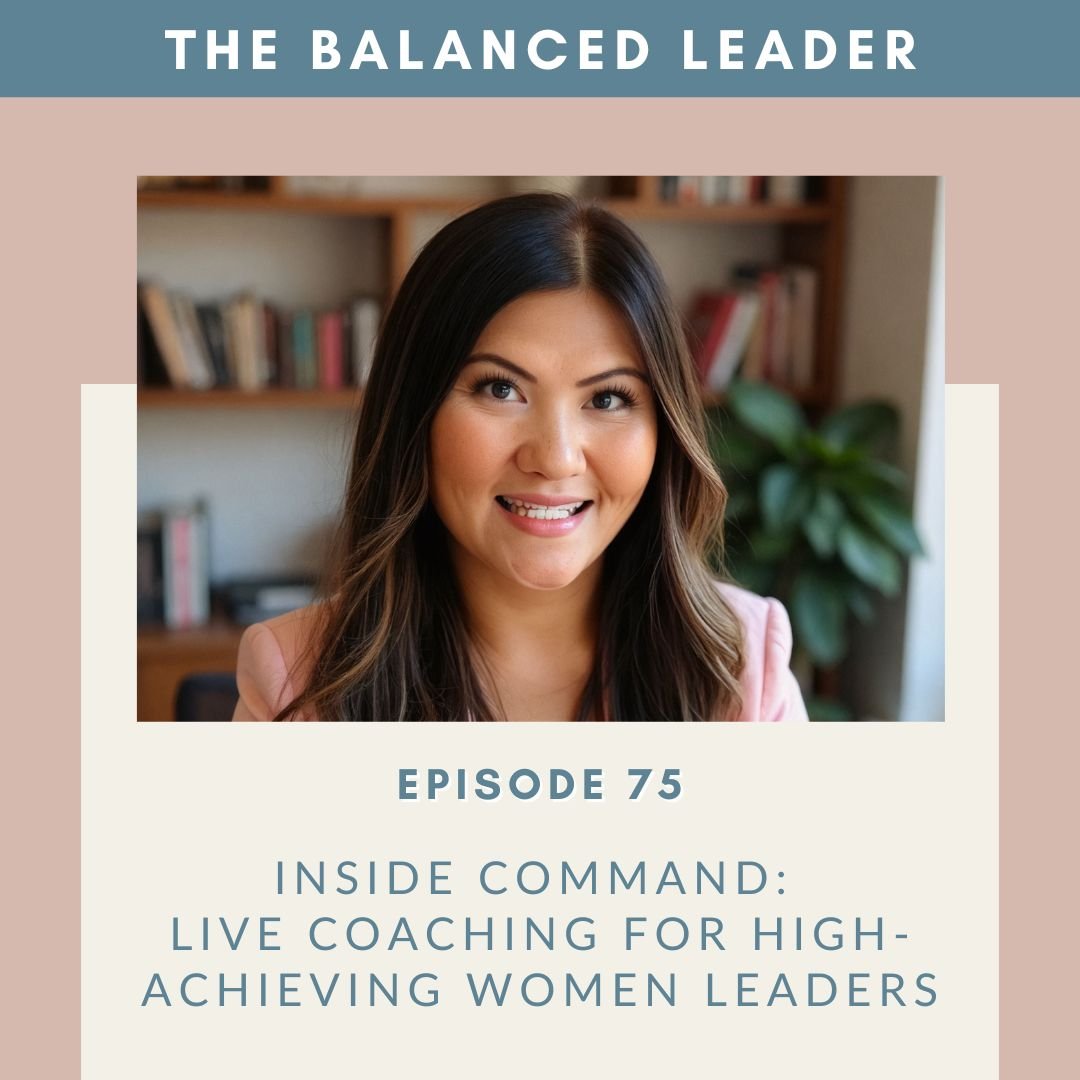
What does high-level leadership coaching actually sound like in real time?
In this episode, I’m taking you behind the scenes of a recent Command live coaching session so you can hear the kinds of conversations women leaders are navigating every day. We talk about boundaries, emotional triggers, difficult work relationships, authenticity, and how to stay grounded when leadership feels personal, messy, or emotionally charged.
Listen in this week to hear what it looks like to slow down and become more intentional with your emotions instead of reacting to them. We also unpack what happens when you’re trying to grow, but the people around you are not on the same emotional journey, and how discernment becomes essential in those moments.
Interested in working with me? Book a free 1:1 consultation here!
What You’ll Learn from this Episode:
How fear can show up as sharpness when you’re trying to set boundaries.
Why emotional attunement helps you move through exhaustion instead of resenting everything around you.
The value of distilling nuanced emotions into core feelings so you can respond more clearly.
How to navigate difficult workplace relationships without over-functioning or over-explaining.
Why discernment matters when you’re growing faster than the people around you.
What it looks like to pause, regulate, and respond instead of react.
How live coaching helps reveal the patterns that quietly drain your energy and authority.
Listen to the Full Episode:
Featured on the Show:
If you haven’t already, please follow the podcast and leave a rating and review to let me know what you think. Find complete instructions here!
Watch my TEDx talk: Reclaiming anger: A woman’s birthright
Episodes Related to live coaching for high-achieving women leaders:
60. How High-Achieving Women Advance Without Burnout: Commanding vs. Coping
61. Real-Time Coaching for Women Leaders: Mastering Thoughts, Emotions, and Actions
Full Episode Transcript:
These conversations are happening with a group of incredible women leaders who are learning to lead with clarity, emotional authority, and presence, especially inside male-dominated environments. This is the kind of work that creates real transformation, not just in your leadership, but in how you experience your career and your life. I'm sharing this with you because I want you to get a true sense of what happens inside high-level leadership coaching spaces like Command.
And if you find yourself thinking, "I've been in that situation," or, "That sounds like something I'm navigating right now," you're probably not alone. A new Command cohort will be kicking off soon, and I'll be sharing more details of how you can join if you are ready for this kind of deeper leadership work. For now, let's jump into the conversation. Enjoy.
Welcome to The Balanced Leader, hosted by Yann Dang, a Leadership and Life Coach with over 20 years of corporate experience. Drawing from her journey as a former global finance leader and second-generation immigrant, Yann understands the unique challenges women face in male-dominated workplaces.
Each episode offers insights on balancing masculine and feminine energies, mastering soft skills, and building emotional intelligence. Join us to transform frustration into empowerment and unlock your authentic leadership potential.
Guest: I have found myself at work and emotions coming up as I'm trying to set boundaries with the executive team that I'm working with. More around how much I'm going to give. Monday is supposed to be a holiday. I really didn't want to have meetings on that day. We had one. But I find myself being a little too, I think, assertive or coming across more sharply than I need to. And I think there's a fear that they're going to be, you know, sucking me dry in energy. But so I just realized, "Hey, you know, I could set my boundaries more calmly.” I don't have to have that intensity behind it, which is coming from a place of, I feel like it's fear, you know. So that's one thing I've noticed.
Saturday morning, I wake up, I'm making my list for the weekend. There's just a lot going on at work right now, so the list is pretty long and some things to do for home, too. And I make this list, and I started getting really sad. And I was just asking myself, "Why are you sad?" And I just felt really exhausted looking at that list. I was already tired. It's already been just nonstop.
And so I realized it's just you're tired and you've got this big list in front of you. You know, I don't know if I'm going to be able to do it, you know, take care of it, do what I need to do. So then it was like, "Okay, so how do I help get myself out of the funk?" And I, later that day when my husband came home, we're opening a new business, so he was working Saturday. I actually talked to him about it. You know, I woke up, he said, "How are you doing?" And I said, "Well, I'm starting to feel better." I, you know, I found some— "Better? What was wrong?" He struggles with dealing with emotions, but this was good because one, I wasn't blaming anything on him. It had nothing to do with him. And I sort of kind of resolved it before, before we talked about it. So, you know, it wasn't his issue.
Yann Dang: Yeah. Well, this is great. I mean, I want to underline a few things, right? There's the one of like, "Wow, I'm coming across maybe sharper than I need to be. Why am I doing this?" "Oh, there's fear." And what I assume from that fear is, "Hey, historically, I haven't really, you know, protected this, you know, and now there's something to protect." And so, sometimes we kind of go like a little bit too mama bear on that, like, "Hey, this is my time." Maybe, yeah, we're bracing too much. And it sounds like what you did was like, "Oh, notice the fear, also notice the sharpness. Maybe there's more ease that I could, you know, maybe there's more flow that I can invite."
Like this person, like I actually just shared about like, you know, these reflections. They're an invitation for growth. They're not an indictment, right? And sometimes in our mind when we think like, "Oh, there's something wrong or, you know, I'm protecting something," then we start like either judging ourselves or judging the other person or coming across like more strongly than we need to be. So you used your feelings to connect that, right? And you're able to instead of continuing and seeing something's off, you're like, "Okay, you know, it matters to me. This is okay." And like, it's also okay to not have such a rushed tone with things, especially if, you know, I'm building this new skill and I'm, you know, learning how to be with it.
The other piece was that like you listing it out. And I think oftentimes people think emotions slow us down. But if you're just like looking at the task and you don't actually notice the emotions and you just feel exhausted and you feel burnt out, you just kind of start resenting the list and resenting your life and feeling burnt out by it, right? But you allowed yourself to feel sad. And maybe there's a loss of a pleasure of like, "Oh, I can't do the fun things," or, you know, having more of that curiosity of like where did that sadness come from? Oftentimes when we can just sit with the emotion, we can figure it out, right? We can figure it out versus like try to power through it and then carry it into and potentially having a fight with your husband, even though it's like not, you know, because we're just displacing that emotion.
Like, you're working and I'm working and we're all working and we don't even have the lives we want, right? Like some that spiral that can happen. But you sitting with that emotion and then him asking you like, "How are things?" And you're, you know, not dumping on him emotionally or anything like that. You're just saying, "This is how I felt." And he's like, understands your world a little more, right? And you understand yourself. You're more connected and grounded to yourself.
Guest: Yeah. And I don't think I would have thought of either one of those things or handled it that way without us having this conversation, you know, about being more intentional about our emotions. I don't know that I would have acknowledged either situation.
Yann Dang: Well, this is the growth, right? And this is that continuation of like noticing those emotions because, I mean, listen, we're in a very like masculine like just get shit done. You know, put your head down and get shit done. And then you wonder why everybody's like emotionally eating or depressed or burnt out, right? This is the cause. When we don't actually connect to ourselves, when we actually don't stop and say, "Hey, what's actually going on here?" Like maybe my life looks great on paper, but it doesn't feel that way inside. We want it to look as great on paper as it does on inside. But we can't do that if you don't have that link to yourself, you know, that link to your emotions.
Guest: Yeah, very good.
Yann Dang: Good work. Great work.
Guest 2: When we're processing our emotions, do you recommend, sometimes the emotion that we identify with is a little bit more nuanced than the, you know, the five that we listed? Do you recommend mapping it to one of those? Like, let's say, for example, someone's being condescending or you feel dismissed or even patronizing, right? So it's going to be somewhere in the world of anger and hurt. Do you recommend trying to kind of map it to one of those core simple emotions?
Yann Dang: Let me ask you this. How does it feel when you're like, "Oh, condescending," and then you feel like, "Oh, this person's being condescending to me"? And when you map it yourself to like, "Oh, it's anger and hurt," how does that help you? What do you notice for yourself or what comes up for you when you're like able to distill it down to a primary emotion?
Guest 2: My hunch is that's a good way to go about it. I think distilling it down provides clarity and allows you to, I guess, you know, think about how you want to respond or even just acknowledge yourself. Also, it's like easy to understand, right? Like, "Okay, I'm angry." Whereas an emotion like, "Oh, this is dismissive," and then like parsing out the exact nuance of it actually is more instead of being in your feeling of your emotion, it becomes a little more mental work where you're like, I think a little more analytical of the circumstance versus just working with your emotion. So that I get. But then sometimes I feel like it doesn't quite capture it because it's so simple. I'm like, "Well, I'm angry, but I'm not that angry." But I also, if I want, so if I want somebody, especially somebody who works for me, if I don't like that behavior, right? And if I don't want that situation, it's like, "Okay, I can deal with my emotion.” And something needs to change because I don't really want to be treated like that, right? I feel like then just work, it's not as helpful. So maybe, okay, I'm going to say that. I think to process my emotion, the distilling helps, but to come up with a plan, I feel like maybe it could be a little too broad to work with.
Yann Dang: Well, so definitely that first part, right? Because sometimes people come to me and they're like, "I'm annoyed," or, "I'm like, I feel dismissed," or, you know, and so broad, right? So being able to distill it down helps you to connect with your core emotions, connect to yourself versus get heady into, you know, sometimes we're like describing the story versus actually being with the story. And the emotion will allow you to like to be with yourself, right? Not the story, but yourself. Like, "Oh, I notice that's how I feel," right? And I, I challenge everybody that I coach to distill it down, not to like have a right answer, but to connect with yourself. Because if we can all kind of at least speak the same language or get closer to that primary emotion, then you're, you know, again, just as you said, more in your sort of heart than in your head. And you can connect with yourself. And then from that place, typically, if you're more grounded and calm in yourself, you're more likely to come up with a solution. But let's talk about where that is. Because if you're feeling angry, right, with, I mean, do you want to talk about the specific situation with somebody who works for you or what comes up? Because it sounds like it's like working for you but not to the, to the expression, right? To actually move that.
Guest 2: So I have a center director who is, I mean, she is like, think about a brick-and-mortar store, she is the person that's there. You know, initially when we opened this laser therapy center, I was really working on all the— I still work on all the processes, but I'm not there physically as much anymore. And I do like a lot of work from calls and things like that. My goal for 2026 is to really nail down processes and communication so that I can be even, like give her more, empower her even more, give her more freedom, which is what she wants, and still feel like I have a grip and a handle on the, you know, the strategy of the business. It's a little bit hard because you're dealing with patients all day long. So that's the backstory.
And the challenges we've constantly had is communication. So it's like, this is really different than when I've worked in the workplaces where I worked at big companies because people are generally in the same professional level. It's corporate. And this is somebody who like I had to teach how to write an email, right? Like she's got some great skills, but they're definitely not refined. They're not business. It's like, so it's been like this huge coaching session. And I felt that I've given like way too much of myself. Not like, "Oh, I've given too much like that way," but like, "Here I am coaching someone who doesn't even know that they need to be coached on a topic." So they can only appreciate it so much, right? Until, it's like a child, until one day they do. And then it's like, "Oh, you know."
But in the meantime, all I get is pushback. So it's really frustrating. And so, I say that to just paint the backdrop for this very specific story. So let's say there was like an email, and oh, you know what, like, I'll give you one example. So I've told her, there's like another corporate level that we deal with sometimes, a whole bit of a complicated like relationship. And we don't have the best relationship with them, so we don't like want to share everything with them all the time. Let's just put it that way. But that being said, I don't want to like create a negative environment for my staff, like the rest of my team. I don't want them to think that like, you know, I don't want to talk badly about corporate, let's put it that way. So, you know, it's hard. There's been comments here and there. And so I've been the one to tell them that like, "Hey, like, as leaders, we have to keep our professional, like, you can be authentic, but we can't make like negative statements, right? Because that gives other people permission to take it 10 times further." And then they kind of act inappropriately.
And so I've said that to her, but I made a comment, which was like, I was making a joke in one of our texts, and apparently it didn't land. I absolutely want that feedback, but she felt like she couldn't just give me direct feedback and say, "Hey, just a little nudge, like, I know you, you know, you don't like to do this, but I think maybe this might have, this comment might just didn't land with the staff, right?" It wasn't even that big of a deal. But maybe it was to them, I don't know, but the point is, she instead wrote me this very long email with paragraphs and like ChatGPT explaining the importance of— like it was so patronizing. And I'm like, literally, I'm the one that has taught you this. So I get it if I have done something that you just want to give me a nudge. I actually really appreciate that, but this is actually the opposite of that. This is like, and the thing is, she does that kind of thing all the time.
So I will tell her the importance of business metrics and reporting and regular communication, and then when she finally gets it, she'll turn around and write me this like report on it. Like, I don't know, it's really a bizarre thing. Or if I'm telling her like, "Hey, I'd like to have a team building meeting. This is the vision," and I'm giving her all like the ways to do it. It'll just be like the 14 reasons why we can't, but not any solutions. And I'm like, I'm like, "Okay, I'm not feeling heard, or you're condescending me, or you're patronizing, all of that just so that one day you could be like, 'Oh, I get it now.'" And I'm like, "This is really frustrating." So I've been, every day it's like me grappling with how to deal with this, and I think I have an answer. Like I think less is more now. But when I get these kind of communications, I feel, you can imagine, like I feel a ton of emotions that I'm like, "I don't need to waste my time with this right now." There's no ROI on this. But I'm human and I'm like, "Ugh." So, that's the story.
Yann Dang: Okay, let me just share with you what I'm hearing because I think there is emotional tension on both sides. There is this one, right? You're corporate, you are the leader, you are the authority, right? She's learning from you. It is interesting. You have this underlying thought that she doesn't somehow like know that you're pouring into her or coaching her or you have this question that she actually doesn't, maybe it's value or doesn't actually see how much you are giving, right?
But also here's the thing, like oftentimes, right, when we write a big book, when we're like writing a like - instead of doing three sentences and we do a lot, right? We're kind of getting into her head now and we're making some assumptions here, but if the dynamic is that, she sees you as this like corporate authority like very polished person who's training her, and she's trying to give you feedback or trying to tell you something, right? Then it sounds like she's going into like convincing. Like I have to like write a lot to convince her, otherwise she won't just believe me because I am not corporate. I don't really have this experience. I need to show her. And then maybe she goes to ChatGPT to try to show you, right? When you really want like two or three sentences or you just want a real conversation and say, "Hey, I saw the long email. Let's just talk about it. Tell me what you're feeling."
Guest 2: Yeah, and I'm going to tell you, that's what I did. But this is where it gets really complicated for me. I feel like I'm actually ahead of— I hate to use it in terms of ahead, but like I'll say unique. Like compared to a lot of people where I do notice these things, I figure out that she's trying to avoid, she doesn't want me to feel bad. I get all that. And I'm very comfortable just being like, "I don't need a letter. You can just give me a heads up and tell me. I'm good with that. Like I'm okay with that."
Guest: Don't send me these communications again. Call me. We'll have a conversation.
Guest 2: Yeah, and then she's like, I know she doesn't get it. So then I'll even take it further and I think I step into like coach mode, like kind of like what you're, like your role here, but like in that scenario where I then break it down and explain to her and I think that's maybe where I'm going overboard. I think I am assuming that like not just the boss and the real conversation or whatever, but like I'm also then taking on responsibility to like help her do the work that we're doing here. Maybe it's my own actions that's causing me to feel devalued because I'm putting so much more into it.
Yann Dang: And there's a like a little, like this less is more, because I also want to recognize your own emotional tension, right? Like I don't like seeing these long emails, right? I don't like this. I don't like feeling this way, right? I don't like having these conversations. And then also noticing what is that emotion? Oh, it's anger. I don't like to, like we don't like to always be like angry, right? Especially at our children or at…
Guest 2: At the end of the day, she said, "You know, I just want to give you feedback without it being like turning into a long conversation." And I'm like, I'm literally looking at her, I'm like, "You've got to be kidding me." I'm like, and literally this happens so often that it’s - I gave you guys like a couple more recent examples, but it's really, it's draining. And then I then sit back and like I'm like, "Okay, how is this affecting—" at some point you're like, "How is this affecting my bottom line?" But that's not how I like to be. I like to be authentic. Everyone wants good relationships. I love to like see, I mean, I love to grow so much as does everyone here, which is why we're here. I love this kind of work. So I just kind of maybe operate with the assumption that everybody does.
Yann Dang: There is a difference between getting like effective outcomes from people than expecting them to go on the same emotional journey or have the same emotional maturity as you, right? Like, it she's on her own path and yes, probably someday she'll be like, "You were like the best boss ever. Like thank you for walking me through." But you also need to notice yourself and conserve your energy. But it is about being more open and having that aliveness and saying, "Listen," and even catching yourself like, "Okay, wait a minute. I'm going down a rabbit hole. Let's get this thing done," right? But still be in relationship. I think there's a part where you're feeling like, "I'm spinning a little bit. I'm giving too much. This is out of control," versus, "Okay, I have this feeling. I'm angry. Let me pause and sit with that before I jump in and try to save, rescue, fix, you know, smooth things over."
Guest 2: That fixer that you mentioned in another session. You know, actually, I think this is a very relevant topic, probably for everybody here, like, when you are on a path to improve, especially, let's take a specific area like this, right? How do you handle then your close relationships? So obviously a husband or a significant other, but even like your business partner or a team member who you have to work with so closely and they're like not learning the same lessons as you and they're not, you know, maybe as interested in taking the same responsibility as you. Like what is your suggestion on that? Like as you grow in this area.
Yann Dang: I think it's definitely noticing it, right? And you're doing that. Noticing like where am I like really trying to take somebody on a journey that they don't want to go on, right? And being able to say, "This is where they're at. I'm going to meet them where they're at, and I'm going to, you know, still do my own work because I care about growing and expanding, but I'll meet them where they're at." That doesn't mean I'm like withholding things that I'm learning, but I'm also not just giving them freely. Like I'm going to understand where they're at.
Like I had, I have another one-on-one client where she's like, she's in the construction business, and she like so wants the men to understand the emotions and the strategy all together. Like she has like this like, you know, and she has these long conversations with them, and I think all they're hearing is like, "Oh no, she's emotional again, and now she's telling us what to do." And then it like becomes a spiral, right? Where they're like, "Give me direction, help me lead, train me in small steps. Don't like expect me to, you know, understand everything because I just don't, and I get lost in it." And like when people get lost, they just tune out.
Guest 2: But you know, you've mentioned, again, I don't know if it was another session or in this thing where you talked about the fixer, the ball buster. We have a response, our mode. But the way that was presented was that those modes are really a little too much. They're like overcompensating. But when you say what you've just said, I, I'm going to tell you that's where I want to go. And I, I then recognize it and I'm like, I've always recognized when I'm doing something that doesn't feel authentic to me. For example, I'm like, "Okay, fine. If because then I feel like, well, if I can't explain this to you and if you don't want to also break down this interaction and figure out what you can learn from it, fine. Okay. And then it's like, okay, then I need to like withhold, not take the meeting, make my husband take the meeting, like, you know, like do one of the ones or just lay down the law." Like I feel like I don't know - that's what I don't know. Like how do I then say, "Okay, I'm going to handle it and I'm not going to," because I can't explain it to you. You don't want it to be explained to you. Or you don't want to even entertain that maybe you're not capable or whatever it is. And then I can't like if I just withhold her a little bit, like then I'm now into a coping mechanism mode.
Yann Dang: Yeah, like you don't want, so this is all about discernment, right? Because it's like you can't, it's not like you're going to just be like, "Oh, this didn't impact me at all. Let's give this problem to my husband," right? Where you're like feeling like you're sort of holding yourself back. You're like, "Okay, I can't like lead these people or," but there is like a lot in the middle, right? There's this one side where you're like, "Ah, take them on the journey. Have them learn all these things. Become like me." And then there's like, "Let me just withhold or fix them or manage them in some way," right? There is this discernment in the middle to be able to, but it first starts with you of recognizing, "Okay, I don't like the outcome of this. I am emotionally triggered by this. There's also an interesting like, why do I get so emotionally triggered by this? What's going on here for me?"
And having that space to say, "Okay, what emotions can I express and at least connect with myself with?" And with where this person is and can I sit with this for a minute before I just react? How do I want to respond? And in that response, there may be a little bit of, "Hey, I don't like these long emails from you. I get what you're trying to do, but let's try to have more of these conversations," or whatever it is. Like there's no real right word, but there's just like a combination where you're not overly like, you've got like this strong grip to like have them really be on the same page, but enough where you're like, "I'm still in it. I still need something from this person, but I also want to feel grounded in myself as I do it and I don't want to just like cope it." And that's actually like the learning.
Like it's not an easy answer, right? Like there is some like sort of middle ground where you're like, "Hey, I don't like that, you know, when I have an idea that I get all this pushback from you, where is that coming from? Let's talk about it." And you can say, "Hey, I've heard all the pushback. Now I need you to get on page and we need to move forward," you know? And it doesn't mean that your feelings don't matter. I'm just at this point needing to make a decision.
Guest 2: Yeah.
Yann Dang: And you can share your emotions in that, but not allow that to spin out either. This is the finesse. This is like the, I mean, this is literally like emotional intelligence. It's not like you're like, you know, but really knowing where you are, knowing what energy you want to expend or like having that relationship with it, because we do need to be clear. We can't just sit in a box, right? We have to say, "These are my expectations. This is what really matters to me. This is what I'm scared of happening." Now, you go, right? Now they get to react to that.
Guest 2: Yeah. Yeah, I'm hearing or like understanding that this is just going to be a lot of different practice for also because it sounds like I'm not going to be able to nail down like, "Okay, 20 minutes is the right amount of pause." Like it could be like, it could be like 20 minutes, it could be two days, it could be two weeks depending on the person, the situation. And then when you were talking, the one thing that came to me is I'm like, "Oh yeah, I have done that before." And it has been extremely— just the way you sounded, I'm like, "I've done it. It has been extremely effective, and I have not done it also, probably many more times than I've done it." That's the thing. It's so hard to figure out where how long it's going to take you to truly get to neutral, depending on the situation and the person.
Yann Dang: Yeah, and then there's people that are closer to you, right? And that you are dealing with more regularly. Kind of have like a context of a lot of emotional things with them. You know, you being able to at least call out your own emotions and stay grounded in that, right? Like trusting that will naturally help you come up with what's next. And it's true. There are some times where you can't, like, you're still processing, you know? Like there's that thing where they're like, "Don't go to bed angry." I don't know. I'm angry at my husband and it's not going to happen. Like I still love him, but I can't like just snap my fingers and be like, "Okay, like let's let it all go," right? There is like permission to still like have strong emotions and still care and love about somebody, but still have your own processing time. You know?
And trust that if you're going to be focused on it, you'll come up with a solution.
Guest 2: Yeah. I think that trust is, like you said it a couple times and it's like in a different way. It's like trust that simply sitting with your emotion is in and of itself useful because I think probably a lot of us are like, again, use our corporate jobs where…
Yann Dang: It's got go, go, go.
Guest 2: Well that and like at some point you're like, "Well, that's great that's going to take you two days and we need an answer, we need to do something in the next 20 minutes." So, you know, or like, so I feel like there's that's hard, but there are a lot of situations that you can actually sit with for a lot longer than we think we can sit with them.
Yann Dang: Yeah. There is that like tension, right? And we do live in a very masculine, like urgent world, but us being able to understand are we actually wanting it to be urgent and there's a strong need for it or are we pushing ourselves because we think that's the way it should be?
Guest 2: Okay, I have a one question. What do you recommend doing during the pause? Because, you know, the person's still there, you might still be in the meeting, whatever, life goes on while you're in your pause.
Yann Dang: Mm-hmm. Yeah. So there are like words, right? Of saying, "I need to, like let's park it for now, right? I need to take this offline. I need to come back to this, right? I need to circle back on this," right? Actually, men are really good about. I was talking to, well, I was coaching this woman to create more discomfort with her boss. And her boss literally, I thought he was like amazing. Like this is what you could tell is a good executive. He was like, "I'm not prepared to talk about this right now." Like he was just like, "I'm going to create so much space for myself," right? I'm not ready to answer this question right now. Or, you know, my bosses have said to me like, "Okay, I get your point, and we can't answer it right now. You know, like this is, we got to sit."
Guest 2: You know what's funny? I said that to myself every night I was supposed to do that exercise this week. I was like, "I am not prepared to sit with this right now."
Yann Dang: Well that's like noticing, right? What is that? What is that like, you know, sitting with that.
Guest 2: Thank you.
Thank you for being a part of The Balanced Leader community. We hope you found today's episode inspiring and actionable. For more resources and to connect with Yann, visit us at aspire-coaching.co. Until next time, keep leading with confidence and purpose.
Enjoy the Show?
Don’t miss an episode, follow the podcast on Apple Podcasts, Spotify, YouTube Music, RSS, or wherever you listen to podcasts!