102. How to Be Heard: Why Brilliant Women Go Quiet in High-Stakes Rooms
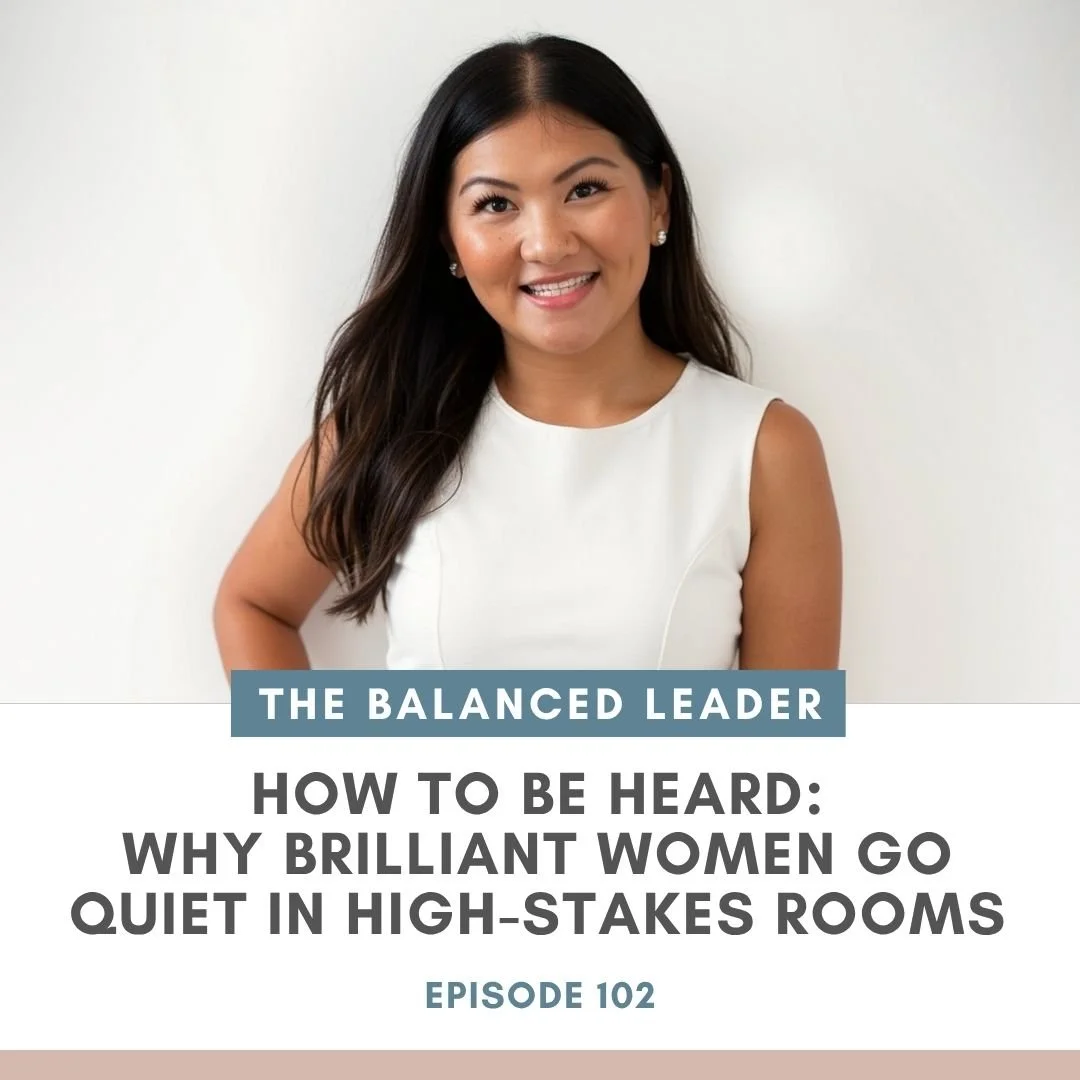
Being heard isn’t a confidence problem. It’s a calibration problem.
You can be completely confident in your expertise and still walk into one room and feel like you lose access to the woman you were five minutes earlier. You know what you think. You know what needs to happen. But when the stakes are higher and the power dynamics shift, you may find yourself explaining more, softening your position, or leaving the conversation wondering why you didn’t just say what you wanted to say.
In this episode, I share why brilliant women often struggle to be heard in high-stakes rooms, and why the issue is not a lack of confidence. Your capability doesn’t disappear when you’re surrounded by powerful people. Instead, the conditions change, the pressure increases, and you may lose connection to your own power. This is what I call a calibration gap.
I break down what happens to women under pressure, including the ways we protect ourselves through patterns like shrinking, pleasing, fixing, over-controlling, or managing other people’s perceptions. You’ll learn how to recognize these patterns, reconnect with your authority, and practice the awareness, discernment, and Command states that allow you to show up with grounded power and presence.
learn more about command here
What You’ll Learn from this Episode:
Why brilliant, high-achieving women can lose access to their power in high-stakes rooms, even when they are confident in their expertise.
Why being heard is not a confidence issue, but a calibration issue.
How pressure and power dynamics can change the way you show up, communicate, and make decisions.
The survival patterns that can keep you from being heard, including shrinking, pleasing, fixing, over-controlling, and managing other people’s perceptions.
How to recognize the masks you use to protect yourself and reconnect with your authority.
The difference between reacting from fear and choosing a more powerful response through awareness, discernment, and self-command.
How to practice the Command states that help you lead with grounded presence, clarity, and conviction.
Listen to the Full Episode:
Featured on the Show:
Interested in working with me? Book a free 1:1 consultation here!
If you haven’t already, please follow the podcast and leave a rating and review to let me know what you think. Find complete instructions here!
Send me an email: connect@aspire-coaching.co
Watch my TEDx talk: Reclaiming anger: A woman’s birthright
Get the free guide, The 5-Minute Reset to Own the Room, here!
Episodes Related to how to be heard:
59. Survival Masks in Women’s Leadership: What They Are & How to Break Free
98. Why High-Achieving Women Overexplain: From Convincing to Convicted
101. Assertive Authentic Communication: How to Say What You Mean Without Losing Connection
Full Episode Transcript:
Here's what I want you to know. This is not a confidence gap. It's a calibration gap. In this episode, I'm going to show you what changes when the stakes are high, why your authority can feel harder to access in certain rooms, and what you can begin practicing so that you stay connected to your power when it matters most. Because the goal isn't becoming louder, harder, or being someone else, or more polished. It's about being the same woman in the high stakes room that you already know how to be everywhere else. Let's dive in.
Welcome to The Balanced Leader, hosted by Yann Dang, a Leadership and Life Coach with over 20 years of corporate experience. Drawing from her journey as a former global finance leader and second-generation immigrant, Yann understands the unique challenges women face in male-dominated workplaces.
Each episode offers insights on balancing masculine and feminine energies, mastering soft skills and building emotional intelligence. Join us to transform frustration into empowerment and unlock your authentic leadership potential.
All right, hey podcast listeners, welcome to today's episode. We are gonna be talking about how to be heard in a room full of men. As you know, I've just done a masterclass on this, and I've been talking about this subject for quite a long time, because when women come to me, they're like, I wanna be heard, I wanna be heard in this room full of men. And that is a specific skill, and that is a specific learning. And what I've been doing over the last few years is helping women really understand what the problem is.
Most people, most people think it's a confidence issue. They're like, I don't know, I just lose confidence in this room. I am here to tell you, it is not a confidence gap. It's a calibration gap. Your capability didn't disappear. The conditions changed, the stakes were higher, the pressure was higher, the power dynamics shifted, and you lost connection to your power. So we're gonna talk exactly about this, and I'm going to give you some examples and also share with you what happens to most women under pressure.
And I also will share with you why I have created Command and why Command is like a leadership gym where you practice being able to connect to yourself, to your power, especially in the times of high stakes and high pressure. And why when you practice this over and over, it becomes embodied in you and it's more about your identity expansion and the way that you hold yourself powerfully in rooms full of powerful people.
And I'm going to break down all of those steps for you because I think a lot of times, people are solving for the wrong thing. And when you solve for the wrong thing, you waste a lot of energy and you waste a lot of time. You say you have a confidence issue, but actually it's much, much more sophisticated than that, especially for the women I coach. And if you're listening to this podcast, you are probably a highly accomplished, brilliant woman who knows a lot of stuff and doesn't have confidence issues overall, generally.
You just notice that in these rooms, something happens to your power, right? Maybe you go to overexplaining, softening, being more harsh or defensive than you wanna be. So I'm gonna break this down for you so that you can be very clear about what's happening to you, how to notice that, how to interrupt it, and how to create a practice for yourself and to do this deeper work in Command because I want you in my group actually doing this work. This is what we do in a unified field with a lot of women, you know, failing and learning and growing. That's what we do.
And the more you do this with people who are doing it with you, the more inspired you're gonna be, the more you're gonna normalize what this is and how hard it actually is, right? If we all could speak powerfully in a room full of men, people would not be coming to me, you know, asking me constantly, how do I be heard? How can I show up with more power and authority, right? That's why we have to build these muscles and we have to practice and we have to be around people who are also practicing it, right? We're athletes in this, we're warriors, figuring it out together.
All right, so let me tell you what happens, right? Because oftentimes, I'm with people who are like, I know how to lead, I know what to say, right? So first and foremost, this is what I always tell people, you already know how to lead. Today, what we're gonna talk about in a room full of men is what happens to your leadership when the conditions change, when the pressure is higher, and what happens to your desire to be heard, right?
Because it really starts with your desire to be heard. Before you can be heard, you have to know what you want to be heard for, what you believe, what you want to ask, what are you unwilling to abandon, right? Because there's a tension that always follows. We're in this room, we're feeling scared, we feel uncertain, we don't want to say the wrong thing, and then we end up focusing on other people's emotions, and we focus on our own emotions, and we actually don't lead. We don't say, actually, I know I care about these people's emotions, I care about my own emotions, but I also really care about this business outcome and I need to speak up about this thing that needs to happen.
Like we're, for example, a customer focused. company, we really need to listen to our clients and solve this problem with our clients, not in a silo by ourselves, right? There's a level of conviction and clarity and groundedness because I care so deeply about being heard and about helping our clients versus in my mind, judging myself, wondering if I'm going to say it the right way, wondering if people are going to push back on me doing all these calculations, right?
So oftentimes what happens, you know, and I've used this metaphor before, but I'm going to use it again. When you know how to drive your car, you feel really confident. You get in your car, you drive super fast, you cut the lanes, you kind of do all the things. You're like almost like not quite on autopilot, but you're very like in tune with yourself and you know how to handle your car and you know how to handle yourself. What happens when you're in a room full of men or a room full of senior leaders or people that are very, very powerful, what can happen is it's like me giving you keys to go drive this semi truck.
And then you go and you're like, oh my gosh, this semi-truck is super big. It's so powerful. I'm not sure if I can use it. You start doing all these calculations and you start wondering like, I don't know, and I'm not even sure if I know how to drive anymore. And so then you start feeling like, oh my God, I have a confidence issue, right? I think this is where people misdiagnose themselves. They're just like, oh, I have a confidence issue. I don't know how to drive.
I'm like, no, you know how to drive. You know how to do this. You're just in a bigger machinery and you have to calibrate yourself to this next level and you have to think about yourself as more powerful and you have to think about the ideas and what your skills are in a bigger and bolder way because your mind is going to want to push the brakes on itself and say, no, this is really scary. Let's not speak up. Let's not rock the boat. But you have to learn how to override those voices and how to bring calm and groundedness and safety to your body so that you do move forward.
And it's like talking to yourself, even in the semi truck of like, hey, I know how to turn it on. I know how to move forward. I know how to press the brakes if I need to. I actually know how to turn the corner. I just need to be a bit more mindful, but I'm not stopping myself. And what happens to a lot of women is they're constantly pushing the brakes on themselves because they're calculating and they're constantly feeling like they don't know how to instead of calibrating.
When we calibrate, we calibrate ourselves to this bigger, you know, piece of machinery or this bigger room and we say to ourselves, hey, there's a reason why I'm in this room. There's a reason why they asked me to be in this room. There are things that I need to say in the here and now that are going to be important to the leadership of this team. Not in my head, not trying to manage everybody's perception of me, not trying to, you know, compare and despair myself, but really focused on the problem at hand. And that takes mental clarity and it takes being really onto yourself and going to school on yourself.
What happens oftentimes is we get scared. We are flooded with fear. We're like, we've never been in this room before. A lot of people think, oh, I just need to be more confident, like that's how I'm going to override it, or I need to be more assertive or speak louder, or all these sort of like surface level tactical fixes that you see online, which I don't teach, right? I teach you real embodiment, identity expansion, calibration, so that you feel not just powerful, like you're performing power, but that you are powerful in yourself, right? That you're learning to close this calibration gap. You know you're confident and you're just creating a bigger context for yourself.
You're like, I am able to do this. I am able to drive this car. I know how to do this. It's a different self-talk and you have to be onto yourself because when the fear is there, when fear is in the car with you and it wants to drive, it's gonna tell you, stop, don't do anything. It's scary, don't move forward, right? And when things feel scary, we have these protective strategies that come in. And we'll link this in the show notes because I've talked about these survival masks before, but I wanted to share it in this context, right?
In this room full of men. What typically happens, and this has happened to me too, you either show up too passive where you're protecting yourself and you're being small, or you're too active in terms of being too aggressive and defensive. Both have you posturing in some way that's not grounded in your authority, being open and present. It has you protecting yourself in some way. So the passive mask, and this is where I used to find myself too, is like the ghost. You start hiding and shrinking away and being like, oh my God, the pressure is high. People are yelling at each other. I just don't want to even engage in this conflict or conversation.
Or you become the good girl and you're like, oh, I know how to help this people to be calmer and to be the peacekeeper. And you jump in with like good girl energy and you're like, let's do this to fix it. But it's not really strong leadership. It's you trying to appease authority. Or you're the lone wolf where you're like, oh my gosh, these people don't know what they're doing. And I don't want to speak up because people are going to think that I'm stupid or they're going to think that I don't belong here. And so... I'm just gonna withdraw. I'm gonna be like the lone wolf in the corner, withdrawing my energy.
All right, those are the passive ways that we protect ourselves. And it's good to know because the more you can go to school on yourself and be like, oh my gosh, I'm showing up with good girl energy, what's going on? How do I get myself back online so that I can actually be heard, right? Because you can't really be heard when you're playing these roles. Or you can't be heard in the way that you want to in that impactful authority figure way. Now the active math. This is about overcompensating, controlling or intimidating, right?
So a big thing most women do is they go to fix it. They step in, over-function, rescue people and they're like, oh, there's a problem at hand. Let me go fix it. They go and do stuff. And it gives them like a dopamine hit because they're like good at fixing things. But guess what? It also doesn't help people see you as a leader, as a strategic thinker. They're more like, oh, she's the reliable one. She fixes messes. That's what she does. And it's very career limiting.
The other thing people do is the ball buster. I used to do this as a finance leader, right? I dominate, force over presence. There's no connection. It's like, hey, we gotta get this done. Let's do it right now. It's a very activated mask, but it's also not in relationship or rapport with other people. And then of course, there's the ice queen. I will control my emotions. People are out of control. Let me just freeze connection and move through things and be very logical and use facts and data instead of actually being present and more emotionally open to what's going on, right?
So these are more of those active survival masks that have us protecting ourselves with force. So it can look confident, but really underneath it, it's also a protective mechanism to keep people away. And so we wanna know these because these are all strategies that work to a certain extent, right? For example, I was really, really great at ball busting. I was really good at like holding people accountable, but guess what? didn't build a lot of trust and rapport with my peers. They didn't feel like they could trust me because I was using my title, my force, my power to get things done versus being in a rapport, actually being more open to them, leading with more of my sort of connection energy, right? Being heard with them and being in relationship with them.
So those are how it can be limiting. And what I want you to know is that I truly believe women are innately powerful. You are powerful and your power isn't missing, but it's allocated, right? It's fully allocated when you are proving, pleasing, perfecting, preparing, fixing, managing perception, anticipating reactions, doing all of these calculations on how to be safe before you speak up or have certainty before you speak up. So your power goes to positioning yourself versus your power going to leading and actually saying what's so and letting it be messy and learning how to take imperfect action.
So that's where people's power goes. They end up feeling like either they're in their own head judging themselves or they're judging the people around them and they're not actually leading. So it's super important to go to school on yourself. This is one of the biggest things that I teach in my command cohort, going to school on yourself, learning about yourself, learning about the patterns that are keeping you from being powerful, from being heard, right? And being able to name it because you can't change what you don't name. So you need to be able to name it. Like, oh, yeah, and you're acting like a good girl again. What is going on? Why are you scared to say the truth? Why are you scared to lean into what you really believe?
But we cannot say that. We cannot name that if we're not conscious, if we're not aware of ourselves. So it does start with awareness, and it starts with us having that connection to ourselves. That is why Command is about commanding yourself first and foremost. When you can command yourself, When you understand your emotions, not control your emotions, but understand your emotions and understand the thought processes that you're having, this is where you can pause and this is where you can choose responsibly how you want to show up in that moment. You don't just react.
I've had powerful women in my Command cohort who've literally been like, oh, I was super triggered by this person. They were like literally attacking me in front of everyone. And instead of allowing that to happen, I jumped in, I didn't defend myself, but I moved everybody towards a common goal. And it was powerful. It was like, you know, not engaging in things that, you know, take away from my power, but using my power towards getting things moving and getting satisfied. That is a power move. That is a Command move. You need to be onto yourself and have a bigger perspective to be able to do that type of stuff.
So when this happens, what I want you to focus on when I tell people to go to school on themselves number one notice. What is going on with me? What am I feeling? What mask am I wearing? When you notice yourself either shrinking or getting really, it's either you're getting really passive or you're getting really aggressive and you're not feeling in command of yourself. This is where you want to ask yourself, what survival mask is coming up. Then you wanna pause. You wanna check in with yourself. You wanna reality check too. Like what is your mind seeing? What is the story seeing right now? And if there's a trusted person by you, maybe asking them as well.
And then thirdly, you want to discern. What does this moment actually require? Should I be defensive? Should I be reactive? Oh, actually that's not gonna create what I actually want. What would it look like if I showed up as a powerful woman in this moment? How would I move things forward in the direction that is powerful and purposeful for me. That is discernment, that is zooming out and being able to see a bigger picture and not just reacting to the emotions that your mind and body are having because of what's going on around you.
And then number four is choosing a Command state. This is a conscious state, this is being in command of yourself. And the Command states that I teach within my cohort and what we work on is number one, the grounded leader, being rooted, being present enough, being open, right? The truth teller, speaking with clarity, honesty, that carries weight. That's so powerful to just say what's so. I know a lot of people kind of like want it to be polished or whatever, but just saying the truth and saying, hey, I don't agree with that, or hey, I'm really concerned with that. Let's take a pause.
Or the connector. This is where a lot of women end up leading, but I want you to know the connector doesn't just connect people. You connect to yourself first and you listen to yourself and you use that knowledge and that wisdom to connect other people through authentic engagement, right? This one's one that women more naturally fall into.
And then of course, there's the vision holder. You lift the room up with possibility and purpose. You move with vision. You get people on board with your vision. Hey, what are we doing here? How do we move this forward?
And then lastly, the authority. You set the standard. You lead with conviction. Your presence commands respect. These are all ways that you can work on the Command states. So when you notice the mask and you slow yourself down and you see the bigger perspective, then you can consciously decide, if I were to move with a Command state, which one would those be?
So those are the steps and it takes consciousness and awareness to practice the steps and to lean into them and to actually embody them and to feel powerful because you are in command of yourself first and foremost. And that's where it all starts. If you can have this power and this leadership inside of yourself, you're going to lead with that conviction outside.
And that's where you command the room. That's where people feel your energy and your frequency. That's where your words land. Whether you're interrupting the conversation, whether you are just taking up more grounded space in the conversation, that's how you use this methodology in order to be heard. You have a lot of powerful knowledge within yourself. you just need to get out of your own way, right? And we gotta get out of our own way by noticing what are those masks that we put on when we're trying to protect ourselves.
And we lose access to the prefrontal cortex where we're really thinking powerfully about what's going on in the room. And we're really solving problems at that level, not just in our minds, trying to posture ourselves or manage other people's emotions. So that is the work. And I just want you to know that this work is totally doable. I break it down step by step. And it is such an important skill to learn how to be heard in rooms full of men, to be heard with powerful people, to be heard with senior level people.
This is how you accelerate your career. This is how your leadership gets seen. This is how people are like, wow, she's like so impressive in person, just like she is on paper. There's alignment, there's coherency. There is you showing up as the most powerful version of you. But it takes practice. It takes you exercising these muscles and it takes your dedication to do this. So that's what we do in Command. I wanted to share this episode with you.
I feel very strongly that two things, it's not a confidence gap, it's a calibration gap. And you can learn how to calibrate yourself to more powerful places, to more powerful machinery. And then secondly, you are powerful. You've just been using your power to please people, to not shake the boat, to manage people's perceptions of you. I want you to use your power powerfully to move towards an outcome that you care about that's for the business, not just in your head judging yourself or judging the people around you.
Okay, that is today's episode. I hope you get a ton out of this and that you are able to really look at yourself and think about command and how you wanna be commanding yourself. And take a look at the website to see what it's like to do this deeper level work, to actually be in a cohort of women that are working on their command and the foundations of it, which is self-trust, really learning how to go to school on yourself with that self-awareness, learning how to discern. these pieces is what leads to being heard in a room full of men, having authentic leadership, and also being able to have an executive presence that people are in awe of. This is the practice. So, I'd love to have you join me inside, but until then, have a beautiful week, and I will see you all soon. Bye!
Thank you for being a part of The Balanced Leader community. We hope you found today's episode inspiring and actionable. For more resources and to connect with Yann, visit us at aspire-coaching.co. Until next time, keep leading with confidence and purpose.
Enjoy the Show?
Don’t miss an episode, follow the podcast on Apple Podcasts, Spotify, YouTube Music, RSS, or wherever you listen to podcasts!