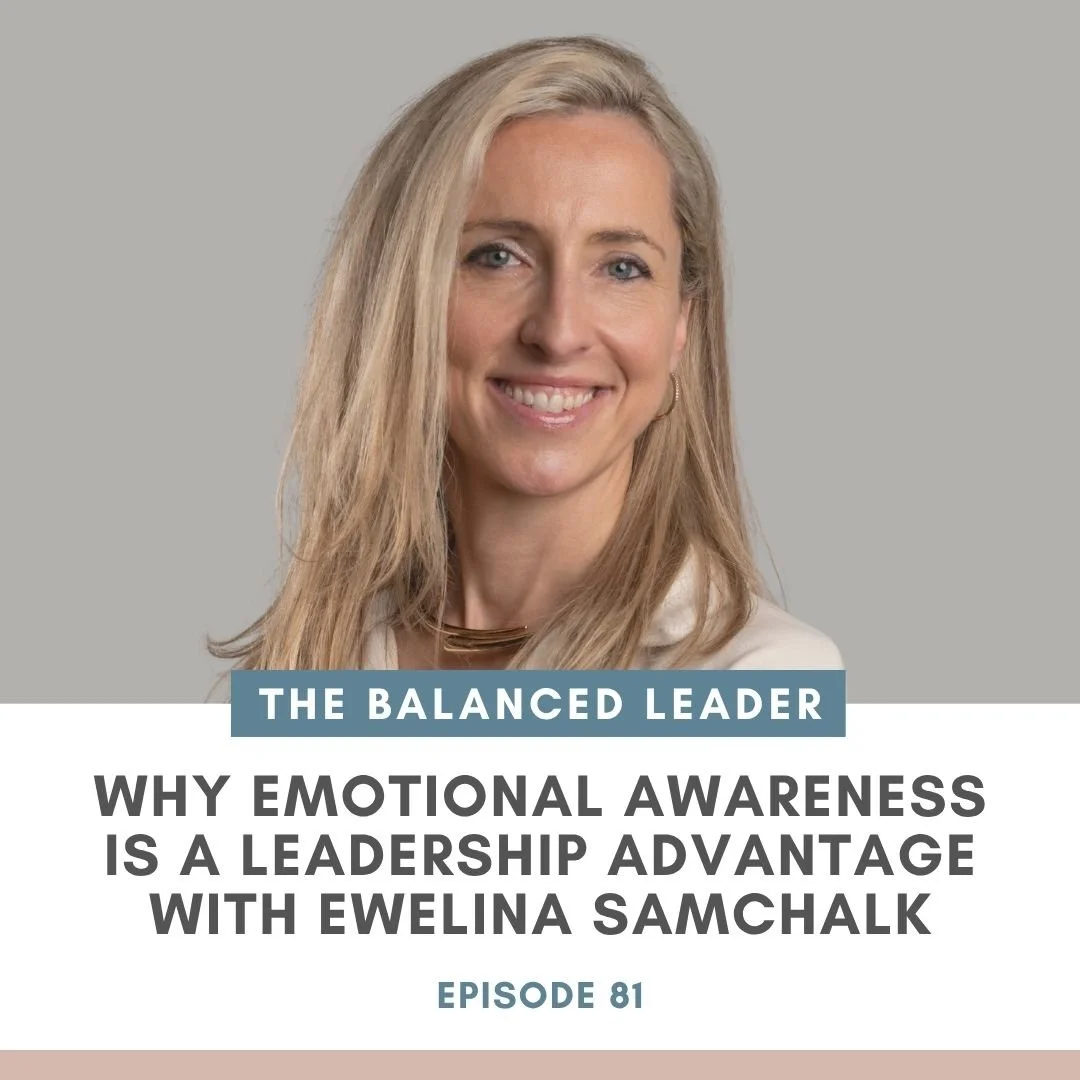
81. Why Emotional Awareness Is a Leadership Advantage with Ewelina Samchalk
When you are used to moving fast, slowing down can feel like losing power. For many high-achieving women, the ability to push through, deliver, and keep going has been the very thing that created success. But there comes a point in leadership where drive alone is not enough. The next level requires emotional awareness, not as a softer skill, but as a deeper form of command.
In this episode, I’m joined by Ewelina Samchalk, VP of Business and People Operations at Pernod Ricard, for a powerful conversation about emotional awareness, leadership identity, and the shift from survival mode to command energy. Through our work together, Ewelina began to see how naming emotions, pausing before reacting, and separating self-worth from external validation changed not only her leadership, but also her relationships at home and at work.
Together, we explore why emotional intelligence is not about becoming less ambitious or less effective. It is about becoming more conscious, more relational, and more grounded in how you use your power. This conversation will show you how emotional awareness strengthens executive presence, how slowing down can create greater leadership authority, and why commanding yourself first is essential if you want to lead others with clarity, maturity, and impact.
Interested in working with me? Book a free 1:1 consultation here!
What You’ll Learn from this Episode:
Why emotional awareness is a leadership advantage, not a liability.
How survival mode can create intensity that affects your leadership style.
Why high-achieving women often link self-worth to external validation.
How pausing before reacting can turn strong emotions into constructive communication.
Why emotional awareness strengthens both professional and personal relationships.
How slowing down supports stronger executive presence and command energy.
What it means to command yourself before leading others.
Listen to the Full Episode:
Featured on the Show:
If you haven’t already, please follow the podcast and leave a rating and review to let me know what you think. Find complete instructions here!
Watch my TEDx talk: Reclaiming anger: A woman’s birthright
Get the free guide, The 5-Minute Reset to Own the Room, here!
Episodes Related to emotional awareness in leadership:
61. Real-Time Coaching for Women Leaders: Mastering Thoughts, Emotions, and Actions
73. How High-Achieving Women Leaders Move From Survival Mode to Command Energy
Full Episode Transcript:
Welcome to The Balanced Leader, hosted by Yann Dang, a Leadership and Life Coach with over 20 years of corporate experience. Drawing from her journey as a former global finance leader and second-generation immigrant, Yann understands the unique challenges women face in male-dominated workplaces.
Each episode offers insights on balancing masculine and feminine energies, mastering soft skills and building emotional intelligence. Join us to transform frustration into empowerment and unlock your authentic leadership potential.
Yann Dang: Hey podcast listeners, welcome to today's episode. I have a special guest that I've gotten the opportunity to work with one-on-one as well as in my Command group coaching for high-achieving women. So I have Ewelina here, and she has been on a journey with her emotions, which all my clients are, but I'm welcoming her on the show so you can hear her unique perspective and experience. So, welcome to the show, Ewelina. Please introduce yourself.
Ewelina Samchalk: Hi, and thank you for having me. Yes, I'm Ewelina Samchalk, and I work for Pernod Ricard as a VP of Business and People Operations right now.
Yann Dang: Great. Let's start with a little bit, if you don't mind sharing about your upbringing, because oftentimes, and actually the first time we met, I think I just dived in and asked you, tell me more about like how you grew up so that we can get an understanding of how it might be impacting your leadership, both in a lot of positive ways and then also potentially limiting ways.
Ewelina Samchalk: Well, how I grew up, I grew up in a communism Poland back in the '80s back then, so emotions wasn't necessarily a topic that we would talk about openly. And my dad has visited us recently and actually confirmed the same, that was the case. So the focus at that time was more about, you know, being strong and responsible and moving forward. So you worked hard and you delivered and you didn't necessarily dwell too much on how you felt at that time.
So in many ways, it gave me like an incredible strength that I learned at that time, with the resilience, the discipline, the perseverance. But it also meant that emotions were not something I thought about. I just mostly pushed through them rather than explore them at that time.
And then years later, when I was already a grown up, my mom came to visit us many times at that time, and she used to say something, when she was watching me throughout my professional career, she would say, "Hey, I want you to slow down. I want you to be a little bit more present with me, spend more time with us." And I didn't necessarily understand what she meant at that time. To me, slowing down felt like losing momentum and not necessarily doing enough as well. So that is how I equated slow down at that time of my life.
So only later throughout our discussions that we had, that did I understand a little bit more so as to what it meant. You know, she was not necessarily talking about the productivity part of it, but what she meant was noticing what's happening inside of you. And that realization came to me through our coaching and through life experiences. So now when I finally, and then it clicked, you know, just a few months ago, that clicked to me. And it actually made me very sad and emotional because she passed away. So my first thought, I remember thinking when it clicked was, "Hey, she would have loved seeing me now. She would have loved seeing the journey. She would have loved seeing who I've become." But it took me years to get to that point, you know, our discussions and coaching and all of that. So anyway.
Yann Dang: And it's tricky one though. I'm actually so touched though. I'm like tearing up here just thinking about how your relationship with her and also how proud she would be for you to actually take on this work, right? I think it's so tricky, especially for people who have been very accomplished and very successful in the way that they've done things. And I think what you're describing is that you were also the oldest, right? You were the oldest child.
So there's extra responsibility there. And it's in a time of chaos where there's much more pressure. And I think, I have some similarities. I wasn't the oldest, but my family, you know, refugees from the Vietnam War, there was just a lot of pressure to figure it out. Like whatever you're going to do, you're going to figure it out and you're going to push yourself forward. And there isn't a lot of time for that emotional reflection. And that drive actually, in some ways, right, probably helped drive us very quickly to accelerate. In some ways, you know, the youth today, you want them to have more of the drive, more of that, you know, pressure in that way, but not in the way that it has you losing yourself in it, right? Or losing your connection to your emotions or the presence of being.
Ewelina Samchalk: Yeah, listen, I don't think emotions was even a topic. It wasn't even on agenda, let alone exploring that theme or connecting with yourself. It sounds like we had similar, very similar experiences. So yeah, I mean, I doubt that for people like ourselves that was even a theme or topic.
Yann Dang: Yeah. And then on the positive side, it's like it actually has us accelerating and we're not so stuck in the emotions or indulging in maybe victimhood emotions, if you were like getting stuck and feeling sad and, you know, so but then it's like the opposite where you're just like, well, we're just going to get stuff done, right? And there is a mastery of having that balance of both connecting to your emotions, not overly indulging them or allowing them to take on too much to have you get stuck, right, in the emotions swirling in it. Because sometimes your emotions have stories, which we'll get into too, right? And, you know, there's a difference between the emotion itself and the story it tells you.
And if you've listened to some of my podcasts in the past, I have, like with sadness, victimhood would come up a lot. And I've had to do a lot of work to separate that I can be sad and I'm not a victim. But sometimes it's all mushed together and we don't see that. But if people grew up kind of the way that we did, right, you're not even focused on that, just get stuff done and move forward.
But tell me more about how has it been for you? And I thought you were so brave to walk into, you know, this one-on-one conversation with us, even in our coaching, right? And I'm telling you about emotions. And a lot of people are just really scared about facing their emotions. They're really scared about operating at a different level. And what I saw in you was the willingness, right? I think there was still like, "Okay, I'm not really sure what this is going to be like," but you were willing to step into that to learn. Can you tell me more about that for yourself at that, you know, when we first started working together?
Ewelina Samchalk: Yeah, I think at that moment, listen, I've heard enough feedback about my style. I got a lot done, but I was also intense. But it was hard for anyone to pinpoint exactly as to what it was and what was driving it and what was driving me and what was the style of my leadership style that I was betraying at that time. And upon hearing enough of that and nobody really being able to pinpoint it as to what it was, I finally opened up and said, okay, well, now I'm ready to have a conversation and go through the journey.
So that's what I think that's the willingness that you were experiencing. And I can tell you, I think it the open-mindedness to our conversations really helped me navigate through myself and through our conversations and observing others, you know, to like just seeing them through a different lens and seeing myself through a different lens as well, because I was able to then start separating the professional career type of a drive with my own emotions. And listen, if we up until that time, I don't think I was necessarily separating that.
So in a way, they were intertwined and they were colliding probably at times, and they were driving certain discussions and certain actions and reactions at the time that were not necessarily maybe welcomed in some conversations. You know, so having that realization and that aha moment kind of a thing throughout our journey, I think finally started clicking with me as well and started shaping me more as a leader now. I'm still on a journey.
Yann Dang: I'm still on the journey too. We're on the journey.
Ewelina Samchalk: It will absolutely never end to that. But I think just the acknowledgment and awareness to begin with is what started helping me seeing through what's needed to happen. And I just again, wished it happened sooner.
Yann Dang: Yeah, but there's no time like the present. So it's better than never. And so tell me more about like when you were getting feedback on your intensity and, you know, you were sort of not that in touch with your emotions. How would that feel in your body? Do you remember like a different reaction? Because I know when we've worked together too, you're like, "Oh, I like changed my body movement. I was being more open." So it's like you were almost more intentionally aware of like the bodily sensations that are happening.
Ewelina Samchalk: Yeah, and I think I think it started for me with the awareness. I think us talking about it at first and you challenge of me to start naming the emotions, you know, and pausing. I think just being intentional about it, started creating an awareness. Sometimes that awareness wouldn't come at first necessarily in a moment, but afterwards or before even a conversation.
So I think it comes in through different phases of where how we're going through that. But I think for me, then that relationship with the emotions started, it started with the awareness. It started with the awareness with our conversations of, hey, just be aware about it at first, which was a foreign concept to me to begin with. I didn't necessarily connect with that at first. It was a challenge. But when challenged with that and really being held accountable to start talking about it, I started noticing what's happening with me in the settings, in the conversations, and I started paying attention not only to what I was saying, but also more so to my body language, which I think was a little bit louder at times than my verbal communication. It seemed.
So yeah, I started paying a little bit more, I started relaxing a little bit more, placing my hands on the chairs or sitting in a more relaxed pose maybe that I didn't necessarily again pay attention to. In my mind, I would have probably done it and have I paid attention to it, but I wasn't. So my body was very in tune with my verbal communication back then. Now I'm trying to also decouple both and kind of not just control one or another, but just be aware of one or another if I can.
Yann Dang: Yeah, a heightened level of awareness. Well, tell me more about when you started, you know, naming and being aware of your emotions. Were there certain emotions that came to you more than others? You know, what did you notice in that?
Ewelina Samchalk: Yeah, I think at one point of my career I was more in a survival type of a mode. So there's what the emotions that came with that, that I wasn't necessarily again, in tune with because I was before we started our coaching. But reflecting on that, I think there was a lot of truth to that. And then as we're going through the emotions exercise, I started calling them out. You know, I think you have a spectrum of certain emotions that you were challenging us with. And I had a actually harder time with some of them because they were more shades to it at times.
But yeah, I mean, there were emotions, if I was to name them, they were depending on the situations that were coming up as either being sad or disappointed or jealous even or there were moments of happiness as well. So I felt happy, I felt fulfilled, I felt satisfied. And I think over time, so there was a mix of different emotions at first, but I think the longer we've been on the journey, the longer we've been discussing it, the more I've been in tune with myself, I think the I started noticing the more positive feelings coming up a little bit more frequently, a little bit more frequently over time.
So it started at first with this realization that, hey, I'm not perfect, I'm not great. I was pretty judgmental of myself and I wasn't necessarily giving myself much of a grace towards anything because again, I was so hardwired about just doing versus being and maybe doing. I think I was just feeling disappointed with myself that some of the emotions again were intertwined with my doing and they were driving me.
But once I realized that again, the mix of maybe more negative emotions at first when we started kind of started evolving towards more positivity, just because I think sometimes I'm now like a little bit more intentional about how I approach every day. So I wake up and I tell myself it'll be a great day. A great day. And I'm trying to project that energy, you know, throughout the day, throughout everything that I do and some positive intent and that in itself, I think helps me be a better version of myself.
Yann Dang: Yeah, I love that. Because I do think, you know, one of the things that we talked about when we started working together is like the deadlines, right? And then there's like the wanting to hit the deadlines. But there's sometimes the fear underneath it, right? Making sure that things are getting done at a certain level and, you know, holding it at a certain intensity. So it's like that, you know, getting the thing done, but then it's also the relationship with yourself and other people.
Ewelina Samchalk: And that relationship as well varies by business, by company, because all of them have different cultures and different expectations, the kind of legacy setups as well as to what the expectations are. You know, some of them are more apparent than others. But you learn over time, you know, I think where I came from initially had a different level of intensity and urgency than, you know, where I would be now, for example. You know, again, it's the same maybe a variation of it, but expressed in a different way, you know, it's a different set of values that are being shaped by the company as well that you that we would like to that you know, the culture to be as.
So it all varies, I think, again, I think the point I'm trying to make is it all varies by organization, it all varies by the culture that they are driving, that they have in them as well. So our ability to adapt to that, I think is what sometimes clashes with us, right? Because you move sometimes from business to business every few years and you assume that you can, you know, whatever you've been doing work before and should work going forward, but it's not necessarily the case unless you have that ability to kind of adapt, be more agile, see through what's working, what's not, and be more in tune with yourself as well.
Yann Dang: Yeah. And I think like those different cultures, right, they expose different things in us, maybe a skill gap, maybe a different level of looking at things, a different level of awareness. And I also think that happens too at different levels of seniority, right? I think very in your junior career, a lot of times it's just get the work done. You want to make sure authority understands that you know what's how to do the task. And then you become so good at that. And then at a certain level, you're like, "Oh, wait, I have to play nice with other people and influence people and actually challenge people too and have more direct and honest conversations."
And I think that's what I've seen in you, Ewelina, being able to have more direct conversations, but with your emotions too, where you're, you know, the things that you've shared with me and how you talk to people, it's not just like about the work, it's about the relationship. And that's been, I've thought a big growth in you of, you know, even bringing your own emotions to it.
Ewelina Samchalk: Yeah. And listen, I think we're thank you and I think what the disconnect for me was is like in my head before then, I did do the work to the standards that I'm used to, so or that I'm kind of was driving myself towards to. So the difference was, again, I did care about the relationships, I did care about the work, and I still do, of course, but now I'm paying a little bit more attention to some of the words that I'm using or the intentionality of how we are engaging with each other.
Because again, even though I did care about the relationships before, I think my drive for doing versus being was so much stronger that it was overshadowing maybe my intent to also create those relationships and partnerships. So that sometimes was then perceived as, "Hey, she's not authentic, she's not herself. She has her own agenda, she's driving is everything about herself," kind of a thing.
Yann Dang: Yeah, what they were making like the work because I think you're so and I think that's something we've worked with too. You're so identified with your work. So it's like that work is me. And it's like, we need to get this done. It's like for me. So there's like this intensity around it. So what I'm hearing you say is like you always had an intention to care about the relationship as much as the actual deliverable or thing to be done. But what I'm hearing is that you've through this work, you've become more emotionally attuned to yourself and, you know, when we're more emotionally attuned to ourselves, we can actually be more attuned to other people and their emotions. And so the way that you're approaching conversations is much more relational versus sometimes it could feel more transactional when it's about the thing to get done, right?
Ewelina Samchalk: Exactly. Even though I didn't necessarily always have that transactional in my mind, I was associated with the transaction and just the work to be done because I was so work driven. I'm still work driven. Don't get me wrong, but in a different way. Yes.
Yann Dang: Kind of like our parents weren't sitting around saying, "I love you so much. I'm going to take care of you." They were more like, "Get to work because we love you so much and we're all just trying to survive," right? Like there's just that like everybody knows like, of course they love us because you're, you know, we're all trying to survive here, but that's like the undertone, right? Because we're all feeling that pressure.
But, you know, when there's less scarcity and there's more space and I do think it's a luxury to get coaching and to have this work and to be focused on this stuff, which, you know, is so powerful. But I think, you know, especially in our modern day and our very masculine society, right, people are more focused on buying material things than working on their emotions and, you know, their relationships, the quality of their relationships.
Ewelina Samchalk: Yep, absolutely.
Yann Dang: Yeah. So you've talked a bit about work and how it's been impacting your work. Tell us more about how it's been impacting your home life and your relationship with yourself. Because I know you've done stuff with your family too, your extended family that you were sharing about. So I'd just love for you to talk more about that and what drove some of that activity.
Ewelina Samchalk: Yeah, I think I so I started thank you to my current side. She has embarked me on the journey also of creating a vision board. So now I have a annual vision board and it helps me stay guided throughout the year. You know, I have this set of principles that I would like to my doing around also on a personal level to your point. So, yes, that helped me, that helped me put some goals for the year and work towards them. And one of them was, yes, to repair relationship with my, with my brother family, my immediate family. And I am now making deliberate and intentional efforts to make that happen. And I can tell you I do see the results of that already, which is very encouraging.
But again, that came through the drive, the emotions, the coaching, the guidance from my current manager as well, who's very supportive of that work as well and believes in that. So I want to give her kudos for that because it matters and it's important to have that professional support for your personal drive as well. You know, that coaching that we are going through you and I as well is also being supported and it was very suggested to me and recommended which was a fantastic opportunity. And it helped me, it certainly helped me with my immediate family in Europe as well as my family here in the US with my children who are noticing the differences who we are openly talking about them. You know, they poke jokes around it sometimes and because they are still, you know, a little young.
Yann Dang: What are they saying? I'm just so curious. What are they noticing about mom like, you know, shifting?
Ewelina Samchalk: Yeah, I mean, they see me trying to make efforts to spend time with them, being a little bit more intentional and I'm pointing that to them as well, just in case they haven't noticed. Just in case it's not noticeable. I'm making sure that I call them out as well on that, saying like, listen, look, I'm here now with you. I'm putting my phone away. We're going to spend a quality time together. They are asking for that as well now. So it's going to help them going forward. So, yes, they're getting that leg up on that already in life by me myself sharing that with them as to like what's, you know, how to be more in tune with their emotions and how to spend more quality time with each other, how to be a little bit more playful.
You know, again, that too was a new concept for me. And yeah, and just being together, being a little bit more present with them and making sure that we do have that quality of time together. We have now dinners together. We try to have it now every night. You know, it doesn't happen every night, but the intention is to have it every night for us to talk openly, talk about our days and what's ahead of us and how we're all doing. It's a thing now in the family.
Yann Dang: Well, it seems like something your mom wanted for you. So it's great that you can--
Ewelina Samchalk: Yes, she's probably smiling at me now. But I just wish she had experienced it, you know, in person.
Yann Dang: Well, and here's the thing that they get to experience it through you. You know, your kids get to experience it and your siblings, you know, and your father, right, get to experience this piece of you.
Ewelina Samchalk: Yeah. And my husband too is a beneficiary of that, I must say.
Yann Dang: Oh, yeah. What is his feedback? What is he sharing with you?
Ewelina Samchalk: The elements of that he's like you really that he sees as positive and some of them he likes to tease me about. He would say, "Hey, is this on your plans for the year? Or is this on your vision board? Or is this in your emotional notebook?" you know, that sometimes I go off the lines or off the script and--
Yann Dang: Are they, is this an assignment you're doing? What are you doing? Why are you acting so weird?
Ewelina Samchalk: Exactly. Why are we talking about emotions like all of a sudden that's a theme in this family?
Yann Dang: Well, you're changing the culture, right? You're bringing it up and you're sharing it. And we could talk more about it, but I know like in the last Command session, you also talked about soccer and how you had some strong emotions come up and also at work and or you had other strong emotions come up. Do you want to share a bit about those like kind of that I don't know, I've been seeing you, I think sometimes people want to do this work and they're like, "Oh, I'm going to feel these emotions." Like I always share with people like I've been doing emotional work since 2015, you know, and it's like I'm still doing it. And I'm still learning about it and I'm still learning about myself.
And, you know, I think I have some women that are very new to Command and then there's some people that have worked with me one on one, but in Command, we do those assignments, right? And people just are starting to notice, you know, after even working one-on-one that like, hey, the more I flood my life with this, the more things, the heightened awareness, the more intentionality, and the more every time I hear something, I hear it a little bit differently. So I'd love for you to just share like, I just feel like you've been on a trajectory the last few weeks or even few months of like really hitting next level awareness.
Ewelina Samchalk: Yes. So I think one of our assignments was to pause, right, to create a pause and not do anything, just pause. So that came to me during to a point, it was a soccer game, spent six, seven hours with my daughter, you know, driving to a location, prepping for the game, attending the game, driving back from the game, six, seven hours of commitment just for the day. Again, they train very intensely. They have trainings four times, four, five times a week, you know, 90 minutes each, at least. And that's all in addition to all your technical trainings and all other things. You know, so you go to those games then, you spend seven hours, of which again, four or five are just in the logistics and driving, and then you end up watching your daughter play for eight minutes.
Yann Dang: What feelings do you have?
Ewelina Samchalk: I'm feeling to have. It's really hard to reconcile, you know, that commitment and that investment and your drive for your daughter and to keep her be motivated and keep going with that time of a of a type of a result, you know.
So anyway, I think in the past, I would have been much more reactive to it. And don't get me wrong, I had really strong reactions in myself, but I recognized them and I did my very best to sit with them at first.
Yann Dang: So what was it? Disappointment, anger, frustration? Like can we name some of them?
Ewelina Samchalk: Yes, it was actually anger at first. Anger, disappointment, frustration, and sadness, because I know how hard she worked as well, you know, and seeing that type of a behavior from the coaches at that time, you know, the age of 14 already and how competitive it gets at, you know, starting already at that age, actually, in fact, it starts much earlier than that, but where we're talking about the age of 14 in this particular example, it's just created so many emotions in me, you know, and I think where I challenged myself was just to pause and not do anything and then maybe sleep over it at first. And kind of reframing my approach and the next day by trying to eloquently create a text that would pose that my concern or my emotions through a clarifying question in relation to their position as opposed to attacking or being controversial.
Yann Dang: Yeah. So it sounds like you were still using your emotions, but trying to channel them through like an effective communication style.
Ewelina Samchalk: Yes, with the hope that things are going to be better.
Yann Dang: And it's not an easy skill, right? Like part of it's just like, "Oh, I'll just go and do, you know, just say what I'm going to say and be like reactive."
Ewelina Samchalk: Yes. So that was one example, exactly. So that post hit me hard. I mean, it helped me because again, it helped me forcing myself to do that at first, recognizing those emotions, naming them, and then maybe kind of creating something more constructive versus disruptive.
Yann Dang: Well, I like that, right? Constructive versus disruptive, right? Like this is what you're focused on. With the same emotions, but with that pause just creates more clarity of how you want to communicate.
Ewelina Samchalk: Exactly. And then the other task you gave us to the coaching, you know, was also to tell ourselves a simple sentence in a moment, whatever moment that would have been, that said, "Hey, I'm valuable. I'm valuable."
And I remember it was Thursday or so and towards the end of the week, and I knew we had to talk about those emotions on Sunday or express like who, what did you do with it? How did you deploy it or not deploy it? Like what happened? And I remember being on a train to work thinking, "Oh, I actually didn't have a chance to even do that yet because nothing really came up so far, thankfully, maybe that would have baked, have triggered that sentence of telling myself I'm valuable." Now, that happened until I did have my one-on-one with my manager that day, later that day, towards the end of the day, and she shared with me that one of my male peers was selected for the very prestigious leadership program that I always wanted to go for years. And I just remember hearing the news and feeling like an overwhelming wave of emotion that surprised me that I didn't necessarily feel before. You know, I would have plowed through that maybe in a past.
Yann Dang: Yeah. Well, but you've been working hard to feel your emotions, right? Both positive and negative, right? So that comes up. It's like sometimes it's like, you know, I share with people, it's like, oh, that's a well-earned emotion because you might have not in the years past, right? Not even have that allowance of it to come up.
Ewelina Samchalk: Yeah, but it surprised me. I think it surprised me and surprised my manager equally so because she didn't see me reacting that way. Again, just being sad, I just felt sad. You know, I know he deserves it. He's a fantastic person and all of that. There's nothing taking away from that. I just felt that a wave of sadness and a wave of maybe disappointment and a wave of feeling like, "Hey, where do I fit here? How am I being viewed? You know, what is this?" Just a mix of all different things that came through my head at that time. And I remember seeing sitting on the train with my eyes filled with tears. I must say that came up too because I was still processing those emotions. But it triggered something deeper about recognition and the worth as well.
So during the coaching, when you said, "Hey, tell our yourself a simple sentence, valuable," I remember sitting on a train, working through my tears and actually feeling uncomfortable saying it. That was probably the moment to say it to myself, but I did feel uncomfortable saying it to myself because I didn't feel it. I think the negative emotions were overpowering maybe what I wanted, you know, to be a little bit more of a positivity. So I forced myself say that to myself, you know. But then I also then realized, so I did say that and I said multiple times and yes, it did help me calm down a little bit and get the emotions under control.
But that was tied also what I recognized was tied to the sense of self-worth and that being, you know, too closely linked maybe to that external validation. You know, so that experience actually was also an eye opening for me and became like a turning point to also decouple that external validation from my self-worth. Because I know we also did talk about it at one point, you know, the need for constant external validation of saying, "Hey, good job," or we're recognized for this or for that and, and you get that in your younger career, that comes up quite a bit, but the older you get and the more mature you get, the less of that you're getting that. And that, you know, that also comes in with in form of the leadership program or training or this or that.
And again, I think it just mixes all everything together up, which is why that realization that maybe sometimes we can decouple that external validation from our self-worth, that recognition in itself also helps because you're a little bit more at peace with yourself, at peace with what you're bringing to the table, at peace with your own emotions, and at peace with where you want to go.
Yann Dang: So, you know, as I was teaching that assignment like, "I am valuable," and I would always say like, "period, no justification needed," right? Because intrinsically, like kids are born and people are like this baby is valuable, right? But then through life, we're like, "Oh no, we have to get these degrees. We have to get this job, we have to have the status." And then we're like valuable. But in this case, you know, I think you brought it up beautifully because there was something, there's something that you care about, and at the same time, you can have the emotion of the sadness and the, you didn't say hurt, but the sadness, the disappointments of not getting something.
And at the same time, you could still hold yourself as whole and valuable. And so that piece and I think part of the resistance for yourself of like, "I don't want to say it. I don't want to say it," is that like re-matrixing, that rewiring that both can actually be true. You know, that resistance that you had initially because your world has been like, "No, like this is how it works." Like you're externally validated, you work hard and that this is like, you know, how it goes. And so it's a whole different paradigm to be able to validate yourself, have this level of intimacy and honesty with yourself in those moments of, you know, lots of emotions. This is actually a very high level skill that you have been able to experience here.
Ewelina Samchalk: It's a work in progress. It's a work in progress, continuous improvement, but certainly very helpful in recognizing the journey here, you know, where we're at. And again, it's not easy. I can tell you, in that moment.
Yann Dang: This is very vulnerable of you to share this, you know, especially in this, you know, on this podcast. So this is like huge that you are stepping into it for yourself and also stepping into it, sharing this experience with other people.
Ewelina Samchalk: Absolutely. No, it's thank you. It helps decoupling certain things here. Okay, like in the past, I would have intertwined both and it would drive certain actions and a certain level of energy I was probably portraying as well, you know. If I was to not have decoupled those, I think I would have been a different person today than I am. I'm not sure how, you know, how reactive I would have been have I heard certain aspects of what I'm being told at times.
Yann Dang: Yeah, but like here's where you like with the soccer and with this, you paused, right? There's a way you could take that emotion and use it destructively or there's ways that you can actually use it to nourish yourself, support yourself, you know, and communicate in a constructive manner with yourself and other people.
Ewelina Samchalk: Exactly. And I think it's for myself and it's for everyone around me as well, right? Because to a point there, there's an environment and an ecosystem around us and so however, I know that my actions and reactions and how I handle certain situations also impact others.
Yann Dang: That's the ripple effect, right?
Ewelina Samchalk: Exactly. It impacts them at work, it impacts here everything at home, and I just then have to weigh in of to what extent would I want to let something happen or let that type of an action impact my well-being or the well-being of others around me, you know, people I work with or people at home. I think there's just a little bit more of a, again, back to awareness.
Yann Dang: Yeah, awareness. And that's really what like Command is about, right? It's about commanding yourself first. So you can not to not have the emotions, but to decide consciously how you want to be with those emotions. And you're like allowing them to come up to understand them, to use them as wisdom and data and to, you know, even for you to separate the story from them and to see where some of the patterns have been historically that keep you stuck. So this is huge.
All right. Well, thank you so much for sharing about this. I think this is going to be so helpful for other people to see as they're in their own emotional journey and maturity in that level. What would you want to tell somebody out there that feels like they don't have any emotions, they're really not sure if like they can enter this journey and they're maybe there's a lot of fear around, you know, they don't want to be called emotional, but like, what would you say to a person out there? Maybe what would you say to your former self before you did this work?
Ewelina Samchalk: When we started with that. Yes, it's a good idea. So I'd say the one thing that I would say is that the biggest lesson for me throughout that journey has been realizing that the emotional awareness is not necessarily a weakness in leadership, but it's actually one of the deepest forms of strength. There's a beautiful part of this journey in the leadership growth that doesn't come necessarily from moving faster, but finally learning how to slow down.
Yann Dang: That's so beautifully said.
Ewelina Samchalk: And it took me years to understand.
Yann Dang: Well, hopefully with this episode, we've shortened the years for other people so that they can join in this work and start on that road to be more present and to create greater intimacy with themselves and other folks around them. Thank you so much for being on the Balanced Leader. I want to shout out to Laney too for bringing us together. And Ewelina, any other final words? This has been an amazing show.
Ewelina Samchalk: Well, thank you for all you've been doing again. You're helping others. We're trying to carry it forward. Yes. And embark others on the journey with us. Again, reframing our weaknesses into opportunities and our opportunities to the greatest strength is what we're working on and it's been very tremendously helpful and I'm very appreciative of all you do. And thank you, Laney. And thank you, my former boss.
Yann Dang: All right, sounds great. Thank you. Bye, Ewelina.
Thank you for being a part of The Balanced Leader community. We hope you found today's episode inspiring and actionable. For more resources and to connect with Yann, visit us at aspire-coaching.co. Until next time, keep leading with confidence and purpose.
Enjoy the Show?
Don’t miss an episode, follow the podcast on Apple Podcasts, Spotify, YouTube Music, RSS, or wherever you listen to podcasts!