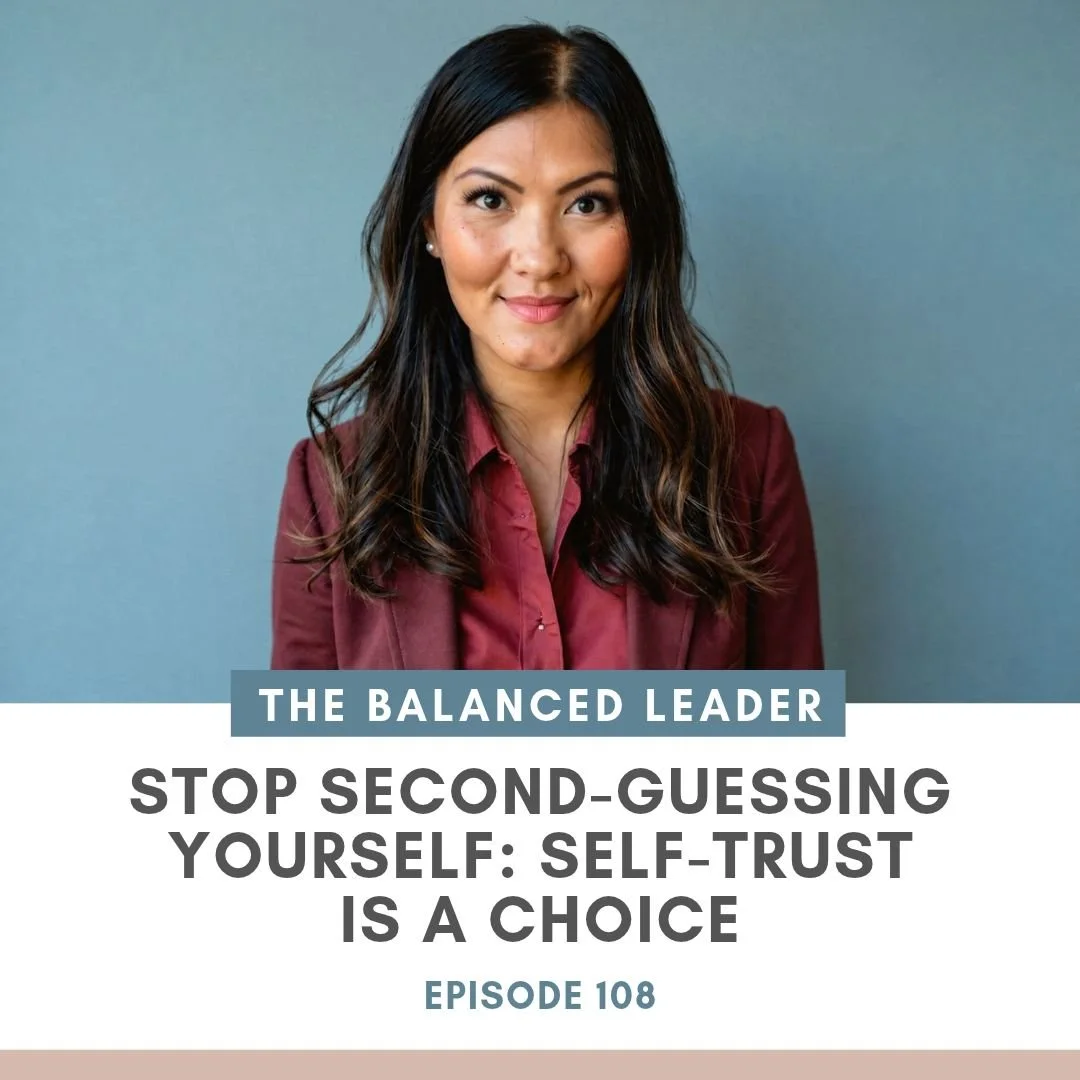
You don't need more confidence to start trusting yourself.
How much time and energy do you spend questioning your decisions, replaying conversations, and trying to anticipate everything that could go wrong? Self-doubt can pull your attention away from what matters, leaving you focused on protecting yourself instead of contributing, making decisions, and moving forward. And even when you're highly capable, you can lose access to your resourcefulness when you're busy questioning yourself.
In this episode, I explore why self-trust is a choice, not a feeling you have to wait for or something you earn after proving yourself. You don't need certainty, confidence, or a guarantee that things will work out. You can choose to believe in your capacity, focus on what you can influence, and have your own back, even when things don't go the way you hoped.
Tune in to learn how to interrupt the self-doubt cycle, redirect your attention towards what you can do with what you know right now, and make decisions without needing to eliminate every doubt or fear. Because self-trust isn't a promise that everything will work out. It's a commitment to stay on your own side, whatever happens.
learn more about command here
What You’ll Learn from this Episode:
How self-trust helps you redirect your focus and access your resourcefulness faster.
Why you don't need to feel confident or certain to choose to believe in your capacity.
The three decisions that build self-trust: believing in your capacity, focusing on what you can influence, and having your own back.
How to stop organizing your actions around doubtful thoughts and start moving forward with what you know right now.
Why having your own back means taking responsibility for mistakes without turning against yourself.
How to stay on your own side through disappointment, rejection, and uncertainty.
Listen to the Full Episode:
Featured on the Show:
Interested in working with me? Book a free 1:1 consultation here!
If you haven’t already, please follow the podcast and leave a rating and review to let me know what you think. Find complete instructions here!
Send me an email: connect@aspire-coaching.co
Watch my TEDx talk: Reclaiming anger: A woman’s birthright
Get the free guide, The 5-Minute Reset to Own the Room, here!
Episodes Related to Second-Guessing Yourself and choosing self-trust:
Full Episode Transcript:
Today, I'm going to invite you to consider something that might change the way you approach your life and leadership. It's going to save you time. It's going to help you focus on what really matters. And this is about self-trust and how it is a choice, not a feeling you have to wait for, not something you earn once you have proven yourself enough times, but a decision about the relationship you want to have with yourself.
Because think about it, every single day, you're confronted with uncertainty. You don't know how that important conversation will go. You don't know whether your idea will be accepted. You don't know whether you'll succeed at something you've never done before. And in those moments, you can approach yourself from self-doubt or you could approach yourself from self-trust. Neither guarantees the outcome, but each creates a very different experience. And more importantly, each directs your attention towards very different things. Today, I want to show you why self-trust can help you get into focus faster, why it isn't the same as certainty, and how you can practice choosing to have your own back.
Welcome to The Balanced Leader, hosted by Yann Dang, a Leadership and Life Coach with over 20 years of corporate experience. Drawing from her journey as a former global finance leader and second-generation immigrant, Yann understands the unique challenges women face in male-dominated workplaces.
Each episode offers insights on balancing masculine and feminine energies, mastering soft skills and building emotional intelligence. Join us to transform frustration into empowerment and unlock your authentic leadership potential.
Hey, podcast listeners, welcome to today's episode. This is a subject that I have been talking about quite a bit as I've been sharing with people about confidence. A lot of times, companies will ask me to talk to their folks about confidence because it is something that they care so much about and they want to feel more and more confident. And I have just been breaking it down and understanding that confidence is not so much that you know how to do something or you do it well, but that is more of a choice. And then when I break it down even further, as I peel back the onions of what this is, what I'm seeing is that we can either spend our time and our energy and our mental capacity to either be in self-doubt or to be in self-trust.
So, let's talk about self-doubt first and what it does to your focus because the more you understand this, the quicker you're going to be able to interrupt patterns that are keeping you stuck, having you wait, and having you question yourself over and over again. One of the biggest things people tell me about Command, my group accelerator, leadership accelerator for women, is that they are spending way less time questioning themselves. They are spending way less time replaying conversations. They are spending way less time at night thinking about all these things that they could have done differently throughout the day. They are learning to show up in their life. They are learning to trust themselves, move through uncertainty, discern, and continue to grow and learn. And they sleep better. Actually, a lot of people say, "I sleep better. I don't think about stuff like I used to, and I don't allow myself to go into this self-doubt spin cycle."
So, let's just talk about what it does to our focus and really understand how expensive self-doubt is and how expensive it is to spend your time, mental, and emotional energy in self-doubt and what it does to your focus. So, let's imagine you've been invited to present an idea to a group of senior leaders. It's a big opportunity. It can really accelerate your career, your growth, and visibility. You have something valuable to contribute. But before you walk into the room, a thought appears: What if they don't like my idea? And then another: What if someone challenges me? What if I don't know the answer? What if I embarrass myself?
Notice what's happening. Your attention is moving away from the contribution you want to make and towards the possibility of something going terribly wrong. You're mentally rehearsing criticism. You are feeling vibrations in your body, imagining rejection. You're trying to anticipate every scenario. And pretty soon, instead of focusing on the value you bring, you're focused on protecting yourself. Here's what I find so fascinating. You can be incredibly capable and still lose access to your resourcefulness and power when your attention is consumed by trying not to fail, by trying to protect yourself instead.
You already know how to think. You already know how to solve problems. You already know how to navigate difficult situations, but when you become preoccupied with what could go wrong, you have less attention available for the work in front of you. And you may start treating every uncertain possibility as a problem you must solve before you can move forward.
Now, I don't want you to make yourself wrong for having self-doubt. Doubt is a part of being human. Doubt is there to alert us to something that genuinely might be wrong or that we might consider that we can help plan for. There's a difference between having doubting thoughts and deciding to organize your actions around those thoughts. And that's where choice comes in.
I always like to coach my clients on really reading their body, noticing sensations, and understanding that part of interrupting a pattern is first understanding and naming that pattern. And sometimes our bodies can tell us what that pattern is before we cognitively think about it, right? So I want to try something with you. If you're somewhere safe and comfortable, take a moment to close your eyes. Otherwise, just follow along. I don't want you closing your eyes while listening to this podcast and driving.
All right. Think about something you're facing right now, something that matters to you, maybe an opportunity, a difficult conversation, a decision you need to make, a bold ask you've been putting off. First, I want you to imagine approaching it from self-doubt. Say to yourself, "I don't know if I can do this. What if I get it wrong? What if I can't handle what happens next? Maybe I'm not ready." Now, notice where does your attention go? What possibilities are you imagining? What's happening with your breathing, your shoulders, your jaw, your stomach? Do you feel an urge to prepare more, to brace, to delay, withdraw, or find reassurance? Or perhaps you feel nothing physically noticeable. Just observe.
Now, I want you to imagine making a different choice. The circumstances haven't changed. You still don't know exactly what will happen. But you're going to choose a different relationship with yourself. Take a moment and say, "What if I choose to believe in me? I can handle what comes next. I can figure this out. I just need to show up."
Now, notice where does your attention go? Are you still mentally and emotionally preparing for everything that could go wrong? Or can you begin to see what actually might go right? Maybe you can imagine yourself walking into the room, speaking, listening, responding, being present. Perhaps you notice your body settle a little, composed, a calm authority. Perhaps you still feel a little nervous, and that's okay. You don't have to feel different to make a different choice.
Now ask yourself, what do I want to be in this moment? What is actually within my control? What's my next step?
Here's what I want you to recognize: You didn't change the circumstance, you changed what you were asking yourself to focus on. You redirected yourself from self-doubt to self-trust. And that can change how you show up. And this is why self-trust creates focus faster. I want to make an important distinction here.
Choosing self-trust doesn't magically erase fear or uncertainty. When you make a decision, when you are driving a car, for example, and you're in that self-trust space, fear may still have a seat. Maybe it's next to you. Maybe it's behind you. Maybe uncertainty is there. Other feelings can still be there and you can still choose to trust yourself. And it doesn't mean your nervous system will instantly calm down just because you're in self-trust. But self-trust can interrupt an exhausting mental task. It can redirect your energy to trusting yourself, believing in yourself, moving you forward.
The task of trying to guarantee that nothing will go wrong is exhausting. When you're approaching something from self-doubt, the question is often, how do I prevent a bad outcome? And when your mind is in that space, focused on survival and protection, you are not using your full capacity. You are not using that resourceful thinking. That question can be useful when you're identifying real risk, right, and noticing the doubt. But when you are repeatedly asking yourself in a situation you cannot fully control, your mind may keep generating more things to worry about.
Self-trust gives you a different question. What can I do with what I know right now? You move from hypothetical possibilities to available, grounded choices, from what other people might think to what you want to contribute and how you want to serve, from what you cannot control to what you can influence, and from trying to predict every outcome to deciding how you'll respond. That's why self-trust can get you into focus faster. Not because it makes you smarter, not because it makes tasks easier, but because it redirects your attention towards something useful.
I'm actually in a coaching container where I am helping coaching this person who's really thinking about her next job move, and she is oscillating between self-doubt and wanting to move forward. And her brain is offering her a lot of questions about does she actually want it. It's like negotiating with her desire. And it's asking her while she's so good at so many different things, does she have to pick one thing.
And I literally have coached her on trusting herself to move forward, on having conversations, on networking, and seeing what is possible, because that self-doubt has her spinning inside herself versus self-trust has you out in the world, contributing, having conversations, getting more data, and then deciding from that grounded place where you're like, "Oh, I have more data. I have a wide variety of skill sets. And that's not a problem." I'm talking to a lot of people who have lots of different problems and this just gives me a better ability to serve them.
That's the self-trust, when you're like, "I'm going to trust myself. I'm going to have my own back, no matter what. Maybe I'm not going to find my dream job, but I'm going to go look for it. And I'm going to choose to trust myself and go look for it," versus constantly questioning if I should or should I not, and then negotiating with my desire, and then being in this self-doubt. And this is why I'm always like women are super powerful, but we sometimes spin in our own self-doubt and in uncertainty versus actually taking action and getting more data and talking to people and actually moving things forward, right? We're not waiting for things to be perfect. We're moving with what we know.
So, I want you to think about it. Think about when you walk into that leadership meeting believing, I have to make sure no one challenges me. That is not a great place to be. That's a place where you're carrying a lot of heavy armor because you're trying to manage other people's reactions. And we can't control that. Trying to sound perfect, searching their faces for approval. Now imagine walking in with a different commitment. I have something valuable to contribute. I can listen. I can respond. And if someone asks a question I can't answer, I can say, "I'll find out." I can also be curious and ask them, "Tell me more about why this question matters to you."
Suddenly, the task becomes much simpler. You don't have to control the room. You have to show up and lead yourself through that experience. This is why my whole philosophy is about commanding yourself first, understanding what's happening inside of you so that you can command the room towards the outcome that you want, right? But it starts with you and you're not going to get there in self-doubt.
So there are three decisions that build self-trust. And I'm going to break this down for you because it's really important that you are onto yourself and you get to yourself to these three decisions. I want to give you three choices you can practice. Choice one, I choose to believe in my capacity. Notice that I'm not saying you have to believe you'll succeed. I'm saying you believe in your capacity, your capability, your ability to adapt, to learn, to ask questions, to solve problems, to recover, to keep going, to be resilient. You can look at evidence of your life and say, "I've figured out hard things before. I can figure this out."
You may not know how yet. That doesn't mean you aren't capable of learning. Listen, I've been moving at a much quicker velocity in my life and in my leadership and I'm making many more choices, but it's because I'm choosing to believe in my capacity to show up for that moment and to show up for myself and to believe in myself. And the more time I spend in self-doubt, the more time I lose foBut the more I redirect myself of like, "You're going to do this, Yann, you're going to fucking figure this out." Okay, I use the F word. I guess this is going to be explicit. But this is important, right? Because you want to have that self-talk with yourself. You want to believe in yourself. It's actually, this comes from my coach. Stacy Boehman has said this before. It's harder to not believe than to believe. It is. It takes more energy to fight yourself, to doubt yourself, than to say, "I'm going to have my own back. I'm going to trust myself."
And that's also true when you are in relationships with other people. Do you realize how much energy you put on wondering if you can trust them or not versus saying, "I'm just going to trust this person until I can't. And if I can't, then I have some choices to make. But until then, I'm not going to continue having this conversation with myself." It's like the same thing with intrusive thoughts. Listen, I have two kids. I have a big life. I have a lot of intrusive thoughts. But one of the things that I say to myself is, if that happens, I will handle it when I need to handle it. I will not use my mental or emotional energy to figure a hypothetical problem out that may or may not occur in the future right now. That is me reclaiming my power and my energy and my emotional capacity. That is me reclaiming it in that moment with myself.
So, the next choice you can make is I can choose to focus on what I can influence. This is the same thing of like, I choose to focus on the things I can control and let go of the things I can't, right? Because you can't control whether everyone likes you. You cannot control whether every decision produces the result you want. You cannot control every reaction, every outcome, or every circumstance, but you can choose how you prepare, what you say, what you ask for, how you listen, how you respond, and what you want to do next.
When you find your mind racing towards imagined outcomes, ask, what is mine to do right now? Right? The question brings you back to agency. The question brings you back to reclaiming your power in this moment.
The third choice you can choose is I choose to have my own back, right? When that self-doubt emerges, you can actually say to that self-doubt, I can choose to have my own back. And to me, this is the deepest part of self-trust because you're going to be in tough situations. And in those tough situations, you can either choose to have your own back or doubt yourself. Because it's easy to say you trust yourself when everything is going well, when people agree with you, when there's positive feedback, when decisions work out exactly the way you hope.
But what happens when it doesn't? What happens when someone criticizes you, when you make a mistake, when the opportunity doesn't materialize, when you realize you need to change course? Having your own back means you don't automatically turn against yourself. You don't have to shame yourself. You don't have to make one outcome mean something terrible about who you are. You can take responsibility without attacking yourself. You can feel disappointment without making yourself a disappointment. And you can acknowledge a mistake without deciding you are a mistake.
I actually had a coach say this to me once and I really felt it when she was like, "Listen, you can make a mistake and you can learn from it, but you don't have to eat crap for it all day." I don't think she used the word crap, but in any case, it was important to know that suffering is optional. Learning is something you can embrace, but suffering is optional.
Self-trust is the commitment to stay on your own side even when things don't go your own way. And that doesn't mean always telling yourself you're right. Sometimes having your own back means telling yourself the truth, owning your part, making an apology, changing your behavior, saying, "I was wrong." You can still be wrong and still love yourself deeply. You can give yourself space and grace even when you've made a mistake, but doing those things from self-respect instead of self-punishment. This is the key distinction, right?
So here's what I want to leave you with, with this whole episode on self-doubt versus self-trust. But I really want you to go to school on yourself. Notice your behavior, notice your thoughts, notice your emotions, notice the energy in your body. I have been going to school on myself lately and I am noticing so much more the sensation in my body. The next time you face something uncertain, the first decision might not be what you're going to do. The first decision, I want you to ask yourself is how you're going to relate to yourself while doing it. Will you approach yourself with self-doubt? Or will you choose self-trust?
Now listen, a lot of you, just like me, have been motivated by fear in the past. I want you to know that you can make a choice and put a stake in the ground and say, "I will no longer be motivated by fear. I will be motivated by desire. I will be motivated by my choices. I will be motivated by choosing to trust myself."
And I want you to remember something. You don't have to eliminate every doubtful thought to choose self-trust. I'm human. I still have doubtful thoughts. You don't have to feel fearless. I'm human. I'm going to feel fear. Unflappability is, I believe, an illusion, right? It's a moment in time. It's a moment of maybe you didn't feel, you felt unflappable in that moment. You were so convicted. But being human, you're going to have different emotions. You don't have to be certain. You can simply decide, "I choose to believe in me. I can handle what comes next. I can figure this out. I just need to show up."
And if things don't go the way you hoped, you can still say, "I'll still have my own back. I'm still proud of you for showing up." Because self-trust isn't a promise that everything will work out. It's a promise about how you'll show up for yourself, whatever happens, no matter what, that you won't abandon yourself, that you will be on your own side and take care of yourself through disappointment, through rejection, through whatever is happening. And that's a choice you can make today and every day. That is your choice. That's how you build your Command muscle: one choice, one action, one moment of having your own back at a time.
All right, that is today's episode. I would love to hear how you are going to school on yourself, how this episode is impacting you, how you are interrupting the self-doubt cycle and choosing self-trust, and what it does to your life, your energy, your vitality, your aliveness, and your connection with yourself. How you feel about yourself, how you carry yourself, how you care about yourself, because that is everything.
All right, have a beautiful week ahead and reach out to me. I'd love to hear feedback on this episode. I'd love to hear what your thoughts are, what questions you have, and how you're implementing this in your life. All right. Take good care and I will see you next week.
Thank you for being a part of The Balanced Leader community. We hope you found today's episode inspiring and actionable. For more resources and to connect with Yann, visit us at aspire-coaching.co. Until next time, keep leading with confidence and purpose.
Enjoy the Show?
Don’t miss an episode, follow the podcast on Apple Podcasts, Spotify, YouTube Music, RSS, or wherever you listen to podcasts!