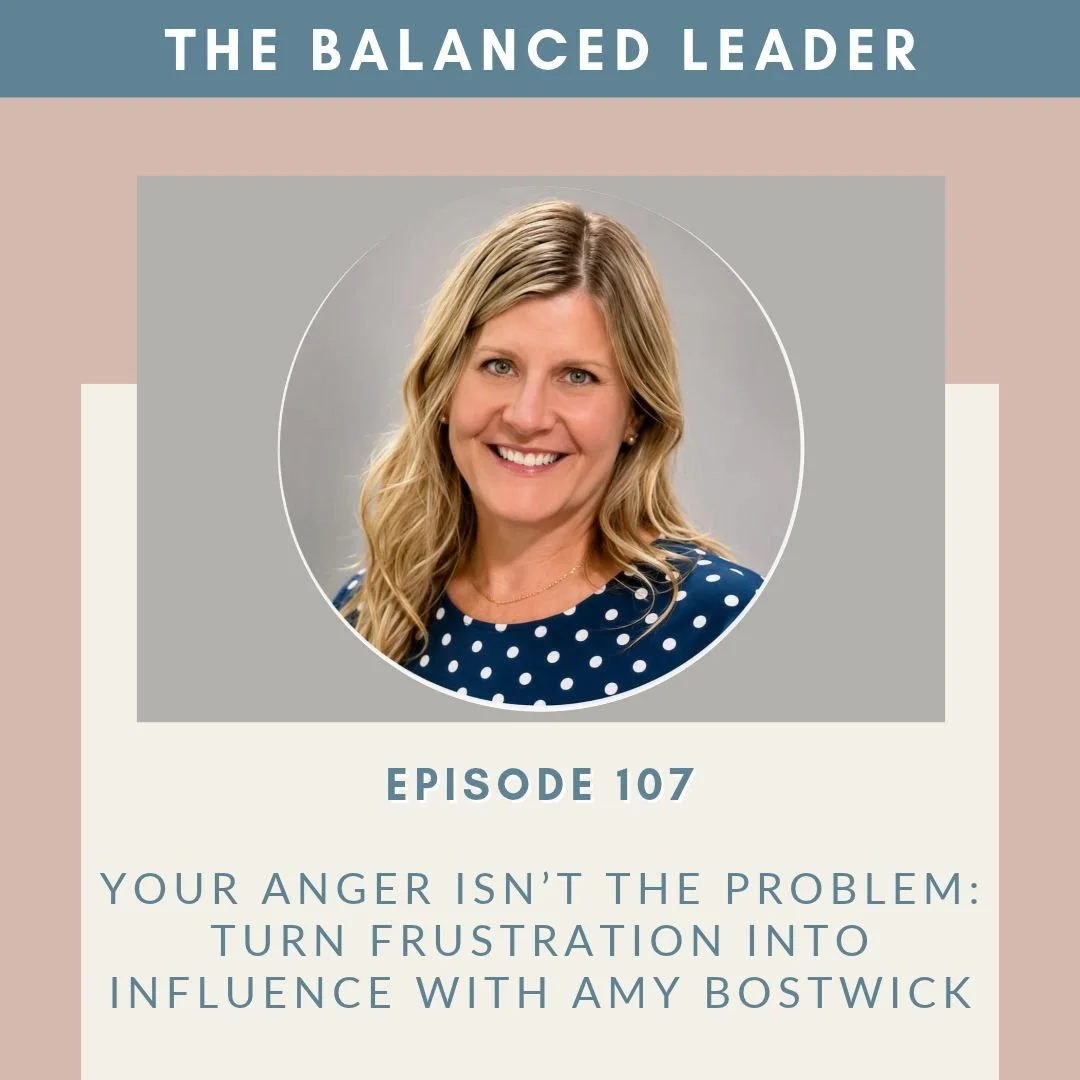
Your anger isn't the problem. How you use it can change everything.
When someone dismisses your perspective, takes credit for your work, or makes a decision that goes against what you believe is right, anger can be hard to ignore. But what happens when you suppress it, react to it, or spend the rest of the day replaying what you wish you'd said? Your anger may be revealing something important about what you want and where you need to take ownership.
In this episode, I'm joined by Amy Bostwick, a longtime listener of The Balanced Leader and a member of my COMMAND coaching program. Amy shares how working through her relationship with anger helped her take greater ownership of her career, ambition, and visibility. She reflects on how she went from being the fixer and team player who helped everyone else succeed to recognizing what she wanted and finding her voice as a leader.
Tune in this week to hear how Amy learned to move from reaction to intention, acknowledge her emotions without letting them make her decisions, and stop sacrificing her own ambitions in the name of supporting others. We'll explore how to create space between what you feel and what you choose to do, so you can turn frustration into influence and make an impact without abandoning yourself.
learn more about command here
What You’ll Learn from this Episode:
Why anger isn't the problem and how your relationship with it determines whether it becomes a source of reaction or influence.
How to move from reacting to frustration to making intentional choices.
Why constantly fixing problems and putting your team first can cause you to lose sight of your own career goals.
How to shift from being the person who creates value to becoming more visible for your strategic thinking and leadership.
Why recognizing your emotions, naming them, and understanding that your next action is a choice can change how you lead.
How to take ownership of your career, ambition, and desire without waiting for the surrounding system to change.
Why leadership and martyrdom aren't the same thing, and why you don't have to sacrifice yourself to make an impact.
Listen to the Full Episode:
Featured on the Show:
Interested in working with me? Book a free 1:1 consultation here!
If you haven’t already, please follow the podcast and leave a rating and review to let me know what you think. Find complete instructions here!
Send me an email: connect@aspire-coaching.co
Watch my TEDx talk: Reclaiming anger: A woman’s birthright
Get the free guide, The 5-Minute Reset to Own the Room, here!
Episodes Related to anger & Turning Frustration into Influence:
95. Why Brilliant Women Struggle to Advocate for Themselves (Self-Advocacy Isn’t Selfish)
100. The Anger Advantage: Why High-Achieving Women Need to Stop Avoiding Anger
Full Episode Transcript:
But here's something I've come to understand about balance. Being a balanced leader doesn't mean being calm all the time. It doesn't mean you're never angry, frustrated, disappointed, or afraid. In fact, some of the most powerful moments in your leadership will happen when you're experiencing those very exact emotions.
Think about the last time you felt angry at work. Maybe someone dismissed your perspective, crossed a boundary, or made a decision that went against everything you believed was right. Did you speak up, shut down, overexplain, or spend the rest of the day replaying what you wish you had said?
Here's what I've learned. Your anger isn't the problem. Your relationship with your anger determines whether it becomes a source of reaction or a source of influence. And that's what I want to celebrate as we mark the two-year anniversary of The Balanced Leader. Not just the conversations we've had, but the capacity we're building to lead ourselves through the moments that challenge us most.
Today, we're going to be exploring how to turn anger and frustration into influence and impact. I have a very special guest who will share her experiences. We'll also talk about how you can recognize your anger, what it's revealing to you, how to create space between your emotions and actions, and how to use that clarity to communicate with conviction. Because the goal of a balanced leader isn't to feel less, it's to increase your capacity to feel deeply, lead intentionally, and make an impact without abandoning yourself.
Welcome to The Balanced Leader, hosted by Yann Dang, a Leadership and Life Coach with over 20 years of corporate experience. Drawing from her journey as a former global finance leader and second-generation immigrant, Yann understands the unique challenges women face in male-dominated workplaces.
Each episode offers insights on balancing masculine and feminine energies, mastering soft skills and building emotional intelligence. Join us to transform frustration into empowerment and unlock your authentic leadership potential.
Hey podcast listeners, welcome to today's episode. This is the two-year anniversary of The Balanced Leader, and we are going to dive in deep of the theme of The Balanced Leader, which is really to turn anger and frustration into influence and impact.
And I have a very special guest here who's going to be sharing her experiences. She has been a religious listener of The Balanced Leader. She's always sharing with me how things are impacting her and how she's using what she's learning from the podcast to impact her life. And so I'm very excited to welcome to the show, Amy Bostwick.
All right, Amy, can you share more about yourself and tell us what brought you to listen to the podcast and how has it impacted you? And I have some other questions we'll dive into as well.
Amy Bostwick: Sounds great. Hey, Yann, first, let me just say, happy two-year anniversary. Seriously, I'm geeking out over the fact that I am such a frequent listener to the podcast and to get to celebrate this milestone with you means a lot.
My background is pretty wide. I am in a commercial role that leads a team working as consultants with retailers, understanding consumer behavior. It's a lot of fast-moving intensity in that role, but I also have a background in wholesale sales and retail with some really big brands. So I have a lot of corporate in my background and a lot of experience in working in very diverse matrix teams.
Yann: Yeah. What are some of the brands just so that people the audience can get a feel for it?
Amy: Oh, yeah, so excited. So I in the early retail days, I worked with a group of people to help build and grow Soma Intimates, which is a part of the Chico's brand of retailers. I also worked for Old Navy and Gap. Yeah. And then in wholesale sales, I worked with in Maidenform brands, Hanes brands, Wonderbra, intimates. I have a lot of intimates in my background.
Yann: Very cool. Well, I think it's always amazing because we get so many people who are from so many different industries, but the core of what The Balanced Leader is about is how to use emotions and how to use your ability to show up, speak up, and take ownership of your own leadership. So, I'd love to dive in and hear more from your perspective, as you've not only been a frequent listener, you've actually also were part of the last cohort of Command. I'd love to hear for you how has your relationship with anger and your other emotions impacted how you show up today as a leader?
Amy: It's a big deal. So what brought me to your podcast was the need to really understand and to find some tips and tricks is what I was looking for in working in a male-dominated industry in my organization, very male-dominated, a lot of the clients I work with, there's this paternalistic, very authoritarian view of hierarchy. And I felt like I was hitting a wall. The podcast, I was really thirsty for ways to figure out how to work with that.
I came to Command because there was a realization in several podcasts almost about a year ago where I realized that maybe the problem wasn't all the things around me as much as the problem might be something to do with me. And not that I'm the problem, just trying to figure out how do I need to address the environment I work in.
Yann: Well, I mean, I do think, this is something that I've kind of talked to some people about, but I think in our society, there is like a group of people who would rather women be angry and not focused on not influenced on how to use that anger. Like it's just easy for women, not easy because it doesn't feel easy to be angry, but it's easier to be like, "Oh, let's just sit on the sidelines and be angry at stuff, but not actually take action to shift the system." And I do think that even in my own frustration of being in a system and I'm feeling like, am I winning in this system? Am I not? How do I use this system?
But there's like raging against the system and trying to influence that system while you're fighting it versus being able to understand the system, see it more neutrally, but use your own power and resources and influence in order to navigate that system and over time change it.
Amy: And that's a big deal. What you just said is a really big deal. It is something that I was able to work through in Command. I can't work through that with my work team because it's very important how I show up. When you show up as a leader, you are in charge, right? You have a point of view, you have authority. But to talk about the vulnerabilities and the challenges and to really address that elephant in the room of, is it that I'm emotional? Is it the kind of emotions that I'm experiencing and that I'm communicating? Is that really the problem, or is it something deeper?
Yann: Yeah, and what have you noticed for yourself or realized as you've gone through this? Because I also think you are, so Amy is such a hard worker. She is the fixer. She is the team player. And if you've ever listened to the podcast, it's how your we undermines your me, which is all about putting your team first and not advocating for yourself. This was actually inspired by my coaching of Amy inside Command because she's been such a we person. Like, I care about the team.
And I think women are so big-hearted. They care about the culture, the systems, the teams, but then oftentimes they lose themselves in their own career advancement, trying to fix the bigger kind of systematic issues and really trying to nurture their teams, which, of course, we want you to nurture your team. But we also want you to take ownership of your own career trajectory.
Amy: And that's a really big deal, Yann, because that's what I had that reality check, right, in the Command container. And it was not just me telling my story. That was very important that I could trust, right, relaxed, talk about what was really happening, what I really felt, and not put a gloss on it. But the really helpful piece was to hear the stories of the other women in the container and to feel that connection of the anger of having desire and ambition and having to cloak that in helping other people, making others look good, ensuring that my authority above me is softer so that my boss and my boss's boss and any of the executives that I'm working with can continue to demonstrate their power.
And what was happening is it was making me angrier and angrier because I felt like I'm fixing things; I'm helping others look better. I'm enabling my team and watching people all around me get promoted while I was softening, if not even gaslighting my own desire, right? And there was a lot of this like I was fearing what I wanted to be as if it was bad or not something I could achieve or I could even aspire to.
And what was hitting me is even though I thought I was doing the right thing by advancing my team, advancing the work, hitting objectives, achieving goals, what I was missing was something very important. And this is these are my goals, my objectives. What did I want? And it was coming out as anger, and that anger, although the anger wasn't bad, I wasn't using it in a way that was helping me.
Yann: Yeah. Yeah. And I think this is where you were taking, starting to take ownership and responsibility of, like, wait a minute, why am I fixing everything? Why am I taking on things that could be done by other people? Because you were starting to notice and see the system where you were actually enabling all of this stuff, as you were saying. And one of the things that I taught in Command and also outside is this learning how to accelerate your career and focus on yourself. And I talk about the model of value, visibility, and velocity. And value is like what women are so good at doing, right? Head down, get the value done, be the glue for people.
But visibility is really taking up that space and being known for not just what you've done to fix, but your strategic thinking and the direction that you've taken the organization, and being seen in those senior-level meetings to be that strategic. And then the velocity piece is having those one-on-one conversations to actually help people but then move your career forward as well.
And Amy, you took that on. You really took that on for yourself and you've created a lot of visibility for yourself. So I'd love to hear how that shift was for you, what it was like, because it's vulnerable to shift and to say, actually, what I've been doing has helped me get successful. Because listen, you're successful, right? And I always say this in my communities: people are highly successful and brilliant. They are just feeling not as aligned within themselves. They're not feeling as satisfied. And oftentimes, it is what we do in Command is to help you get more aligned by commanding and connecting to your own emotions. But tell me what it's been like for you.
Amy: Yeah. So I came into Command with a lot of anger and knowing that anger, I had to do something about it. And what my hypothesis was is I needed better tips and tricks, right? I needed to figure out what this game was on the other side and try that game on the other side. And let me be honest, I thought I would do a little bit of some bashing. Like, let's talk about this misogynistic, paternalistic culture, and let me just vent a little bit and figure out maybe there's other women that have figured out how to deal with it.
What happened was different, right? And it was the thing I needed, which was first to just take a breath. And taking a breath is a skill that I have had to develop because things have moved fast. And especially when you're in a role where you support a team, you support objectives. Everything is fast-moving, fast-changing today. You just cannot rest. But we must take a breath.
And being in Command, I learned some important skills. First off, getting in touch with me, who I really am. And I do see a therapist, right? But I have had this kind of fractured, dissociated role of this is my personal me, and then this is my work me. And there were very clear boundaries that they just must not meet. And Command brought the two together because I'm me; I'm one whole person.
The other thing was recognizing the masks that I was using and how they were either working or not working for me. And I love that in your Command coaching and then in our one-on-one coaching, you didn't give me what I thought I was going to get. You didn't tell me what to say. You didn't tell me how to think. You didn't tell me how to feel. You helped me figure out that feeling is what we do, and getting grounded in the feelings and recognizing it, giving it a name, and knowing that the next thing is a choice is the most powerful thing that you've given me.
And it has changed a trajectory. And it isn't that like some things around me have changed too. Like there is that gift of I've been in the right place, right time. I hear women use that all the time. Oh, I was lucky, or I happened to know. Well, that's only a small piece of it. Proximity is key. But what else is important is knowing when you're grounded in yourself, who you are, what you want, and not apologizing for it.
Yann: Yeah, I love that. Because you're right, like a lot of women are undermining themselves by just saying they're lucky, right? Yeah, you're lucky, but you're also bringing yourself to the table. You're getting seen, and you are making things happen. And when we can't recognize and honor our gifts and own our gifts in that way, we're not actually seeing ourselves fully, which is a big piece of what I was helping you do, is to see yourself fully, to see yourself as somebody who has feelings, who has desires.
And I think a point that you talked about, especially being mothers, we're like, "Oh, well, let's raise our kids. We'll, like, not do the things that we think we need to do to take care of ourselves and our career." And it is a societal thing. We've been conditioned. We've seen our moms do it, right? We've seen other people do it. But it also doesn't help to elevate us or that next generation by telling them, like, "Take care of yourself." And then mama's not taking care of themselves, right? I've loved seeing you do that.
And I've, one of the things that you had shared is how historically you've been really frustrated, you know, by not being seen and heard. And you know, I know that you did a big project and you shared like you didn't feel like you were seen and heard, but instead of just being angry, you took up space.
Can you share a little bit about that? Because that's like a huge shift and it's in these subtle shifts that you start seeing your power in those moments, right? I think we have this urge to be angry and then go down the, well, this is just how it's going to be. And I always warn women of, like, if your thought is this is just kind of how it's going to be, like, that is a big thing because that also is keeping you stuck.
Amy: Well, I was, look, it was martyrdom leadership, and that doesn't get anybody anywhere. I wasn't showing up as my best self, right? I'm not going to apologize for being there. There's a reason why I was in that state. And Command helped me get out.
But the situation you were talking about was big and it was an aha for me that was on so many levels. It was where I was; my world today is virtual. It is two-dimensional. I don't travel like I used to. I'm not in person. The good side of that is people are accessible, whether that's my internal business partners or executives, whether that's my clients. They're accessible. But the bad side of that is that we're not in the room together. And so things can often move fast, and it's easy to lean back in a video and not say anything.
Well, I had raised my hand to volunteer to lead a very important integration project. It's something I'm really good at. Remember, I'm the fixer. And I raised my hand to help and assembled a team and helped like synthesize this work from really smart cross-functional people that had point of view and we figured out, and we didn't always agree, but we figured out how we were going to run this project.
And I ended up being invited into a meeting to speak on a couple of the steering committee working points. And one of the male executives spoke about my work and there was a question and he spoke for it, took credit for it, even though he's not doing it and he isn't leading it. And I felt myself kind of levitate. And I pulled back in this place I would have normally, which was anger. I could see my face in the video, like looking mad, and I went, no, no, I've got to do something different.
And I just spoke up, and I said, “Thank you for bringing that up. And I lead this steering committee. Let me answer those questions for you.” It was a game changer, and I keep looking back to that moment, as that is what you are talking about, Yann, when you say, move from reaction to intention. My intention was this is the work I led. This is me raising my hand to be the leader, not just to fix it. I needed to find my voice and represent it.
Yann: Yeah, and you took ownership in that moment, right? Instead of that moment passing you by, you took ownership, you took that visibility, and you didn't have to make him wrong. You just could be like, "Oh, yeah, like, let me take up the space and thank him for speaking up and sharing about the thing that you created, right?" And we don't have to do it in like a snarky way.
We could just take that, but if we're not aware of our own emotions or how to use it to actually influence and move towards satisfaction, then it just becomes, I left the meeting angry, and I wish I would have said something different, or I wish I would have X, Y, and Z. And that takes you only so far versus where it took you because you not only did that, but I think you leveraged that experience to have even more conversations about what you created.
Amy: Yes. And I'm listening differently because of that. Like what I hear and, you know, when I'm scanning the room for, and again, remember that's virtual, I'm not sitting around a table or standing in a conference room. But I'm thinking about moving from the reaction and frustration, the anger. I still feel it. I'm not suppressing it anymore. And I was doing that. I was really like, "That's a bad girl feeling. I'm not going to go down that path." But I was still feeling it.
Yann: And it takes a lot of energy to suppress it and to be like, "Okay, let's be a good girl now. Let's like pretend that doesn't exist," because it's a part of you and you abandon yourself when you don't hear it, right?
Amy: Yes. And I see that all around me. I see that in other women leaders who do that. They apologize for speaking out. Excuse me, I'm sorry, or maybe it might be that. There's a lot of apology in that approach. What has really helped is again, going back to that grounded place of acknowledging what my emotions are and then moving the thing forward. It's been a game changer.
Yann: That's amazing. Well, I'm so excited that this is where you're at because one of the last things we talked about was how you are just as ambitious as you were in your 30s. So tell me a little bit more about that, because, like, where you are in your career and how this has changed like how you're viewing your path forward. Because I share with people like in Command, people are like the age is like 35 to 65. And like there are a lot of commonalities, right? And then there's some similarities. There's also contrast. And yeah, I'd like to hear where you are and where were you when you started Command, where are you now in terms of how you see your career trajectory and what you're capable of.
Amy: Yeah. And let me give you just a little bit of context too. Remember that I work in consumer behavior. And so I'm working with clients all the time that are trying to roll up aggregations of how humans behave. What that means is always talking about Gen Z this, Gen X this, Boomers that, whatever. But because of that and because of the very paternalistic work environment that we're dealing with, there was this messaging of being relevant and that when you hit a certain age, a certain decade, it's time to think about retiring. And I was buying into that and I was letting my ambition go. It's too late for me. It's passed me by. I don't have another chance, or this is just, this is what I'm stuck with. This is who I am.
And coming into the container really helped give me that space to kind of unpack what I really wanted to do and that it isn't over, and I'm excited. So what it helped me realize is I do have ambition. I want to lead. I get excited when the things happen, we hit objectives, but more important to me is seeing my team or seeing clients, or seeing even executives like the light goes on and they get it. Watching a really difficult conversation kind of unfold and then things come together to move forward, right, where people are moving in the same direction, whether or not they agree or disagree.
And being in the container helped me recognize that I still have a lot of runway in front of me, and it rejuvenated my energy and my enthusiasm to have that desire to want to keep planning my career as if I have more runway. I have more room to move to the top.
And that has helped provide the motivation to help me continue to dig deeper on why I came in with all this anger and resentment, what I'm going to do about this, and how I can really tap into my desire and recognize my tendency to want to fix and want to help and fade into the background and just keep moving into more of a visible position and not apologize for it.
Yann: What I'm hearing is that edge, right? The edge where you are, right, not going to the thing that you're good at, but the thing that's keeps you safe, but doesn't have you on that edge of visibility, leadership, making that impact that you so desire to do. And then I'm also hearing desire, right? I think we talked about this at the beginning a little bit, but like how I do believe that a lot of times women, they kind of feel frustrated. They don't know how to move forward. They look for quick fixes, right?
I also talk to people like, I don't do just scripts and all of those things because I want it to feel authentic to you. I want you to learn the skills to do it, not have a script, right? Because when we're going off of a script, we're not as present; we're not as powerful. We're thinking and memorizing something as if we're going to get the perfect answer.
And in these rooms, just like you said, we're just trying to move things forward. There's a lot of uncertainty. You don't know what's going to happen, right? And that's part of leadership. We don't know what's going to happen. That's why we're leading. But then that desire gets dampened when we don't feel like we can get it, or we've been so far away from it because we put so many things in front of it.
But what I'm hearing for you is like you're like grasping onto your desire and pulling it closer and closer to you. And it's a journey. And I think that yeah, well, tell me more about that because you were also sharing like some of your favorite podcast episodes and share more about this desire piece.
Amy: So the one that was speaking to me, that literally, I was like, who is this Yann? I'm going to start listening to these podcasts was "Anger is Empowering, Don't Lose It." It's podcast number 19. So it's in the beginning. Yeah. It was big, and I was like, wait a minute, what do you mean use it? I thought this is the thing that's getting in my way.
Yann: It's a bad girl stuff, bad girl energy.
Amy: Right. Right, right, right. And look, let me just say, I have a very, I know I have a big personality. I'm strong, I'm quick to make decisions, and I have a lot of energy, whether it comes across two-dimensionally, right, virtually, or if I'm in the room, I know I have that energy. But I was starting to take it down. And not take it down because it was too much; I just felt like there was nowhere to go with it.
And then there was, I was on a holiday with my family, and it was just the right place, right time. I felt like my body was just ready to hear messaging that you were putting in your podcast. And it was podcast 70. It's “Why High Achieving Women Fear Their Desire.” I had to listen to that podcast three times because it got me to the core. And that's what moved me into Command. I recognized that I was my enemy.
And yes, this paternalistic culture is happening. I am working with a very male-dominated culture both within my internal company and the a lot of the clients I work with. I'm one person. I can't change that. What I was missing is the thing that I could control, which was myself. And so that takes me to the like this third podcast is one that I'm a frequent binger on this one. And I have sent this to many of my colleagues. I've even sent it to male colleagues because I said, I think this might be good for you to listen to this. It's “The Power of Choice: The Reaction to Intention,” number 57.
Yann: Good. Well, I was going to say, like, listen, men are more than welcome to listen to the podcast. Obviously, I speak to a women's lens, but you know, there are male consumers learning these skill sets just as much. And yeah, the power of choice. I see this really clearly in you, right? That you're seeing that you have a choice when that anger or that frustration or resentment comes up.
And actually, you modeled it really well very early on in Command, where you were just allowing yourself to express. Remember that time you were just angry and you just shared, you were mad, and you were in your- I was just imagining we have something in Command called Express Don't Repress. And it is a safe space to express whatever you want, no judgment. And Amy, if you're open to just kind of sharing in that moment, like I think it was vulnerable for you to even share that with the group of women, you know?
Amy: Yes. So, look, in that Command, I really let it fly, and I needed to because I was editing myself, which was keeping me from getting rooted in, like, what is behind this? What is it that I really want? The situation is one I'm sure many of your listeners will relate to, and it is gender limited, right? It was this project, is another project that I raised my hand for because I have this, like, addiction to fixing.
Yann: We've been breaking it.
Amy: Look, I'm really good at it, and that's why my background in retail is in store operations because I'm always thinking of building a better mousetrap. How do we make this better for the customer? How do we understand the customer, and how do you make that work?
So, this project was very related to how we work with clients, and I had specifically gone and tried to recruit one of my male colleagues to be a part of this work. He said no; he was too busy, turned me down. And he's somebody I really respected and felt like we had kind of an equal understanding.
Yann: Mutuality. Like there was a mutuality. Yeah.
Amy: Well, that is not what happened. I showed up, again, another meeting that I got invited to that I wasn't on the original invite, and found out that this colleague started his own committee. He had spent some time with me saying, well, tell me about this project you're doing, and who did you decide to get there? And what are you going to do with it? Then he built his own committee on those same, like, the same foundations that I had built. It was a very short-term project. So, it was crazy to show up in a meeting and find out that here's someone I thought I trusted was going to basically take my work and clone it.
Yann: Repackage it as his own.
Amy: And, okay, but let's talk about truth, Yann. What happened was very real. This is where another shift happened for me in Command, and it was, yeah, I was mad, and I was thinking, thank God, we are not in a real office because we need to have an honest conversation, and there is not going to be any regulating this frustration, right? But that conversation never happened with him. I had the conversation with myself.
What happened was he took visibility. He promoted his leadership, his ownership, his idea. I was working in the background. Yes, I led it. Yes, I picked the right people. Yes, I moved the work forward. Yes, I promoted other people and their strength. But what I was doing is I was allowing myself to just fade in the background. And look, I'm not comfortable just saying, hey, I'm really good at this. I'm, no, let me back up. What I'm not good at is saying this. I can say I'm good at something. I can't say I had this idea. I am leading this. What I thought of was this. What my recommendation is this.
I'll have to keep practicing that. This is something that I'm going to have to continue to develop, but that was where I recognized my behavior was supportive, was fixing and collaborative. His behavior was leading with authority and command. And that's what I want. And that goes back to desire. Like I have time, right? I have time. It's my time. It's up to me where I want to go and what I want to do, given the right situations fall into place. But it's up to me to figure out how Command works for me and my core values and my strengths.
And that, I think, is the biggest aha, is that I'm the one driving velocity. I'm the one driving where I go. And that I did not walk into Command with any of that accountability. I had given that all up to everybody else around me.
Yann: Well, and doesn't that feel frustrating, right? When you don't know what to do or when you feel like other people have the power to dictate your career or to your ability to make that impact or have that influence, right?
Amy: I have decades of experiences and successes behind me. I was not frustrated. I was pissed. I still get angry when I think about it. But I want to use that anger and figure out, like, it's real. It happened and it is happening. And it's happening. I'm watching it to other colleagues. And by the way, it's not up to me to tell my colleagues, "Hey, this is what I figured out, right?" That's their journey. But what is important is for me to keep acknowledging what I'm working on, accept what I don't want to change or what I choose not to change, and then keep moving forward.
And look, there was a thing, I don't know if you remember the Command where I just, I kept laughing at myself because that's the other thing I've found is this sense of humor. Like I can be like a bull in a china shop, absolutely like a bull in a china shop. And there's some funny humor in that. So I have to just be gentle with myself and laugh things off when it doesn't work out right.
Yann: Yeah. And I think that is part of, you know, one of the things that my daughter was in the swimming lesson and the coach said, you know, people learn 25 times faster when they're having fun, when they're actually can be laughing about themselves and learning to make mistakes. And I think that's a huge thing too. Women have a really hard time making mistakes. And so we hold, we're like so tense. We're like trying to control people's emotions, control the outcome, control people's perceptions of us while we're trying to lead. Like, that is exhausting, right? That is heavy stuff.
You know, the big part of Command, the first and foremost is commanding yourself, really understanding yourself and not commanding yourself in like a controlling way of just being like, "Oh, wow, I have feelings. I have emotions. How do I use this? You know, how do I use it as data? I don't just allow the emotion to take me off on some journey that I'm not grounded in and in command of."
Amy: Yeah. And you know, look, for years, I have been practicing that leadership is synonymous with martyrdom. You sacrifice.
Yann: Well, that's motherhood. I mean, that is, historically, what we've taught about motherhood, right? This is why, I mean, I, I think it's good that there's more about like what motherhood really is, right? And how difficult it is, both from a working perspective, but even like the first year of motherhood and all of the physical pain and the emotions that you go through. I think people like to paint this beautiful picture of like these transitions, but they're hard, and they're not easy. And there are so many rules and conditionings that we're not even aware of.
You know, and I talk about it a lot. Like, I'm doing my thing, and I still have mom guilt, but I don't allow that mom guilt to control me. I just noticed that it is part of society, part of my care and love for my kids, part of probably what my mother gave me with, like, her guilt trips that she probably got from her mom. But how do I see it and how do I not allow it to control me? And how do I still move and take responsibility and ownership for my own desire? And that's what I see you doing.
Amy: That's a real compliment. I related to you. Your story is a very different story from mine, like your growing up and your brothers, your family, and but what I loved is how you are on a journey, and you're, you share your vulnerabilities along the way on your whole self, Yann. You know, you share your corporate experience, you share your experience now of what it's like to be a mom of two cuties, and your relationship with your husband and your coaching journey. It helps because it's a good reminder that I'm taking in this piece.
Again, I was fracturing. I had my therapy to talk about, you know, this is my personal me, and then I have my coaching, which is only going to talk about these executive things. Well, I'm bringing my whole self to work, like it or not. And all these things, my three-year-old me is showing up for all these facets of my life. And I loved hearing you and how you related to that, and it helped me go, "Okay, if you do that and you coach that, I can try that."
Yann: Yeah, and this is super important because I know Command, we lead with leadership, but we're leading in our lives too. So we do deal with personal and professional topics all the time within the container, and it's just about our relationship with ourselves and our desire and how we want to lead, right?
I have decided my path and I encourage other women to decide what their path is. But it is that integration and desire to have a full life, not just a life, right? Like it's being able to, again, not sacrifice career for the life that you want with your kids or your family. It's being able to hold it and understand that there are choices and discernment that you have to make, but you get to make those choices. And there's power in making those choices.
Amy: And the power in making those choices, that's what I needed. It does not diminish what's happening around, at least from my point of view, around me, in my male-dominated workspace, with my clients, with my executives, with people that I work with day in and day out in my career. I look at the landscape in the United States and the power of women, or the lack thereof. It is still happening all around me, right?
And while there are places, I want to do my part to help plug in and make an impact. I don't know, maybe help fix something. There is this piece now that I acknowledge that I want to stay grounded and take a breath and feel my emotions and then make my choice.
You know, I thought for years leadership was seeing a problem and fixing it, making a recommendation, telling, giving people advice, even unsolicited advice. That's exhausting. You don't know when needs all that. And I still have that tendency and I will always continue to work on that and pull back.
What's really important is I learned in Command that I get to first make a decision on is this problem mine, and do I want to carry this? I didn't become a better leader over this last 10 months because I stopped feeling angry, because I stopped seeing these themes. I didn't become a better leader because I found a tip or trick. Thank you for not giving me those. I became a better leader because I stopped letting the anger and frustration make those decisions. I stopped letting that take the wheel for me and I started learning what I needed to do in order to make that right choice.
Yann: Yeah. Yeah, because I always say, right? Those emotions can be in the car with us, but we have to be grounded and in command of how we use those things, right? Like fear could be there, anger could be there, but what direction are we choosing to decide to move towards?
So, well, thank you so much for being on this two-year anniversary. I always love hearing from Amy and all of you out there who take the time to share with me how the episodes are impacting you and what you're getting and what more you want, because I also love hearing from the listeners of what you want and what is helping you to grow and learn and to take yourself to that next level.
So, thank you so much, Amy. Is there any words that you want to share, you know, about the podcast or about your journey? I'd love to hear any last final words that you have.
Amy: I'm thinking outside of myself in our Command pod. Look, we were diverse, very different, right? Different in ages and experiences, careers, backgrounds, and it was- we're a clan. So I would say to the listeners, find your clan, nurture your clan. And, you know, leadership is not martyrdom. They're not synonymous. Yann, I really appreciate you being a part of this journey, and I am very grateful to have the opportunity to be on with you.
Yann: Thank you so much. Well, it was a pleasure and I'm sure our podcast listeners got so much out of this for themselves and what their journey of growth and leadership is. So, all right, everyone, I will see you all next week. Have a beautiful week ahead. Thank you again, Amy, for joining us, and I'll see you guys soon. Bye.
Thank you for being a part of The Balanced Leader community. We hope you found today's episode inspiring and actionable. For more resources and to connect with Yann, visit us at aspire-coaching.co. Until next time, keep leading with confidence and purpose.
Enjoy the Show?
Don’t miss an episode, follow the podcast on Apple Podcasts, Spotify, YouTube Music, RSS, or wherever you listen to podcasts!