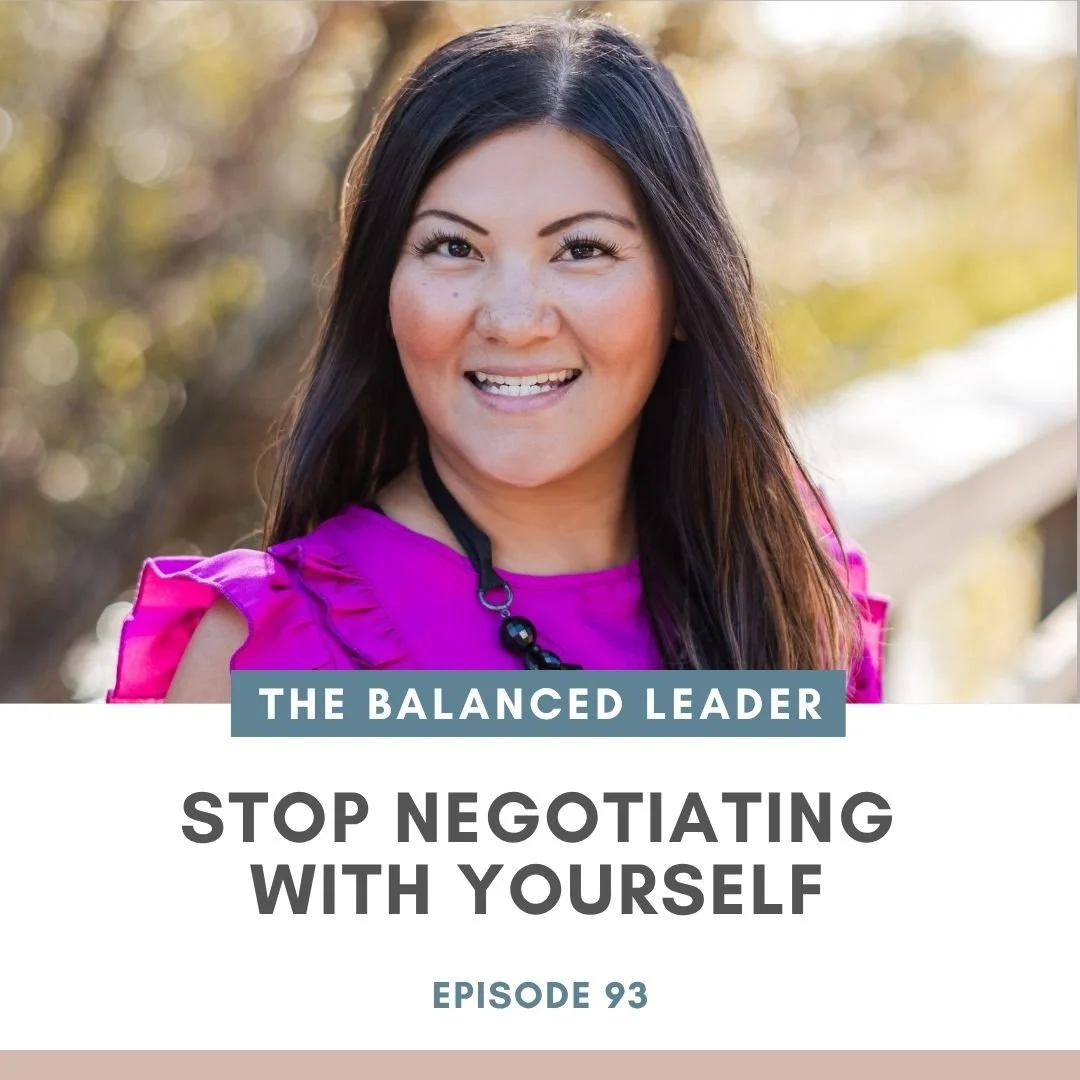
Has this ever happened to you? You know exactly what you want, what you believe, and what’s true in your bones, but then you start negotiating with yourself. Maybe you tell yourself to wait, maybe you question if you’re wrong, or worry about how others will feel. Most high-achieving women fall into this pattern. Spinning between fear, uncertainty, and the need to manage outcomes keeps you stuck and drains your confidence.
In this episode, I break down why negotiating with yourself silently undermines your self-trust and leadership authority. We explore how overthinking, managing other people’s emotions, and softening your truth can keep you from making the decisions you already know are right. I guide you through a framework to identify where you’re negotiating with yourself, distinguish facts from your personal truth, and consciously rewrite the story you tell yourself so that it empowers rather than paralyzes you.
You’ll learn how to stop abandoning yourself in the middle of challenging decisions, how to honor your truth even when outcomes are uncertain, and how to build the muscle of self-trust through small, repeated choices. It’s time to act decisively and lead with authority—without letting fear, doubt, or other people’s emotions control your decisions.
Interested in working with me? Book a free 1:1 consultation here!
What You’ll Learn from this Episode:
Why negotiating with yourself quietly undermines your self-trust and leadership authority.
How overthinking and managing others’ emotions can keep you stuck even when you know the right decision.
How to identify where your mind is negotiating against your own truth.
Strategies to honor your truth while navigating uncertainty.
How repeated, conscious choices build the muscle of self-trust.
Practical ways to act decisively and lead with authority in high-stakes situations.
Listen to the Full Episode:
Featured on the Show:
If you haven’t already, please follow the podcast and leave a rating and review to let me know what you think. Find complete instructions here!
Watch my TEDx talk: Reclaiming anger: A woman’s birthright
Get the free guide, The 5-Minute Reset to Own the Room, here!
Episodes Related to Negotiating with Yourself:
Full Episode Transcript:
What's fascinating is that we think that we're trying to find the right answer, but most of the time, and this has been true for the hundreds of women I've coached and in myself, we already know our truth. We're just negotiating with what we already know because we are trying to manage our own emotions, manage other people's emotions, or manage an outcome that feels good to everyone.
I realized this about myself and with the women I coach, and today's episode is going to change the way you have these conversations with yourself forever and help you lead with more clarity and self-trust going forward from here on out.
Welcome to The Balanced Leader, hosted by Yann Dang, a Leadership and Life Coach with over 20 years of corporate experience. Drawing from her journey as a former global finance leader and second-generation immigrant, Yann understands the unique challenges women face in male-dominated workplaces.
Each episode offers insights on balancing masculine and feminine energies, mastering soft skills and building emotional intelligence. Join us to transform frustration into empowerment and unlock your authentic leadership potential.
Hey, podcast listeners. I am excited to share with you this episode because it's something that I have been noticing in myself, with other people, and even as I look in my professional career, those moments where I was negotiating with myself. And so, I'm just going to give you some examples from my own situation and the clients that I am coaching at this moment.
But what I've noticed is that oftentimes, we as women are thinking about other people's emotions. We're thinking about our own emotions, and we are thinking about the outcome that we want. And it has us kind of in this way overthinking again and holding back on what we really want and actually negotiating with our own truth.
So let me share with you that, you know, I was noticing this struggle. There's a client that I have. She's hurting. She's exhausted. She's really tired. And she is on a coaching cadence that I professionally don't believe is serving her. She wanted to be able to have flexibility with coaching, and I was open to it because I had worked with her before. But when you are actually going through the really tough times, and by the way, if you are going through a really tough time and you're doing it alone, and you're feeling alone, and you feel like you're drowning, I want you to know that whether it's me or another coach, you can reach out for help.
And what I know to be true is that when I'm really struggling, that's when I get more and more consistent coaching. That's when I reach out for help. And so, one of the things that I was noticing with myself is that I was not just telling her what I thought was the best recommendation, right? And I thought, this is so interesting. Why am I holding back on my truth as a professional? I've coached hundreds of women. I know that this is what works.
And I think part of it was that I had agreed that the flexible schedule would work, and it did work, and it does work for some clients. But for other clients, when you're going through really tough times and you don't feel like you are winning and you feel like you're burning out, this is when you should get more coaching, not less, right? This is when you should get extra oxygen and extra help, not stay stuck where you are.
Because transformation happens through repetition and through practicing choices over and over again to really interrupt these patterns. So I already knew this. This is the thing that I knew. But what I noticed about myself was I was wrestling with like this fear of like that she wouldn't like what I was going to have to tell her. And it's interesting because doctors, they kind of like, this is my job. I'm here to tell you the truth. And I'm not here to manage your emotions. You know, I think doctors are taught to have a certain bedside manner in sharing the truth, but to them, like medically, it's the truth. Whereas in business, it's a little tricky. There's a lot of gray areas. What is the truth and the real truth?
But most of us don't struggle to find the truth. Most of us actually, and the women that I coach and the women that are listening to this podcast, like you're brilliant and you probably know what is true for you, whether it's a professional truth or if you stood back and you looked and you grounded yourself in your heart and in your mind, you're like, this is what I would do, like if there was nothing to lose. And I believe most women know this. I know this about myself too. Like, even in this whole thing where I was noticing myself negotiating whether or not to tell my client, like, hey, listen, if you really want to change your pattern and you want to get help, and I can see that there, you know, that you're suffering right now, get as much coaching as you can. Make it a priority. Make it a choice. Make it like oxygen that you need to move and do these things.
And if I wasn't so worried about managing her fear or her upset at me, then I would just go and do it. And it's the same thing at work. Sometimes we have these situations even with our authority figures, and I have a client that's actually in the midst of this where she's like, I think the organization actually doesn't know what they want. She's kind of struggling with, you know, she was brought in to scale the organization up and to help them have a delivery model that is scalable, but she keeps getting pulled into fire drills to actually just deliver the thing, not from a scalable standpoint, but just to like deliver, get the thing done.
And so, her truth is like, this is chaotic, but when she's starting to negotiate that, it's like, oh, I can't say that. I can't say that to the leadership. And you start negotiating, you know, where you're in because you're like, if I can't say that because I don't want to sound like I'm challenging them or calling them out on something, we start protecting relationships, and we actually start protecting ourselves from discomfort. Discomfort from being dismissed, from being misunderstood, being told we're wrong, being seen as too much, being seen as not enough.
So for me, if I'm honest, the fear, you know, when I was thinking about this even with my client, it wasn't actually about losing a client. The fear was something much older, the possibility of not being heard, not being seen, not being believed, not feeling like you exist. And here's what struck me. Those aren't current facts. They're old stories. And I believe most people have this old story, like even when I was talking to you about my client who is like organizationally, I think they're misaligned. Like I don't really know if they want to scale or if they want to deliver.
And what happens is, instead of actually sharing the truth and having the conversation, oftentimes old stories come up and old stories about, well, I can't actually tell authority that, right? And if you think about it, if you're a child and you're like, whoa, my parents actually don't know what they're doing. But then you're like, do I actually have permission to say that? Do I actually have permission to tell the people that are in charge of my livelihood that they don't know what they're doing? So then a lot of fear comes up.
And even in my own story, there is just an old fear that's showing up. This client of mine, she can just be like, I hear you, Yann, and I disagree or I hear you and this is what I'm willing to do at this point, right? It's still her choice. But what I was noticing is this pattern of negotiating with ourselves instead of just telling the truth.
And this is where I really want you to be focused because as you continue to negotiate with yourself, as you continue to soften your message or not tell the truth or not be in your own grounded truth of what you think is right, you start feeling less powerful. You're starting to play a game that you are trying to manage the outcome, manage your own emotional capacity, manage other people's emotions.
And one of the big pillars of what I teach is emotional capacity and just real capacity is that when we are willing to tell the truth, when we are willing to have our own backs, we build the muscle to have more of the emotional capacity to deal with being misunderstood, to deal with not everybody liking us, right? Because we're just like, this is the truth and I stand for the truth and I'm going to be me no matter what.
And listen, I'm sharing this with you, but it is a journey. It is a journey that all of us are on. And for me, when I'm coaching women, I'm like, this is not about me. I want you to be truthful with yourself. Because when you can be truthful with yourself, that is a relationship that builds self-trust, and over time, that's a relationship that is actually going to lead you to the life that you love and want because you are actually having really good conversations with yourself and not just negotiating with outcomes that you think you can create by managing other people, managing your own emotional distress, and managing the outcome.
For us to really create the life that we want and to take those leadership moves and to actually have a leadership journey that's sustaining and that is one where you're thriving and not burning out, it is to be bold and to tell the truth and to move through the pushback in a way where you are building muscles, in a way where you are learning to take care of yourself, even in the hurt that might come up, the rejection that might come up, but you are learning to say, I know that I'm risking rejection. I know I'm going to push back, but I'm going to be on my own side here. And I'm no longer negotiating with the truth that I know inside of me.
So, I'm going to give you a framework to work on this, but I wanted to share this because it is something that when I'm coaching with women, when we get to the heart of the matter and we get to the truth, this is where life starts opening up. This is where opportunities start opening up. And it's not easy because we have a lot of patterns, especially a lot of conditioning as women to wait and to feel really safe before we move forward.
So whenever I'm coaching women who've made bold moves, I do ask them these questions. So I'm going to break it down for you a few things because I have seen this happen over and over where I'm coaching someone and they're like super stuck, and then all of a sudden, they decide. They move forward with their truth. They start operating at their next level identity, and they stop stopping themselves. They stop negotiating with everything and they're just decided that like, this is what's going to happen and I'm moving forward.
So what I typically ask them is like, what were you thinking right before you made that decision? Do you know what I heard over and over? And I think this is super important because if you can ask yourself this over and over, it will get to the heart of your truth much faster. What these women said, and they did amazing things. They would call their CEO out on BS. They would be able to show up powerfully even when they were dismissed or judged. They would tell the truth about something in a really grounded, mature way.
I want you to use discernment. This is not about reckless behavior, but this is about learning your truth. And for the most women that are listening to this, you are already grounded. You are likely understanding the discernment that you need to be taking in the situations you are. But this is the thing that all of the women said when they went and did stuff, when they did bold things, when they went after a new job, when they went after a new role, when they told the truth to an authority figure, when they pushed back on something in a powerful and meaningful way, this is what they said.
What do I actually have to lose? Their thoughts were always, I have nothing to lose, or what do I actually have to lose? Those were either the question or the thought that I heard over and over again. Not because there was no risk. There always is some sort of risk. There usually was some sort of risk that people are dealing with, but something shifted. The cost of staying the same finally became greater than the cost of acting.
So, you know, even with my client that was like, oh my gosh, I'm going to have to do all these things to get to this interview that is going to actually be leveraged for me to get into even another bigger job, right? Yeah, she's going to have to do things, but you know, right now there's an opportunity in front of her. And she's like, what do I have to lose? She only has things to gain if you really think about it.
And maybe you've experienced this. You finally left a job. You finally had a conversation. You finally applied. You finally set boundaries. And more often than not, like the women that come into my coaching, they've done something like this in their life. And sometimes I have them really go to school on it. Like, what did you do? Why did you do that? And what caused you to do something that historically you wouldn't have done?
I even have a client who, you know, super practical, super responsible, and she decided to get a dog. And I was like, I knew that her getting a dog was like a full joy for her and was permission to have a life that she loved, right? And I kind of knew that because that was my thing from me to have a dog too. It's like totally not practical. I was brought up as an immigrant. I am always thinking about the practicality of things and responsibility of things, and a dog is so much more about your love and your relationship with that dog than about like any sort of sense of duty.
So for her, she had said, you know, I just trusted myself in that moment, and I thought, I don't want to lose this dog, right? Like, even though it's not practical, when she met this dog, she was like, I got to get him. And so, there are going to be moments in your past that you've already done this where you stopped negotiating with yourself and you just moved ahead. Not because the fear disappeared, but because clarity became louder.
And oftentimes, it's a in the moment feeling. Like I've actually had this even in relationships where I'm like, this makes no sense. I actually at some point dated somebody that I was living in London and he was moving to Canada. Like it seemed so ridiculous, and it was that emotional connection and vulnerability that was like, okay, this is worth it. And I stopped negotiating with all the outcomes and you're just like, okay, well, I have nothing to lose. Like, let's just go.
So, I want you to notice where in your life are you negotiating with something you already know? Maybe it's a conversation with a boss. Maybe it's a conversation with your partner. Maybe it's a conversation with your parents. This shows up leadership-wise and in your personal life as well. So, I want you to ask yourself these things because these are the things that typically keep us stuck.
I have another client who came to me many years ago and was like, I just feel completely stuck. And she was like, there were some facts and there was her truth, and then there was a very strong story that was keeping her stuck. So, I'm going to walk you through this framework because it's going to help us unpack all of these things, and I wanted to make sure you got a good foundation of what it feels like to negotiate with yourself. And also, what it feels like to say, I have nothing to lose. Let's move forward.
There's a feeling in your body, a sensation in your body when you say that to yourself. I have nothing to lose. Or even if you say to yourself, if I had nothing to lose, this is what I would do. And oftentimes when I'm coaching clients, I'm like, if you had nothing to lose and all to gain, what would you want? How would you want it your way? What would your way look like? So, let's dive into this actual framework that will help you break down.
The first thing when you're going through something, and I'm going to actually share with you the framework and then give you some examples of how I have coached myself through using this framework and how my clients have. So, this is the framework to support you to stop negotiating with yourself and to see where you might be negotiating with yourself, especially if you're stuck on something. So, it starts with the first column is going to be facts, right? So in this first column, you are going to write all of the facts about the situation and what you actually know about the situation. So, I'll give you again, examples.
But then the next column is going to be your truth, your personal truth, your professional truth, what you genuinely believe, not what you hope, but like what you feel strongly in yourself, not what other people want, but what you actually believe. And then the third column is the story. Now, this story is really helpful because the story has emotions related to it, and the story is everything you're predicting, the rejection you might be predicting, the fears of what other people might be thinking about you, and you want to notice, right? Most of us stay stuck aren't stuck so much in the facts. We're stuck in the story. So, that's why having these columns is helpful.
And I would even say, this fourth column is even more helpful because if we are creating a story in our mind of winning or losing, typically the story is losing because that's what stops us from moving forward and has us negotiate with ourselves. The fourth column is one where you get to create it. The fourth one is a story about you that you are choosing consciously to walk into where you're like, okay, these are the facts, this is the truth, my truth. This is the story I'm telling myself. This is the story I want to tell myself. This is the story I'm going to walk myself into to become who I want to become and to build the capacity to become that person. All right, and this is a person that I trust more and more.
So, I'll start with a professional example because this is pretty fresh from my Command group. I was coaching a woman in my Command group just yesterday where here are the facts. The facts are, she has two direct reports and she gave them clear guidance on what to do. There was a big client, a multimillion dollar client that was like, okay, we don't want to renew with you. And so that was the facts. And the facts was she got on it very quickly and she said, this is what you guys have to do.
And the other fact is that they just ignored her. They gave her a lot of reasons why they didn't want to move forward and they didn't move forward and now this renewal is not happening. So it's really nothing happened. The facts are also that she put somebody on a plan or like gave notice to them that like this is important and you need to do this. So it wasn't like she just gave them direction. She also followed up with consequences if those directions didn't happen.
So her truth column two was like, you need to get this stuff done. This is what you need to do. There's nothing in the way of if some person gives notice, if a big customer like this gives notice, your job is to get in there and talk to the client and find out as much information as possible about them, about where they're going, and how we can try to save this. She knew from a sales perspective, this is just what you do. It doesn't matter if they're like, well, you can't talk to the payables group. Like they gave her a lot of reasons, but she was like, no, this is what you do. You're a salesperson, you go in and you get it done. So she knew and she was super grounded to that.
This is the column three. The column three that she was telling herself, even with those facts and with her truth, the story she was telling about herself is that I'm the bad guy. I'm the one that's causing all of this upset in this business, right? These men are really mad at me. They hate me. They ignore me. They treat me terribly. All of these thoughts, it's almost like these people have so much more power over her because of the story she's telling herself. And that is, you know, when she came to get the coaching, she was just like, I could just feel their hatred towards me and I could just feel like here I am the bad guy again, or here I am trying to hold people accountable and I feel like crap doing it. And there's just like a story that she's the bad person in all of this.
And I was telling her like this story is optional. I told her like, actually, with all the facts that you've shared, you know, and by the way, one of the things that I'm always going to be coaching my clients on is the coverage that they get from their senior leaders. Like so one of the big things I asked her is, does your boss have your back? Does the CEO have your back? And she's like, yes and yes. So I'm like, so just watch how you're interpreting these. These two guys are really upset because you're holding them accountable for a really large client that is walking out the door, even though you gave them very clear instructions on what to do, and they decided not to do it.
And the story you're telling yourself is that you are the bad guy versus I'm like, listen, people are going to have projections on you, right? People are always going to think things about you, especially if you're the leader, and quite frankly, if you are a woman, people might have a lot of issues with women telling them what to do. And it has nothing to do with you personally. It has nothing to do with your leadership, but it is the energy that's coming your way. And you get to decide what you want that energy to mean.
So her column three that story was really negative. It was like, oh my gosh, I'm like the bad one here or I'm the one that, you know, has to absorb their hatred and their upset. Versus, I wanted to give her another story. I'm like, listen, if we are going to do, you know, your projecting a story that you're believing in right now and the story that you're believing in is that you're holding these guys accountable and they really hate you and this is a really hard time for you.
What I gave her to think about is a story that she could actually live into that actually has her feeling better about her truth, feeling better about her leadership, and realizing that these guys are going to have emotions and these guys are going to be upset because they are not used to having people hold them accountable. And it has nothing to do with you or your leadership. It has everything to do with them and their actions. And the story you're telling yourself doesn't need to be the story that you are attaching to.
The story you can be telling yourself is that I am a leader that holds men accountable. I'm a leader that holds people in my organization accountable. I am a steward for this organization. I protect the company and I do what's best for the clients, which is really the directive that she was holding, right? It's funny because she was giving us an example of it's like House of Dragons and when the fire comes and everybody can feel the dragons, right? And I was like, yeah, and you're feeling like you're one of the commoners with like that dragon, but you don't realize that you are powerful within yourself. That you are like the queen on the hill and they are upset because you are actually holding them accountable and you are powerful where you are.
I always say this too, that when you are powerful, you're going to get more pushback. When you are powerful, people are not always going to like it. And it has more to do with them than with you. And this is where having the facts, your truth, and the story that you're telling yourself is so powerful. Because now you get to decide the story you want to tell about yourself.
And for me, I was sharing with her like the story I'm seeing in you is that you are the one, again, actually taking care of business here. You are the one that's holding them accountable, and their emotions are not something that you need to absorb. They are upset. It makes sense that they're scared and they're upset. They're probably going to lose their job because they are not listening to their boss that they are making up excuses and justifying their behavior. But don't make their emotional discomfort about you, right? We can still be empathetic as female leaders without taking responsibility for other people's emotions. And that is fundamentally one of the biggest things that we do when we negotiate with ourselves. We are often times too worried about other people's emotional discomfort, and it keeps us from our leadership truth and from our personal truth as well.
I told you I'm going to give you two examples. So the other example is even in my personal life, when I am going to do something, oftentimes I find myself in the story, and the story doesn't help me. This actually just happened this week. So the facts are, my husband and I are going to Chicago, and I usually talk to him about all the details ahead of time. And my truth or my personal truth is like, this trip is valuable to me. I like to see my family in Chicago. I like to have my family, my husband, my kids all together. And you know, it's something that matters to me. It's something that I know is not super easy, but it matters to me, so I'm going to make it happen.
And so the story that I was telling myself because my husband had all of these changes that he wanted to make at the last minute. And the story I was telling myself was that he doesn't respect my time and energy that I put into planning these things. He doesn't care about me. He is focused on himself, right? So that's the story.
And so, at least I could see that story. And there's, there's like some facts too. One of the facts is that my youngest daughter is, we're weaning her from her binky, and so I am also more sleep deprived than I am normally. So that was another fact that I knew, right? And typically, when I don't get enough sleep, I'm more likely to have more intrusive and disempowering thoughts than empowering thoughts. This is again, something that you can take away for yourself.
But that was the story, right? The story I actually wanted to tell myself, which is the fourth column, right, is that he's tired. He's under stressed as well. This doesn't mean that my emotions don't matter, but I also know from evidence that he does care about me, and he does appreciate me, and he wants to please me for the most part. And he's also been working on how does he get nourished in our family relationship and be part of it, even though he doesn't love traveling or vacation and particularly going to Chicago.
So that's kind of like another story that I'm like, it's a story with some true facts in it, but basically, I walked into, let me talk to him about this. Let me share my feelings because the story I want to tell myself is that in our relationship, we tell the truth and we figure things out and we negotiate things and we partner on things and there may be difficult feelings that we both feel, but we build our capacity as we are doing this more and more. And that these things that matter to me are important, and even if it makes him uncomfortable, they still matter to me. And I'm going to still move through with it, right? And I'm going to learn from it, and we're going to learn as a family.
So there's just a different way. If you put down the four columns, it helps you to really break it down into a way where you can start asking yourself, if I had nothing to lose, what would I do? If I had nothing to lose, I will just go ahead and share with my husband what I feel, and I will ask for what I need. And that's what I essentially did.
So, I want you to use this tool because it could be incredibly powerful for you because oftentimes, what I'm seeing is women are self-sabotaging because they are stalling and they are not trusting themselves and they're negotiating with themselves. And the thing that I want the most for, you know, myself and for the women I coach is for us to tell ourselves the truth. Even if we don't love the truth, right, of like, tell ourselves the truth of the story we're giving ourselves, of how we are negotiating with ourselves versus really going after what we want. Because then when we can see that, we can know that we have a choice.
And you can still decide and build capacity to move towards that choice more and more and to move towards that story that you get to invent that's more empowering for you versus the story that's keeping you stuck. So, maybe the next level of your leadership isn't becoming more confident. It's becoming more honest with yourself and with other people, but it starts with yourself. You being honest with yourself is the most important thing because here's what I've learned. Every time you negotiate with what you already know, you weaken your self-trust. You are either strengthening your self-trust, having your own back, or you are abandoning yourself or you are dismissing yourself.
And every time you honor what you know, even if your voice shakes, even if someone disagrees with you, even if the outcome isn't what you've hoped for, you strengthen self-trust. I've had moments where I am getting yelled at because some numbers are incorrect or people don't like the message that I'm giving because they're about financial stuff, right? But the more grounded I am in myself, the more I have my own back, the more those emotions of other people, I understand them, but I don't take them personally. And the more strength I have in building this self-trust muscle. Self-trust isn't built in just big moments. It's built in thousands of micro moments where you choose not to abandon yourself. I'm going to say it one more time.
It's built in thousands of micro moments where you choose to not abandon yourself. And as you do this practice over and over, you become stronger in who you are, in your ability to have a hard no, in your ability to say the truth. So here's my question for you this week. What truth are you negotiating with? And if you stopped trying to control the outcome, manage your emotions, manage other people's emotions, who would you become? That is the woman I am interested in meeting.
When I'm coaching with other women, this is what we're trying to get to, the true authentic you that knows the truth within yourself, that is willing to take that next step and go after it. This is why I don't teach like polish scripts. I teach you how to be the person who trusts yourself to move forward, to have the difficult conversations, to build the capacity to deal with your own emotions and other people's emotions without collapsing.
Okay, have a beautiful week. I'd love to hear how this episode lands with you and what it's like for you when you stop negotiating with yourself and when you quiet that noise and move more and more towards the story that's most empowering for you as you lead yourself to the person that you want to become, the person who has her own back, the person who trusts herself, the person who leads through difficult conversations, difficult situations, lots of emotional tension. This is the person that I want you to get closer and closer to. All right, have a beautiful week and I will see you soon. Take good care. Bye.
Thank you for being a part of The Balanced Leader community. We hope you found today's episode inspiring and actionable. For more resources and to connect with Yann, visit us at aspire-coaching.co. Until next time, keep leading with confidence and purpose.
Enjoy the Show?
Don’t miss an episode, follow the podcast on Apple Podcasts, Spotify, YouTube Music, RSS, or wherever you listen to podcasts!