97. The Cost of Indecision: Why High-Performing Women Wait to Make the Move with Katy Nicholson
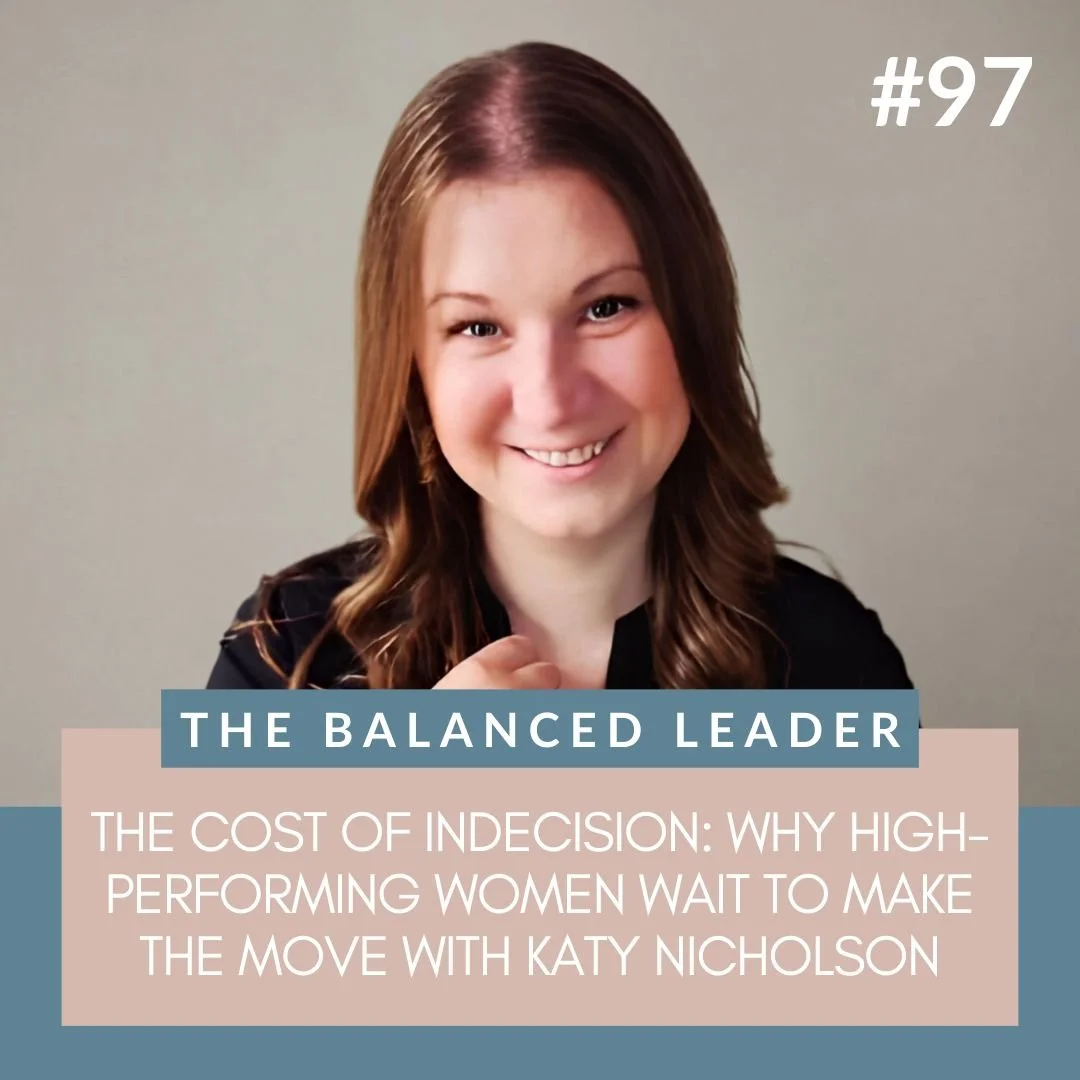
What Is Waiting Costing You?
How long have you known it’s time to make a change, but kept yourself stuck in the space between deciding and acting?
In this episode, I sit down with Katy Nicholson to talk about what happens when high-performing women feel out of alignment but struggle to trust themselves enough to make the move. Katy shares her journey from spending years questioning whether to stay in a successful role to realizing that the energy she was spending on indecision was far greater than the energy required to make the decision.
Together, we explore how self-trust, emotional capacity, and the courage to take imperfect action can help you move forward before you feel completely ready. You’ll learn why fear doesn’t disappear before a big decision, how listening to your emotions can reveal what needs to change, and why surrounding yourself with the right support can help you trust yourself and step into your next level of leadership.
Interested in working with me? Book a free 1:1 consultation here!
What You’ll Learn from this Episode:
Why high-performing women can stay stuck in indecision even when they already know what they want.
How the energy spent questioning yourself can become more exhausting than making the decision itself.
The difference between feeling fear and allowing fear to make your choices.
How to use emotions as information instead of letting them take control.
Why self-trust means believing you can handle the outcome, even if things don’t go perfectly.
How building emotional capacity helps you take imperfect action before you feel completely ready.
Why having the right support system can help you see your strengths and step into your next level of leadership.
Listen to the Full Episode:
Featured on the Show:
If you haven’t already, please follow the podcast and leave a rating and review to let me know what you think. Find complete instructions here!
Send me an email: connect@aspire-coaching.co
Watch my TEDx talk: Reclaiming anger: A woman’s birthright
Get the free guide, The 5-Minute Reset to Own the Room, here!
The Let Them Theory by Mel Robbins
Episodes Related to the cost of indecision:
Full Episode Transcript:
Welcome to The Balanced Leader, hosted by Yann Dang, a Leadership and Life Coach with over 20 years of corporate experience. Drawing from her journey as a former global finance leader and second-generation immigrant, Yann understands the unique challenges women face in male-dominated workplaces.
Each episode offers insights on balancing masculine and feminine energies, mastering soft skills and building emotional intelligence. Join us to transform frustration into empowerment and unlock your authentic leadership potential.
Hey podcast listeners, welcome to today's episode. We are going to talk about what it's like to move before you feel ready. I have a special guest here, Katy Nicholson, who I've worked with for quite a while. She is part of my Command container, which is a women accelerator leadership program. And I'm so excited to have her here and for her to tell you more about her transformation. All right, Katy, good to have you. Please introduce yourself.
Katy Nicholson: Oh, thank you. It's good to be here. My name is Katy. As Yann said, I've worked with her for many years now, both one-on-one and through Command. I spent years in a national nonprofit and recently made the move to a smaller, regional nonprofit as the executive director.
Yann Dang: Yeah, and tell us what all went into that because I think there's a lot of listeners, a lot of women who have a desire for change, have a desire to move. And I think your change was quite drastic as well because you also moved across the country before you made this decision. And so you can walk us into that. But oftentimes when I am coaching women, it's like they want to move, but there's a lot of fear. So tell us what it was like for you. And, how long you had been wanting to move and why. So, go ahead.
Katy Nicholson: I think for me, what started out this journey was this feeling of being out of alignment, but not being able to name it, right? I candidly had spent a lot of my career being guided by the organizations that I worked in, right? I was kind of person that could step in and do a lot of different things, which is a great skill set to have and one that I'm learning many women, especially in Command, have and the organization was saying, "Oh yeah, you're great. Now we're going to have you do this. Now we're going to have you do this."
But when we started to working together because I felt out of alignment, it was only in that moment that I realized, oh wait, someone else is driving my career trajectory. I'm not taking the reins. I'm not taking ownership, which is why I started to feel so out of alignment, so far off from where I thought I wanted to be. And by all accounts, I was successful, right? Getting the title, getting the raises, getting the portfolio increases, but that wasn't the issue. The issue was being true to myself and what I wanted and what I was ready for.
And I think there's some times where I'm a little ashamed to admit, but trying to remove the guilt of, I spent maybe two years stuck in that debating stage of, I've got this stable job, I've got a supportive career, I can move up here, I can do things, but it still didn't feel where I should be or where I was going to grow as an individual. And so taking that time to explore myself, get confident in my feelings, and also drown out the external narrative. We've done a lot of work on family of origin and maybe pressures from childhood or parents or things like that, right? It's powerful to find my voice and to say, no, this is really what I want to seize it.
And the minute I made that distinctive choice to say, "No, I'm going to leave, I'm going to take the leap," everything started falling into place. It just took me to make that shift in my head, and it's almost funny to think about how much energy to your point I expelled in that indecision. Every conversation with friends was, should I stay, should I go? Every conversation with family was, should I stay, should I go? Now it's like, oh wow, I actually have a lot of free time, more so than I ever anticipated because I stepped into that space.
Yann Dang: Well, you have a big job, so I don't think you have like tons of time, but you have more probably purposeful time, like actually handling problems and projects and leading an organization towards what you care about and what's in alignment for you.
Katy Nicholson: Absolutely. My time is spent building the future and the path that I want and not just sitting in that kind of fear of, am I going to regret it, right? Am I going to regret taking a different role? Am I going to regret moving across the country? But what I've learned that's so powerful, especially in Command is to sit time with yourself and to say, "No, this is what I want." And feel worthy to say that I, I can want that, and then be supported by this powerful group that is your cheerleaders and saying, yeah.
And the thing is, I know I'm not going to get every decision right. Like we bought a house here after moving, and I didn't love it. I didn't get it right. But to be in tune to say, okay, it feels out of alignment again. How can I get back on track? How can I listen to myself and my instincts and trust myself to know that I can find the path that feels better and satisfies my needs in that time.
Yann Dang: So this is so great because it's like not only did you make this big move, but you continue to practice the same skill set to, I don't think the indecision, it's just catching ourselves in the indecision because it's going to come up, right? Especially oftentimes in my group, I'm talking about women's brains. We're very great at doing multiple scenario planning. We're looking at all of the possibilities, but it's also that groundedness of, okay, it's time to make that decision.
So there's sort of that feminine like, what are all the scenarios and what are all the factors? And then there's the masculine like, okay, now we make a decision. Now based on, you know, I think there's still that feminine like alignment of our body and our emotions and trusting ourselves, which is quite feminine, right? Like we're going to move into that space of, now I've done it and I'm not going to spin around in indecision, but I'm going to make a choice.
Let's take it back a couple of beats for the podcast listeners because you said a lot of things from that, being in the indecision for two years and questioning and how much energy that took. But what you also said was there were factors like feeling more confident in your emotions, like trusting your emotions. And one of the big things we do in Command is, build your emotional capacity to hold more emotions and to use them, right? Not to, I think sometimes we can get spun up with our emotions and they take us for a ride. But we, one of the big things that I teach in Command is like we understand the emotion, we separate the story from the emotion, we move forward with it.
So tell me what your journey was with that. And then I also want to touch on the family of origin because these are two big pieces that I think for you unlocked to help you trust yourself.
Katy Nicholson: I mean, we started working together because I had a lot of anger, right? And I didn't know how to express it. I didn't know where it was coming from. And I also had a lot of empathy with my team and their struggles and not knowing what was my weight to carry versus like the important boundaries that I needed to place in supporting them and supporting myself.
And I quite candidly, I don't even know if we've ever discussed this, but it's like, I started working with you because I wanted you to make me comfortable in my role. Like I fell out of alignment and I wanted you to coach me to make me feel like, no, this is the place you need to be. Like you're making smart choices. I didn't expect this journey to go in this direction to say, no, listen to that anger, right? It's a signal. It's telling you something. Don't suppress it because then it's just going to work itself out in weird ways. But to use it as a gauge to say, okay, something is wrong. Listen to that and see where it goes.
And so there were a lot of conversations that I had with my team and my boss at the time to say like, it's not feeling right. Like maybe this, maybe that, and really supportive group to say like, what if we make these shifts and things like that? But it took the listening and then the action, right? To say, okay, I'm going to use it as a gauge. I'm going to try a different approach and see how that works out. Right? Like I think stepping out of just the mental spaces, you have to start to act on some of these things to get a redirection if you're headed in the right, the right path or not.
Yann Dang: Well, I think this is a great point because actually when you came to me, you're like, I'm angry. I like go home, I'm angry. I'm like with my husband and kid, they're, I'm angry. And it was like, and I think this is kind of goes back to the family of origin and how anger played in it, right? But I think just one of the points that you said too was like that you came into coaching wanting a result, but this is also the reality of coaching, like it's part of that co-creation. And I'm always coaching people towards what they want and always asking them what matters to them and supporting them to feel the emotions.
I think oftentimes people think like you hire a coach to like get you somewhere, but it's actually the process of the coaching that emerges, right? Your vision emerges from, you know, understanding your emotions better, having that capacity to feel them. And like you said, you're not just spinning around being angry, you're actually saying, okay, something feels off. I'm going to try some things and I'm going to see what happens to that. But let me pause there and if you can share a bit about the anger and the family of origin, because I think that'll help the listeners also understand, you know, your relationship with anger and your journey with it.
Katy Nicholson: Yeah, one of our kind of first group sessions, we talked about masks and the different ones that, we carry and why, where they come from. And for me, it was really eye opening to realize that I was stepping into the space of like the good girl, right? Doing what I was supposed to do, suppressing what I wanted, suppressing the things that were important to me. And I knew that I was doing that at work, right? Like taking on this role, taking on this new project without ever questioning, just being like, "Yep, when do you need it by?" Like I need to, you know, put in double the time, I'm going to do that, right? Instead of saying, okay, how do I still meet my needs and say that I don't want to do that thing?
But the critical part was understanding where that came from. It came long before I ever entered the workforce. It came in my family dynamic is that was expected, right? In this culture of, we want you to in essence comply. We want you to be this good kid and say yes. And that's where there wasn't a lot of dialogue in my family and it's not to say again that we didn't love each other and it's just my parents, I don't think had that skill set to say, let's talk about what you're feeling, let's talk about your wants, your needs, and figure out how to get that. And I'm still unpacking a lot of that to this day.
Yann Dang: Well, let me share some context about, what that is, because it's going to be different for different people. Like for me, you know, I oftentimes talk about like being a child of refugees and like immigrants and like really needing to be super responsible and really my parents were just in a new place trying to figure it out. So like how could they have the emotional capacity to understand what my journey was? They were going through so much themselves. But I think for you, right, it's like Catholic girl, dad who's in law enforcement, right? Middle child. There are some of these themes of like, how do I survive this childhood? What do I learn in this system to move forward?
Katy Nicholson: I think that's right. Like, I mean, we've talked a lot about like my Christian upbringing and how that factored in. But even if I think about my parents' origin story, right? Like my mom grew up on a farm and education was not a thing, career was not a thing. She tried to go to college and my grandpa drove out and took her home. He said, "No, you belong here." So I think about that, right? She learned as well to comply and to do those things. And I'm proud to say now she's going back to school towards the end of her career for her and finding that voice, right?
But then also on my my dad's side, the law enforcement, all he knows is control. That's what he was trained, stripped down to bare bones of a human to say, this is how you get compliance, this is how you get control, this is how you handle a situation. There are no if ands or buts, right? Because it's dangerous, right? So it felt very life or death for him. And that's how he knew to respond. And again, only now is he realizing, oh wait, that's probably not the best approach, right? But it takes that realizing of where it came from, acknowledging it to be able to find a different way forward.
Yann Dang: Yeah, and so even with that context, right, you're in this work environment. And actually, some of these things have made you highly successful, right? Head down, get the job done, figure it out, control things that you can control, move forward, please authority, right? Comply with that. But at the same time, there were things that were out of alignment for you. How did you, because there's still that fear. And I think sometimes there's a misconception that people think you just decide and the fear goes away and you just move ahead. But what was that like for you to finally decide? What was the self talk and what were your emotions?
Katy Nicholson: So when I finally decided to make the shift and apply for a job, right? A wave of insecurity followed, right? I had made the decision. I was going to rescue myself from this situation. I was going to stop being indecisive. I was going to take action, and then that wave hit me. And I wasn't quite prepared for it. And we talked about it. And I, I asked you, I was like, I want to be unflappable.
And you quickly reminded me that this is a human experience. Like we're going to have that fear. We can't expect to make choices and that fear just dissolve. It's what we do in that moment of pushing through that matters. And so there was a really powerful moment for me in command where I was going through the interview process and something came up in relation to quite honestly, I think my age, something I can't change.
And I was starting to talk to the people in the group and my fear was felt and my insecurity was felt. And then you asked me a question, you said, "Well, what would you tell them if you could address it directly?" Right? Because they hadn't said it directly. I found out through the grapevine. But what would you tell them if you could address them and confront them on this topic? And it gave me an opportunity to talk about who I am and my strengths and what I've accomplished in such a short amount of time and the kind of person and leader that I am.
And it was remarkable because the women provided me feedback and they said, "Katy, you have to go back and watch the recording because you shifted in that moment. When you don't focus on the fear and you focus on your strengths, it's felt and it's visible and you can see it." And so it's acknowledging that that fear still exists, but choosing to focus on the strengths and choosing to focus on what we can control and ultimately, they might have decided that was a weakness that they couldn't have overcome. But because we worked through in command and because I had this essentially these cheerleaders pointing out my strengths, drowning out that insecurity, I think I showed my best self in that process and I'm, I'm grateful at how it turned out because of that.
Yann Dang: Well, how did it feel for you to get the feedback from the women and to know that there are all these women in your corner?
Katy Nicholson: I got emotional about it. I feel like I'm still getting emotional to this day because I feel like when I started Command and seeing the people in the room that I was like surrounded by, I was like, I don't belong here. I have nothing to contribute to this group, right? But that moment and their comments, I felt so seen and I felt like, oh no, I'm the only one holding myself back from belonging. I get to make that choice. I get to be in this room. And I get to influence how people see me because it's based on how I see myself.
Yann Dang: Yeah, like at the end of the day, you're deciding. You oftentimes we judge ourselves before other people even judge us, right? But what I'm also curious about is how does it feel to be in the room with these strong, powerful women? You taking up space, you getting coaching, you getting the guidance. How does that feel for you?
Katy Nicholson: I feel like I'm leveling up, right? It's always a little bit outside of my comfort zone, but there's no growth in the comfort zone, right? It's helpful for me to realize that I do have things to contribute and that my voice matters. And there was, I think a week where maybe you were on vacation and one of the women in the cohort was like, "I've got this thing. I need you all to hop on and join." And there was a moment of doubt. I was like, I don't have anything to say. She's a major powerful player in this space and I look up to her.
But hopped on, listened, and was like, "Oh, I've dealt with something like that. In fact, I felt like I navigated it pretty well. Like, maybe I could share some of my experiences." And that's, I think that's the power of the group is we all have something to learn from each other because we all have our blind spots, right? And this group is an opportunity to shine a light on those, but like not, not in a negative way, in a like, let's help each other, let's learn from each other because we need each other to shatter ceilings.
Yann Dang: Yeah, and I think there's like a normalization as well because you hear women from different industries. And then, you know, even when you shared about the age thing, there were other age things that people were experiencing. So I think it's also expands the perspective and normalizes your experience versus I'm alone in this, there's nobody who understands this, you know, maybe there's something wrong with me. But the more you either witness other people that you respect and you see, the more you also have a sort of more respect for yourself and being in the room and noticing yourself of like, actually I am, I do belong here and they belong with me too.
Katy Nicholson: Yeah, and I'll tell you so in in this new role that I've stepped in, everyone has been willing to share their advice and the kind of consensus is it's lonely at the top. It's very isolating. You're not going to have anyone to confide in. So the sooner you build a cohort of people that you can turn to and confide in confidentially, the more successful you'll be. So I feel like what an incredible thing that I have taking into this role, I already have this network that I've built that is there for each other.
Yann Dang: That's so great. And I think there's the one-on-one experience, which is like you can deepen and do lots of this deep work, but there's that group experience where you get other things. How would you describe the one-on-one versus the Command group?
Katy Nicholson: Yeah, I think the one-on-one helped me spend time with what I want and voicing that and articulating it in a meaningful way, but the Command sessions sparked a different aspect that I didn't even know was missing on exactly what you said, normalizing. Because I spent so much time being like, "Well, this is just me. Like if I were this and this, I wouldn't be struggling with this issue. I wouldn't be worried about this. I could just move forward because that's what I think confident women do."
But in Command, it was like, "Oh no, like everyone has these moments of self doubt.” Everyone that I would just look up to and be like, they're perfect. They've got it all figured out. They don't need any help, right? And the standards that I would hold myself to is it's not real, right? And it is, I think extremely important in my journey to have come across that vulnerability of this is what it takes to progress to these levels, right? And no one talks about it except for you.
Yann Dang: Yes, that's great. Well, I'd love to hear what your thoughts are. What would you say to, there's a woman listening to this who has been just like you back and forth, maybe for two years, maybe longer than that. And there's a decision she already knows she wants to make. What would you tell her?
Katy Nicholson: I think two things. If you already know, you have to start listening. But that took work for me to get there. So I'm not naive in saying like, oh, just, just make the change, right? I think it's worth the time and the investment to build that network, to build those positive voices because there's a lot in the world that's going to flood you with negativity. People that maybe actively working against you, right? But building up that positive force that you can confide in, talk in, and build the life that you want. And so for me, it was investing time and financial resources to make this shift. And until I was willing to make that commitment and take change seriously, right? When I have skin in the game, there are high stakes, I don't think I would have gotten to this point.
Yann Dang: That's great, Katy. Thank you so much. And this is actually what I consistently talk about when we are talking about building the foundation and going to school on yourself because so often times we are trying to disempower ourselves by questioning ourselves or suppressing that thought or that yearning inside that says, you know, there's more out there for you. But it also rocks things up and then you're not in compliance anymore, right? But this is that courage isn't something that we wait to feel. It's actually inside of you as you listen to yourself more, as you trust yourself more. And you have the capacity to know and feel the fear, but you also have the courage to take that imperfect action because we never know, right? For you, luckily, it was just that one. I think you just, was it just one that you had applied for? Did you apply for multiple?
Katy Nicholson: It was the one. I also acknowledge that that's like not the same for everyone. And well, I will say like I dabbled, right? But this was the one where I saw it. My first instinct was to say, "Oh, it's been posted for a month. That's too long. No one's going to look at me now," right? But then I said, "No, I'm perfect for this role. This is the perfect job for me and I can do really good things here." And so I messaged the recruiter, something I probably would have never done in years prior, but to say, I'm going to take that bold action. I'm going to put myself out there because I know that this is a good fit for me. No one can tell me it's not.
Yann Dang: Well, I love this because it's like the compliant good girl rule follower is like, "Whatever, I'm still going to go for it," right? Like this is what you're creating as you, right, are more and more in command of yourself and you're like, "Well, what's the worst that can happen? I just ask and let's see." And like, you asked, and not only did you ask, I think it was like a fast track to an offer and an offer, by the way, that you negotiated well for yourself, which is again, that self-trust and that foundation that you build.
Katy Nicholson: Absolutely. Yeah, that negotiation process was one that again, didn't feel comfortable, but I knew that I needed to do it. We talked about it in one on one sessions and in command and I can't tell you how much it meant to me that there was another Command session that we had recently where someone was like, "And I negotiated and I put down boundaries and it worked." Like and so it's like again, going back to that, we're learning from each other and supporting each other.
Yann Dang: And inspiring each other, right? I think that's a big thing too. I think there are other women in the group that are on the cusp of deciding for themselves what's next. And they are getting inspired because they're like, this person can do it and it can happen fast. And this person, it took them longer, but they also did it, you know? I think that is the perspective that you get when you're in a group. And it is also the energy of this unified field that we are moving towards the desire and the alignment that we want.
So thank you so much for being here today and sharing your experience. I think there's going to be so many women who are going to listen to this and start listening to themselves more as you were saying and start understanding their emotions in a more grounded way and moving before they feel ready, right? Because I think there's always this thought where people are like, "Oh, I have to feel ready." But that fear is always there. We don't always feel ready to take that next step, right? But we decide that we trust ourselves. And exactly what we build in command, we build the self-trust, the emotional capacity, the courage, the inner authority that allows us to take that imperfect action even when fear comes up.
And what I love about your story too, Katy is like, and then you do it again, and you do it again. You know, you're never done, right? This is part of life as you expand. It's just the way the relationship you have with yourself and your emotions changes because of that foundation.
Katy Nicholson: I will just say that one, thank you for having me. Having this opportunity to reflect back is like huge to say, "Wow, look how far I've come," right? Because if the benchmark is always moving, you forget to realize that you are making progress forward. But I think for me, if I could just echo this self-trust piece, realizing that trusting yourself is also if you get something wrong, you can trust yourself that you can correct it and you can fix it and you can handle whatever comes up in the moment. And that for me helped remove some of that fear to make that momentum.
Yann Dang: Yeah, and this is huge because I think as children, we get punished and we don't control that, right? But as adults, oftentimes we're punishing ourselves more than anyone else, and it's more of that mental, emotional game we play with ourselves. But you can also say, "No, I'm done with that. This is not what's happening here with my time and energy, and I'm in command of myself, and I get to decide how I feel about myself in this moment, even if I've made a mistake." All right. Thank you so much for being on today. I hope you all get a lot out of this episode. I hope you are inspired to take action before you feel ready. And I would love to welcome any of you into Command.
Katy, do you have any words for people who are interested in Command or thinking about it? What would you say to those folks out there?
Katy Nicholson: I would say join, try it out because you won't be disappointed. And that's the first step. That's the first step to taking real and meaningful change is to have that accountability in a group.
Yann Dang: Yeah, and I think like you said, right? When you start taking yourself seriously, you start taking your goals seriously, you start listening to yourself and, you know, this is an investment in your future and what matters to you. That's part of this whole journey. So thank you so much for being here. And I am excited to continue to see where you go.
Katy Nicholson: Thank you so much for having me.
Yann Dang: All right, take good care. Bye.
Thank you for being a part of The Balanced Leader community. We hope you found today's episode inspiring and actionable. For more resources and to connect with Yann, visit us at aspire-coaching.co. Until next time, keep leading with confidence and purpose.
Enjoy the Show?
Don’t miss an episode, follow the podcast on Apple Podcasts, Spotify, YouTube Music, RSS, or wherever you listen to podcasts!