84. How Powerful Women Lead Even When They Feel Fear
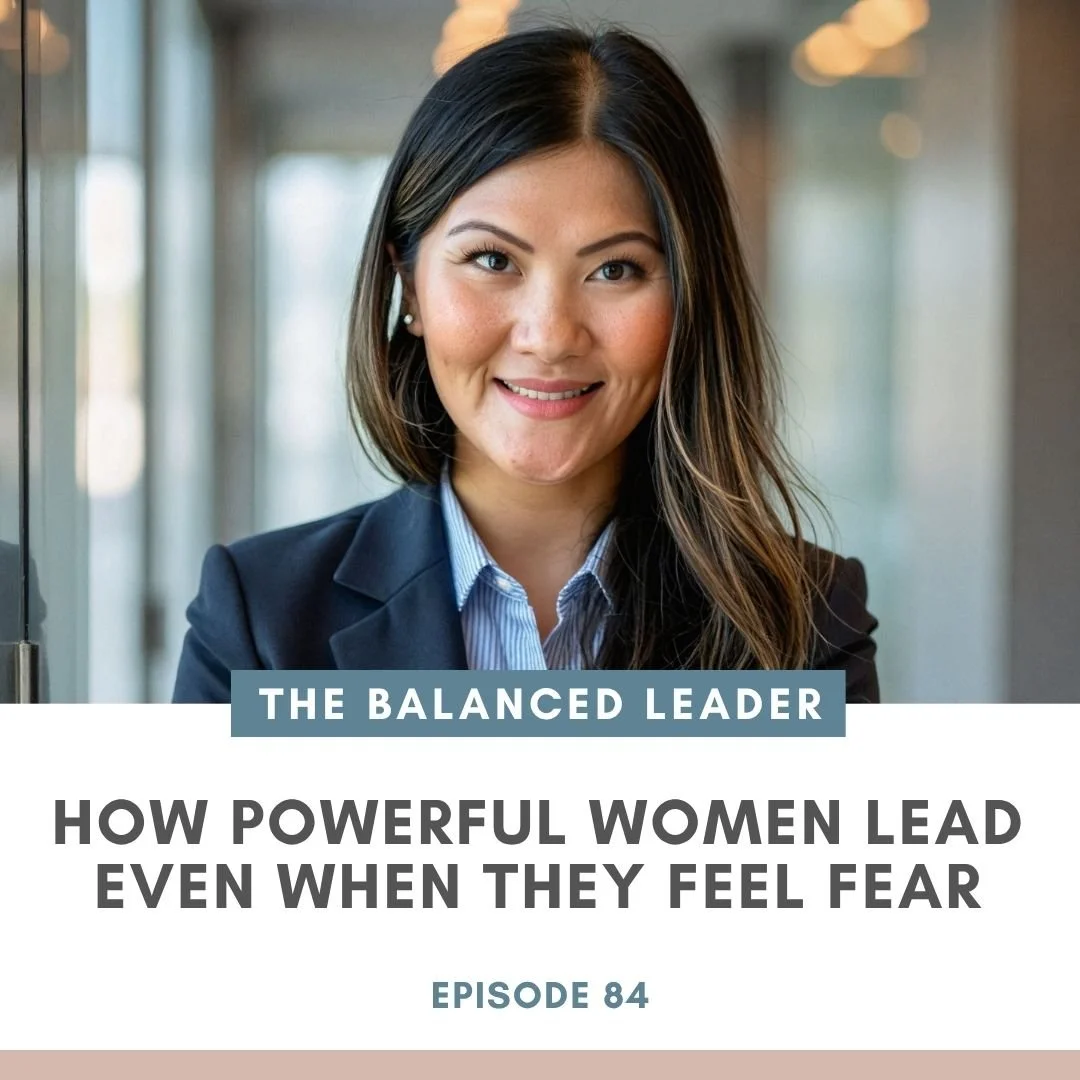
Fear is a natural part of stepping into new opportunities, but most women mistake it for a warning sign to stop. High-achieving women often feel paralyzed by fear, doubt, or overwhelm when facing new responsibilities, bigger rooms, or unfamiliar leadership challenges. In this episode, I share why fear is not the driver—it’s simply a signal, a passenger in your leadership journey that you can acknowledge without letting it control you.
I walk you through the mental framework I use with my clients to reclaim the wheel: noticing fear, naming it, and choosing your next move deliberately. You’ll hear real examples from executive-level clients and my own experiences navigating fear while leading major initiatives, stepping into visibility, and managing uncertainty. This episode shows you how to use fear as data and energy to act, rather than as a reason to shrink.
By the end, you’ll have practical strategies to step into discomfort without retreating, regulate your nervous system under pressure, and continue moving toward your goals even when fear shows up. Fear doesn’t stop you—it signals that you’re expanding into your next-level identity.
Interested in working with me? Book a free 1:1 consultation here!
What You’ll Learn from this Episode:
Why fear is a signal, not a stop sign, in leadership.
How to notice fear without letting it control your decisions.
Practical ways to “reclaim the wheel” and lead deliberately.
How to step into discomfort and act even when it feels scary.
Why fear is inevitable in leadership and how to use it as data.
How to regulate your nervous system under pressure.
How to move forward with confidence, clarity, and authority.
Listen to the Full Episode:
Featured on the Show:
If you haven’t already, please follow the podcast and leave a rating and review to let me know what you think. Find complete instructions here!
Watch my TEDx talk: Reclaiming anger: A woman’s birthright
Get the free guide, The 5-Minute Reset to Own the Room, here!
Episodes Related to How Powerful Women Lead Even When They Feel Fear:
Full Episode Transcript:
By the end of this episode, you're going to have a simple way to handle fear, doubt, and overwhelm so you can keep moving towards what you want, even when it feels uncomfortable.
Welcome to The Balanced Leader, hosted by Yann Dang, a Leadership and Life Coach with over 20 years of corporate experience. Drawing from her journey as a former global finance leader and second-generation immigrant, Yann understands the unique challenges women face in male-dominated workplaces.
Each episode offers insights on balancing masculine and feminine energies, mastering soft skills and building emotional intelligence. Join us to transform frustration into empowerment and unlock your authentic leadership potential.
Hey podcast listeners, welcome to today's episode. We are going to talk about cars today and fears and feelings and desire. I wanted to share that I have just finished the Leadership Lab with a bunch of women. And on the last day of the leadership lab, I talk about the price of command and what it really feels like to step into uncertainty, to step into visibility, to speak up, to take up space, especially in rooms that weren't built for you or where there are tons of people that don't look like you at all.
So, I talked about all of this, and the thing that came up was fear, fear of moving forward, fear of taking up that space, fear of the risk and the unknown, and the uncertainty at the other side of it, right? So I want to share this with you because I think this metaphor really helps my clients and myself as I think about fear.
So, I want you to think about your life like a car. You are the driver of this car, right? And your goals and your desire are the destination. You are driving towards what you want, what you desire. And your emotions are passengers in this car with you. Most women think the goal is to get rid of fear, doubt, and anxiety. We call it a lot of things: imposter syndrome, anxiety, all of these things, overwhelm.
And what I want to share with you is that having emotions is part of the human experience. And it's okay to have emotions, right? And the goal is not to get rid of it. That's not the goal. The goal is to let them be in the car, just not in the driver's seat. So, I know you all know there's a concept that I have around command. And that doesn't mean control. It means I'm in command of myself. I am with myself. I'm regulating my emotions. I am understanding myself, and I'm also open to the experience of life as it is unfolding.
Fear can ride in the car. It just doesn't get to drive. I want you to notice this, right? Because often times, what happens when we are flooded with emotions and when doubt and fear and anxiety take over and start driving the car, it will have us pushing the brakes on ourselves instead of moving forward, instead of speaking up in a room. It will say this is too scary, something really bad's going to happen. Let's push the brakes, right?
So, instead, I want you to imagine yourself as the driver in the car, the one that is leading you and the car and the passengers forward. So fear can ride. It just doesn't get to drive the car. Because what happens when fear shows up and we interpret it as danger? We overthink. We stop. We delay. And we tell ourselves, I'll move when I feel better. This is what happens, the emotional tension that happens in high-stake rooms. We say to ourselves, I'll do it next time. I'll wait for my CEO to talk. I'll wait for my leader to talk. I don't feel safe in this car, right? Basically, you're saying, I don't feel safe because the fear is driving you. We tell ourselves that let's just delay. Let's not make this decision right now. Let's not go.
But here's the truth. You won't, because the very thing you want is on the other side of the emotions you're avoiding. It won't happen. Whenever you're wanting to move forward and you are struck by so much fear and you don't like that feeling of discomfort and you allow fear to drive, fear becomes more powerful. It has already stopped you before you started, right? So I'm going to give you a few examples of this so that you can really understand what I mean by fear and how we sometimes allow it to take over and what actually happens.
I live in Florida and there is just like tons of lovebugs. I don't know what happened this year, but the other day my daughter saw all these lovebugs. And her reaction was she was totally overwhelmed and felt so fearful. It was so hard to watch as a mother because I was like, listen, these bugs don't bite. I know they're annoying. But in her body, it felt so real, urgent, like something was wrong. And that actually scared me because I was like, listen, if you can't calm yourself down, you're going to hurt yourself.
So she was feeling all of this fear, and I didn't tell her you shouldn't feel that way. I didn't try to eliminate the fear. Instead, I stayed with her while helping her move through it, taking deep breaths, actually regulating her nervous system as there's swarms of lovebugs around. And that's what most women don't do for themselves. Instead of learning how to regulate yourself with the fear and saying, "Hey, I'm with you, fear. I'm in the driver's seat." You abandon yourself the moment fear shows up. You say, let's do it later. Let's not put ourselves at risk. And when we keep doing that, that fear grows bigger and bigger, and then we feel more stuck in our life because we're allowing that fear to drive the car, to actually just put a big foot on our brake and not have us move through it, right?
So I wanted to share that example because how we relate to that fear, how we deal with it, how we are with it, but still choosing to move ahead and how I'm talking to my daughter like, I know this is really scary, but we need to move. We need to still walk forward. And let's do this together. Let's breathe together. Let's count together. I have her actually count to calm down her nervous system. And we do it. We move through it, right?
Here's another example that I want to share with you. I remember when I was a director and I got the opportunity to lead a big budget process. I think I might have been, maybe I was promoted to VP at that time. But anyway, I used to feel this way during budget season, like full of pressure, full of scrutiny, full of expectations. It was this huge thing for us, right? We needed to get budget done. We need to have lots of conversations with people. We need to sell budget to our parent company and to get really clear about what we were asking for and why, right? So fear was there.
But I got to decide what I was going to do with that fear because fear was always there. It's just there, right? What if I missed something? What if I got challenged on this? What if people tell us that we've made a big mistake? But I still showed up. I still led. I still made decisions, right? So I was in the driver's seat. Fear was in the room, it was in the car, but it wasn't running me in the meeting. And the more and more you learn to calm your nervous system down, the more you learn to be grounded in yourself, the more the emotions can be there without overriding you as the leader.
That's leadership. I think a lot of women, we touch on leadership, and then we get so scared about all of our fears that come up. And we self-sabotage. We say we're not ready for this. We want to get another certification. We want to get an MBA. We want to get other things to help us not feel what we're going to feel. But what I want to tell you is that you're going to feel what you're going to feel, and the feelings are not the enemy. Often times, if I feel fear now, I'm like, what is the fear? And I use the fear to maybe have me plan better, maybe have me ask more specific questions. The fear is there for a reason. Sometimes fear is just there because you're anxious and doing something new. But if you can at least say, "Hey, I get it. You feel scared because you're doing something new and you haven't done it before and there's a lot of uncertainty. But I got you. I got you covered."
That will help your nervous system calm down. And it will help you to say, okay, I know that there's this fear and I've thought through that fear and that's okay. Now I can at least move ahead. The fear doesn't stop me. I have a conversation with it. I have a relationship with it.
So, let me share with you a little bit more of how I think about fear because this is super important. Fear is not the problem. Avoiding fear is the problem. Fear is activation. Fear is movement. Fear is a signal that you care, that you're alive, right? You don't need less fear. You need a different relationship with that fear. When your desire is stronger than your need to feel comfortable, and if your capacity to hold more fear and to hold more uncertainty and to be more unknown, right? You start to learn how to move with this fear. Wow, this is scary. I am now in charge of this huge budget. Now I'm in charge of this big organization. Yes, it is scary, but I can handle the fear.
So I want you to use this simple, repeatable framework. Notice who's in the car, right? Notice what your emotions are. Who's in this car? Wow, there's fear, doubt, overwhelm. I'm just noticing it. And I'm going to use this framework and then I'm going to share an example of one of my clients that is going through a lot of this fear. But number one, notice who's in the car? What are the emotions? Name it. Say it, fear is here. You don't want to say, "I'm afraid," right? You want to create some separation between you and the emotion. You want to name the emotions, not so identify it as like, "I'm scared." It's like, fear is here. Joy is here as well. If you can create a little space between you and your feelings, you get to reclaim yourself.
And you want to reclaim the wheel. You want to say, "I am in the driver's seat." I am not the fear. Fear is happening in my body right now, and there are other emotions happening in my body, but I am not fear. I'm more than fear. I get to reclaim myself. Where am I going? Ask yourself, where am I going? And drive anyway, right? Take that next step even with that fear sitting next to you. You don't wait for silence in the car. You drive with the noise. Just like if you were in a busy car with your kids and everybody's screaming, you are focused. You're like, "I have the life and safety of everybody in this car, and I trust myself to be calm and to focus my attention and to be disciplined and not to allow the distraction and noise to take me out of being in the driver's seat." This is how you need to be with your emotions. You need to support yourself in a commanding way, not in a controlling way, in a commanding way to say, "Okay, fear is here." Right? Even me saying it like, "Oh, there is fear," right? You're naming it to calm your nervous system and realize that there's choice here. There's emotions happening.
And I wanted to share this tool because I just used it with my client who has now stepped into a CEO role. She was always kind of like the number two and now she's the CEO. And she's noticing so much fear and so much doubt and so much overwhelm. And we have really practiced naming the feelings and being able to have a conversation with it and reclaiming the wheel, right? And even questions like, if you weren't afraid, what would you do? This helps us reclaim the wheel and take that next step and to help us drive towards what we want and what we desire. Because that fear is there. You don't want to suppress it or think that it's not there because that's not true and it actually takes a lot of energy to suppress it.
But for you to say, "Fear is here and it's okay. It's here to protect me. Fear is here to help me. Fear is not here to say stop," right? This is where a lot of people go into all-or-nothing thinking. They indulge in their fear, they spin out in it versus being like, "Okay, fear is here, let me have a conversation with it."
Like often times, this thought comes up for people like, who are you? Who do you think you are? And depending on the tone, it could feel very dismissive, it could feel very condescending, it could feel very aggressive. But you can also transform that voice to say, "Who do you think you are?" And it could be the most activating, exciting voice of like, who are you? Who do you think you are? And you get to answer it, right? You can just say, "I am a woman who is leading. I'm a woman who is willing to take space, to speak up, to make an impact. I am a woman who is willing to be with my fear and move anyway. I am this woman. I am this person," right? So answer the fear. Have a grounded conversation with the fear. Don't let the fear say, "Hey, all this gloom and doom is going to happen."
Just like when you're speaking in a meeting, notice yourself. Fear is there and speak anyway. You're about to post your article on LinkedIn, a thought piece that was super important for you. And you have all this fear that you're going to get negative feedback and maybe nobody will comment on it and see it. So I want you to notice, fear is there and post anyway. What's the worst that can happen? Part of your brain wants to say the worst thing is like all these things, but really in a grounding, discerning way say, what is truly the worst thing that can happen and the likelihood of it, right? Having more of that grounded conversation. And then when you go to make a decision, fear is here. Decide anyway. Don't allow that fear to stop you from your decision making. Don't allow yourself to delay your desires because of fear.
Your power is not in eliminating the emotion of fear. It is leading with it present. This is how we use our emotional intelligence. We don't use it to lead with just our emotions. We need to use our brain and our logic and our groundedness and use our emotions in a grounded way to have us lead and really feel like a human person as we're leading, right? So you're not meant to be emotionless. You're not meant to be robotic. You are meant to be in command of yourself with your emotions intact. And you are meant to let fear come, let doubt come, let overwhelm come. Just don't let it drive the car.
I want you to really hear this and sense this because when fear comes, I want you to be able to say to yourself, there's a few words that I really want you to take from this podcast, which is fear can ride. It can't drive. Fear can be in the car. It can be like an accessory in your outfit, but it's not running the show. And I want you to know that you don't need to feel better to move forward.
Sometimes the fear is there and it can feel scary and you are going to move anyway. Emotions are passengers. They are not leaders. You drive forward always in command, in connection with yourself. That is the number one thing that I want you to get from this episode because the reality is if you are brilliant, but your brilliance is too subtle to be heard in these high-stake rooms and you need to learn how to speak up in a more commanding way and you need to see yourself as commanding and worthy of taking up space and that your words matter. Fear is going to be there.
Fear is always with me, but it doesn't control me. Right? Fear is just part of my makeup. And I think being a child of Vietnamese refugees, I actually think that like fear just runs through me a lot more because that is my ancestral like what was passed down. And I've done so much work on myself to embrace the fear, to embrace the unknown, to feel solid in myself, to create safety within myself even if fear is present and is there.
All right. So I want this for all of you because if you are to really show up for yourself, if you are to be commanding in the spaces that weren't created for you, fear is going to be there. Your relationship with your fear is everything. Your ability to connect to your fear and expand and still move forward with it is everything, right? Because if you keep letting that fear control you and you don't speak up, that fear becomes bigger and bigger and bigger. And as you continue rising up the ranks in your company, that fear will take on more and more of a control for you.
And it will have you be telling yourself, "Actually, I'm not meant for this. I am not made for this. I don't know how to deal with all this fear. I don't know how to be with myself and the fear," and then you end up burning out because you try to push through things or you try to work your way out of things, right? Instead of feeling the fear, you double down on working harder, but you still don't get the promotions because you're not being visible and you're not actually taking up the space that's needed to elevate your leadership, right?
And this is why the work around building your emotional capacity is so critical to executive maturity, which is being able to have these emotions and still move ahead. The reality is if you're an executive, if you're a leader, a lot of emotions are going to come your way. You're going to be responsible for a lot of things. It doesn't mean you can't handle it. It means you need to expand into it. And your emotional capacity to hold these emotions and still move forward needs to grow as you grow as in your leader or it will be your ceiling. It will be the thing that stops you from actually accelerating and your emotional maturity will cause you to not be able to move forward if you are not actually growing it and expanding it.
All right, that is today's episode. I want you to go out and take this really to heart and to use this and notice, hey, oh my gosh, fear came up. Okay, I am in the driver's seat. Fear can sit on the side or it can sit in the back, right? You might not want to give it the shotgun position, right? You might want to say, "Hey, you got to go to the backseat. I need other emotions. I need joy in the front seat. Maybe I need some anger to get to intentionality, right?" Or maybe you're like, "I'm good with my fear. Fear is here and I am good with working it. You can be in the front seat," right?
Have fun with this. Use this analogy. Use it with yourself. Call yourself out on the fear. Call yourself out on different emotions that you're allowing to drive the car. All right, have a beautiful week ahead. I can't wait to hear how this message lands with you, and I want to hear from you. How did this hit you? What changed for you? What is the awareness? What actions are you doing differently? And how are you more and more the authority in your life because you know how to be with and handle your fear? All right, have a beautiful week. Take good care. Bye.
Thank you for being a part of The Balanced Leader community. We hope you found today's episode inspiring and actionable. For more resources and to connect with Yann, visit us at aspire-coaching.co. Until next time, keep leading with confidence and purpose.
Enjoy the Show?
Don’t miss an episode, follow the podcast on Apple Podcasts, Spotify, YouTube Music, RSS, or wherever you listen to podcasts!