83. Why High-Achieving Women Mistake Identity Expansion for Imposter Syndrome
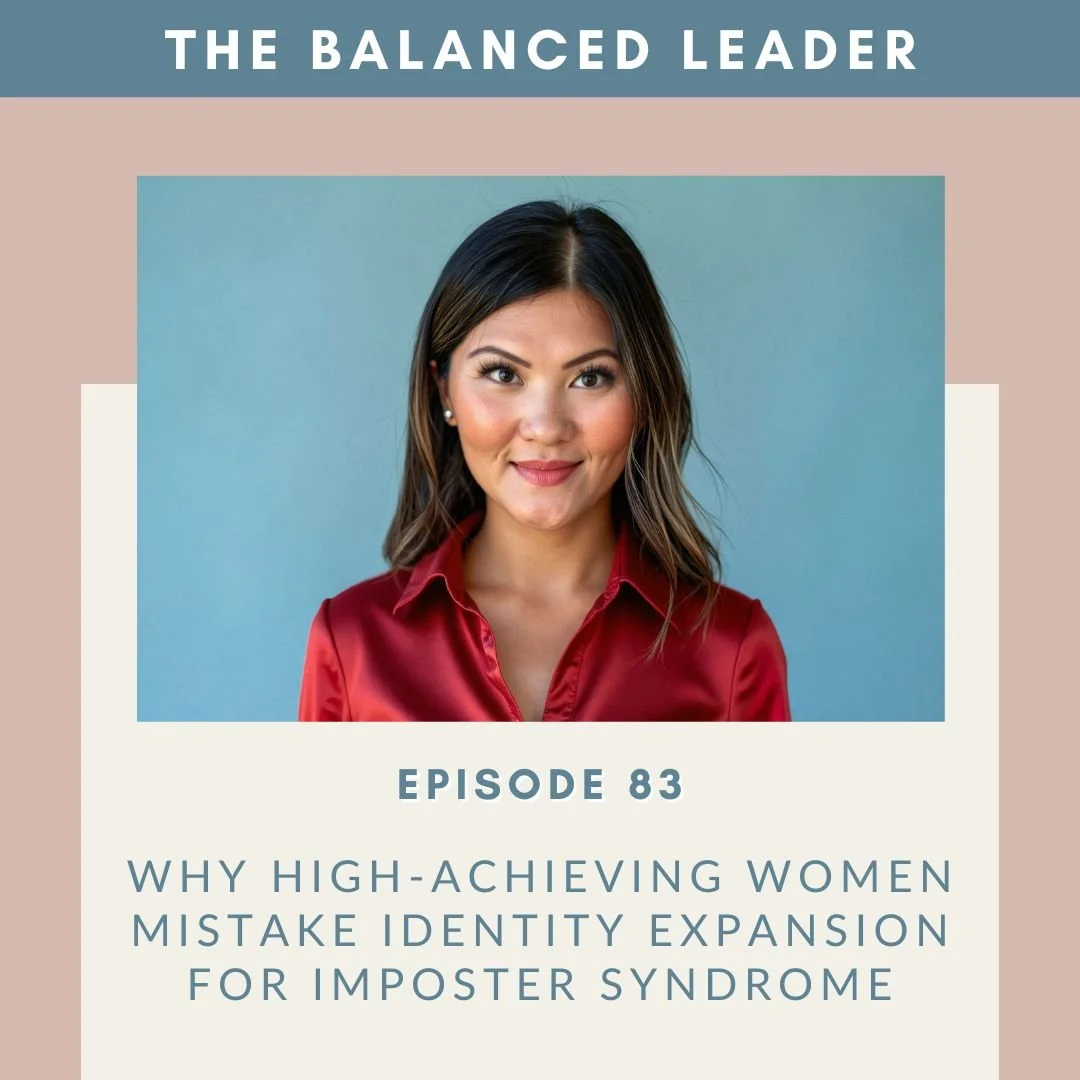
Sometimes, walking into a room can feel terrifying. You’re accomplished, prepared, and capable… but your brain tells you, I don’t belong here. I’m not ready for this.
In this episode, I explain why that feeling isn’t imposter syndrome. For high-achieving women, it’s often a signal that your identity hasn’t yet caught up to your next-level role, responsibility, or environment. This is what I call identity expansion: the natural discomfort that comes from stepping into spaces you’ve never fully occupied before. Your brain reacts because it likes familiarity and safety, not because you’re unqualified.
I walk through real examples from my clients and my own experience—from leading multi-million-dollar divisions to shifting into entrepreneurship, motherhood, and personal growth—to show how this discomfort shows up and how to navigate it. You’ll learn how to catch the spiral in real-time, reframe it as growth instead of inadequacy, and step into your next-level identity with confidence and clarity.
Interested in working with me? Book a free 1:1 consultation here!
What You’ll Learn from this Episode:
Why high-achieving women mistake identity expansion for imposter syndrome.
How your brain reacts to unfamiliar roles and responsibilities.
How to notice the spiral of self-doubt in the moment.
Strategies to name and reframe the discomfort as growth.
How to choose the version of yourself who belongs in the room.
Why confidence doesn’t have to come first—you move, and it follows.
How to expand into new roles, relationships, and identities without shrinking.
Listen to the Full Episode:
Featured on the Show:
If you haven’t already, please follow the podcast and leave a rating and review to let me know what you think. Find complete instructions here!
Watch my TEDx talk: Reclaiming anger: A woman’s birthright
Get the free guide, The 5-Minute Reset to Own the Room, here!
Episodes Related to Why High-Achieving Women Mistake Identity Expansion for Imposter Syndrome:
63. How High-Achieving Women Can Build Internal Safety Through Self-Validation
79. Why You Don’t Speak Up in Meetings at Work (& How to Finally Cross the Line)
Full Episode Transcript:
Welcome to The Balanced Leader, hosted by Yann Dang, a Leadership and Life Coach with over 20 years of corporate experience. Drawing from her journey as a former global finance leader and second-generation immigrant, Yann understands the unique challenges women face in male-dominated workplaces.
Each episode offers insights on balancing masculine and feminine energies, mastering soft skills and building emotional intelligence. Join us to transform frustration into empowerment and unlock your authentic leadership potential.
Alright, hey podcast listeners. I am so jazzed up about today's show. I have been doing a lot around identity expansion. And of course, working in my command leadership accelerator and group coaching with women, we've been working on identity expansion and what that actually takes and what it actually means. And it actually inspired today's episode.
So, here is what high-achieving women do. They walk into bigger rooms, and instead of owning it, they start questioning. This literally just happened to my client who is now the CEO of her own company. She moved from being a VP at a very big company and being a CEO at another company. And she is really asking herself lots of these questions, right? So, you get promoted. Was that luck? You speak up. Did that even land? You're the only woman. Should I say less? Right? These are some of the patterns that come up, right?
So with my client too, she was like, all right, I've got the role. Are they going to figure out that I'm not meant for this role? Are they going to figure out I'm just playing like this authority figure? And this is the cha-cha that I talk about that comes in our minds. And we've labeled it, especially in women's leadership. We've labeled this feeling as imposter syndrome, like something is wrong with you. You have like a syndrome. That's terrible, right? But that label, it's incomplete. And honestly, it's what's keeping you stuck, right?
So let me share about how I think about imposter syndrome. And you can call it imposter syndrome, or you can call it about feeling like an interloper, or you can call it feeling like you don't belong. There's a lot of words for it. But I'm going to tell you about what that actually is and how to reframe it in a way to support you. So that feeling is not proof you don't belong. It's proof you've entered a space your identity hasn't caught up to yet.
I oftentimes call this identity calibration, right? If we're doing new things, we have to calibrate to it because our brains like familiarity. Our brains like to stay safe. They like predictability. It likes to know what we're doing and how things are going to land because we like that safety feeling. But your next level is unfamiliar because you've never been there before. It's unfamiliar and unfamiliar in our nervous system and in our brain, it is almost like firing off an alert. Like there's something going on here, right? So your nervous system fires not because you're incapable, but because you're expanding. And you're not an imposter. You're actually shifting into your next level identity. This is identity expansion. It's seeing yourself in a place that you never thought you were you would be in before. And oftentimes our brain offers us a lot of thoughts that we shouldn't be here because it's trying to hold back this big growth, this reality changing, this up-leveling.
I actually just got off of a call with one of my other clients who she was just saying, I know I'm a CEO, but compared to other CEOs that have bigger P&Ls and have bigger sales and are in bigger companies, I just diminish myself. She makes it like that she's one down and that she's not at that level. And that is her identity retracting. It's her identity shrinking herself versus expanding to what's possible. If she thought of herself as a CEO period, end of story, right? Like if you really think about yourself that way.
So, this is just where our nervous system and our brains are putting a brake on ourselves because it's like, this is a new reality for us. And sometimes new reality is scary. And to slow down that new reality, our brains give us some thoughts and some feelings that have us really slow ourselves down. It's just like being in a bit of denial about things changing. You know, we kind of think either like things are not that different or things are so different that we need to really slow down.
So let me give you some examples to make this real. Alright, I remember the moment sitting in a high-level executive meeting, and I was the VP, and the stakes were high, and all of the eyes were on me. There was a lot of pressure, there's a lot of expectations, there are a lot of power dynamics. And I remember sitting in this room in London where I looked around the room and there were all these people, most of them men, most of them much older than me. You know, and I remember thinking to myself, do I really belong here? I was definitely the youngest. I was definitely one of the only women. I think maybe there was one more woman who was a secretary. And I thought to myself also, wow, I am the only person of color here too. So there were like three things that went to my mind of like how I don't belong.
Years later, I had that same feeling again. But this time it wasn't in the boardroom, right? I want to share that this happens, right? It happens when you expand and you shift from one thing to the next. So I had that moment, but you know, I was able to coach myself through that I actually really did belong. And I realized that like, hey, I'm just having these thoughts and feelings in this moment because I'm calibrating to myself in this room, feeling familiar with it.
And the same thing happened when I left corporate and created my own coaching practice and shifted into entrepreneurship. It was like when I stepped into a new world of other entrepreneurs, of other coaches, I remember being in rooms with women making millions of dollars coaching and I was like, whoa. This is a different room. Am I meant to be here? You know, am I good enough? Right? All these thoughts come up. Am I an imposter here? Are they going to realize that I'm actually a executive trying to pretend to be a coach, right? There's all these thoughts.
But this is what happens when you expand who you are and your identity. These thoughts come flooding in and these emotions come flooding in. And often times women are like, oh, there's something wrong. This must be imposter syndrome. So I really need to pay attention to these thoughts. Well, I don't really pay attention to the thoughts. I realize that I'm going through a big transition and these thoughts are okay and my brain is offering them to me to slow myself down and to catch up to my new reality.
It actually also happened in my personal life. When I got married and I was like, oh, this is what it's like to be married and to make decisions together as a couple. And I'll have to say every time my husband and I used to fight early in our relationship, my survival brain goes to, oh my god, how am I going to get out of here? And my brain used to go to, oh my gosh, we're going to have to get divorced and then this is going to happen and then I would like spiral out. Obviously, I don't have those thoughts anymore, but that was the spiral that would happen because part of me was like, oh, this is a next level identity. And when you're feeling scared in your next level identity, you often times look for an escape route, right? You're like, maybe I can just do something else or how do I escape from this feeling or these emotions that feel so tense in the moment?
And the same thing happened when I became a mother. Of course, there were very positive things that happened, but there are also a lot of me being like, whoa, I didn't know motherhood was like this, you know? And there was also like, wow, this is like a big shift for me to be a mom and to have like a human being like strapped to me and to take care of and to, you know, change my whole life and change everything. And part of us is in our minds, we want to have the identity all figured out. But the reality is you can't have it all figured out, right? Part of it is to be in it and to experience it, but to not let our thoughts and our emotions in the moment mean more than we're going through a change and we want to understand and connect to ourselves.
So I'm not saying to not validate your emotions, I'm just saying don't overly indulge in the thoughts that you might have when you're in more of a survival activated brain, right? So it's not that there's just at this level where you're expanding your identity, there's no clear roadmap. This is a brand new identity, so you're getting to know yourself as a mother, as a coach, as a VP, whatever that your next level is. And sometimes we yearn for external validation, but there is no external validation yet because you are just shifting into this place.
So, as I was sharing with you, these three identity shifts that happened for me, they all happened at once. And yes, every version of me felt like an imposter. But what I realized later is that I wasn't an imposter in any of them. I was expanding into all of them. I was learning how to be all of these things, to shift from being an executive and shift into being a coach, and to shift from being a single person into a married person, and to shift from not having kids to having kids, right?
So here's where most women go wrong. They feel the discomfort and they label it as dangerous. And they're overly focused on how they're thinking and feeling in the moment, and indulging in those thoughts in a really serious way. It's like you're taking your brain's thoughts in that moment when you spiral in a really serious way. So, that's actually what happens when you are really attached to this idea of imposter syndrome. You think something is wrong, and so then you go to overthinking, over-preparing, staying quiet, playing small. You don't shrink because you're not capable. You shrink because your brain is trying to protect the identity it knows.
I'm going to say it one more time. You don't shrink because you're not capable. You shrink because your brain is trying to protect the identity it knows. Your brain is trying to go back to the part of you that feels safe and feels calm and feels comfortable. But that's not what identity expansion is. Identity expansion is imbalance, disruption, destabilization. This is how change occurs. It's uncomfortable.
So, let me give you a framework because when it comes up for you, when you notice it, when you're about to do that big thing, it might be to go for that promotion. It might be to move across the country. It might be to get married. It may be for you to start your own business. I want you to notice that these are things that are going to happen.
So number one, catch it. Notice the moment you start thinking, I don't belong. When you start thinking, I must have imposter syndrome, somebody's going to figure me out, right? I'm not supposed to be here. Number two, name it. Say, this is expansion, not inadequacy. This is what it is to expand into an unfamiliar identity until it becomes familiar. And then number three, choose identity. What would the version of me who belongs here do right now? What would the version of me three years from now who has shown that she's more than capable of leading this company, this coaching practice, you know, what would she do? And then you do that before your brain talks you out of it.
You don't wait to feel confident. You move and let confidence catch up. This was the same thing that I had to do as a VP. I was like, all right, I don't know how to do this. I don't know how to take up all this space in this meeting, but I'm going to do it. I'm going to ask myself, using my wisdom of, you know, who I could become and how I wanted to take up space. And I wasn't waiting for somebody to say, yes, you can do it. I just decided I'm going to do it. I'm going to learn and I'm going to embrace the discomfort over and over again until it is just who I am. It is who I am and how I show up. I embrace that discomfort. I know those emotions come up. I know that part of me doesn't want to do it, right? Doesn't want to feel on edge, doesn't want to feel this level of aliveness, doesn't want to feel this level of destabilization. But it's what is required for me to shift to this next identity, to shift to who I am becoming.
So I'll just give you one more example. I remember I was a VP and I was leading the budget process for the first time. I went through like all the motions. I cried. I was so upset. I spin out. It was crazy. I like almost like I had to go through this. It felt like some sort of weird hazing. And it was a lot in my mind. I reached out for support and help, but I think my nervous system was just like, oh my god, you're really doing this. You are leading the business at the time was like $200 million. And it's like, you are the finance leader of a $200 million business and this is just who you are. And I was totally spinning out and I remember flying from Chicago to London and I worked all night and it was like really like tense and like so fearful. And what ended up happening was like, I delivered. It was amazing. I did a great job. My CEO was so happy. My divisional CFO sent the deck to all of my peers and was like, this is what good looks like.
But that was like the aftermath of me going through those emotions. And yes, I could have indulged and been like, I'm not ready for this. I need to just, you know, tap out, pause, or say this isn't, I'm not ready for it. But I kept saying, this is part of the path. This is normal. This even me feeling highly uncomfortable is a normal part of expanding, right? And I probably didn't have these words for it, but there was something in me that was grounded enough to say, let's keep going. I know you feel scared. Let's keep moving. Trust your brain, trust yourself. Keep shifting, keep moving forward.
All right. And that's the difference between imposter syndrome where you feel like you're stuck and something's terribly wrong versus identity expansion, which is activated, which is pulling you forward, which is showing you that yes, this discomfort, this destabilization is here, and you can meet it. You can meet the moment and you expand into the moment. You don't hide from it. You don't shrink from it. You meet the moment.
All right. So, if anyone in your life can use this message, if they're doing something new, I want you to share this episode with them. This is so important, right? Because there are so many ways that we hold ourselves back in the meeting. We hold ourselves back from saying the thing that is going to help elevate everybody in the room, right? Even with your kids, trusting your instincts, right? Instead of waiting for other people to share their thoughts about how to parent your kids, you trust your instincts. And then, of course, in your business, making that decision, taking that risk.
Expansion doesn't feel like certainty. It feels like discomfort you don't run away from. You meet the moment. So next time you feel like an imposter, I don't want you fixing it. I want you recognizing it and naming it because that feeling, it's not a warning sign. It's an invitation to your next level, to the expanded version of you, to your identity that you are learning to embrace and to become. The more and more you embrace it, the more and more you become it, and the more you are going to expand that identity and not run away from it, right?
So, that's what happens. Your brain starts getting used to it and you just become that person. But it does take discomfort. It does take destabilization and all of those things are part of the growth, part of the expansion. All right. Go out and try this on for yourself and let me know how this lands for you. And share this episode with other people in your life that are going through big things that feel really, really tough. This is an expansion. This is an invitation to get bigger and bolder in whatever area you're in.
All right. I am thinking about you. I care about you all so much, and I would love to hear how this episode lands with you. So feel free to connect with me on LinkedIn or leave a review. I read each and every one of them. And I want to hear how things are supporting you to expand your identity because it is for you to do that. That's an invitation for you to step into. All right, have a beautiful day. Take good care. Bye.
Thank you for being a part of The Balanced Leader community. We hope you found today's episode inspiring and actionable. For more resources and to connect with Yann, visit us at aspire-coaching.co. Until next time, keep leading with confidence and purpose.
Enjoy the Show?
Don’t miss an episode, follow the podcast on Apple Podcasts, Spotify, YouTube Music, RSS, or wherever you listen to podcasts!