82. How AI Quietly Erodes Self-Trust in Leadership
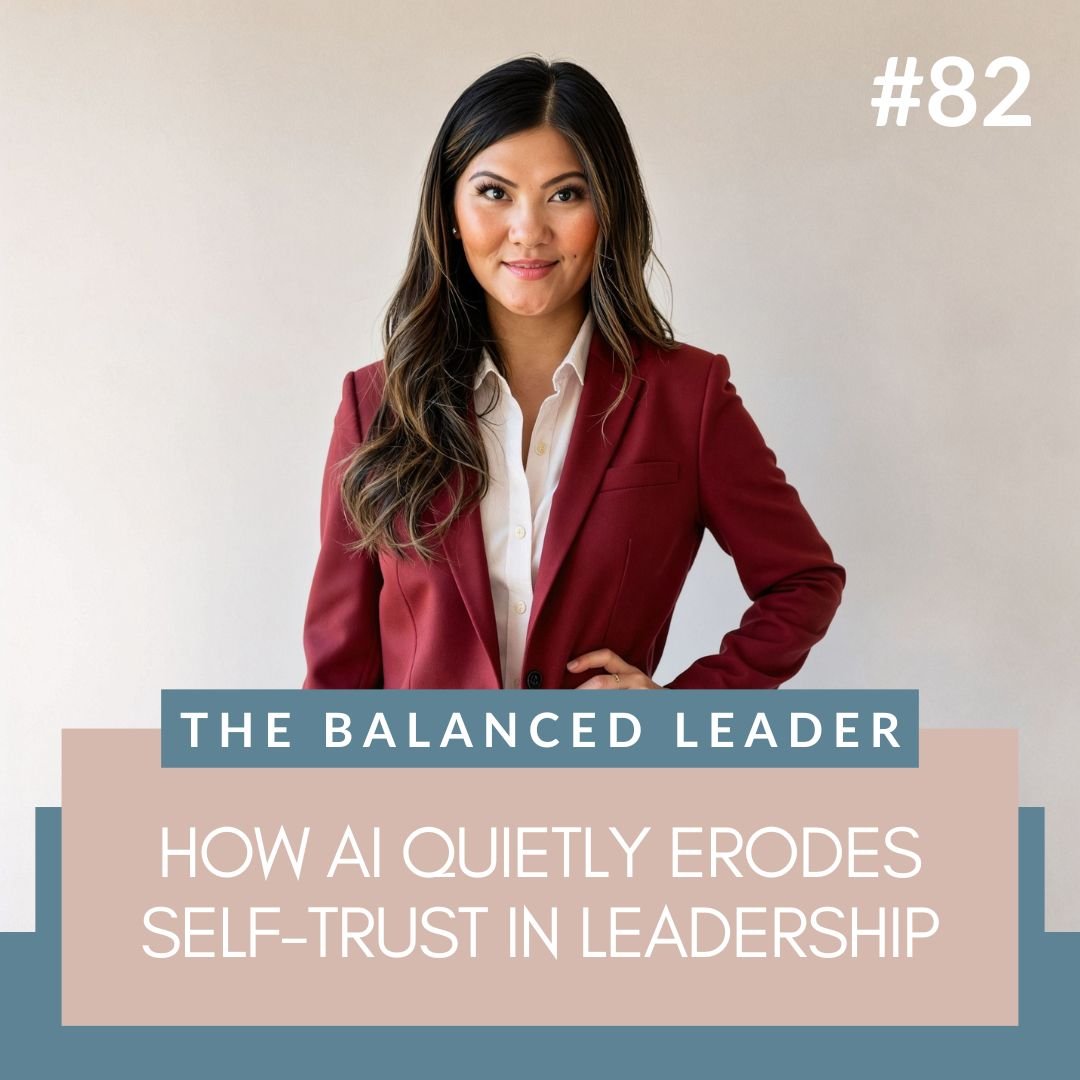
AI can be a powerful tool for refinement, structure, and speed, but if you are using it to make every decision, polish every thought, or validate every instinct, it can slowly weaken the very authority you are trying to build. The issue is not AI itself. The issue is whether you are leading it, or letting it lead you.
In this episode, I’m talking about the subtle ways AI can quietly erode self-trust in leadership, especially for high-achieving women who already feel pressure to sound polished, prepared, and certain. I share how AI can support your executive presence when you use it as a thought partner, but also how it can become a place where you outsource your voice, your decisions, and even your leadership identity. When you rely on AI before you trust your own thinking, you interrupt the process that builds real command.
You’ll learn how to use AI in a way that strengthens your authority instead of replacing it. I’ll show you how to decide first, prompt with context, refine without abandoning your voice, and take imperfect action even when it feels uncomfortable. Because the goal is not better answers. The goal is stronger self-trust, grounded authority, and the ability to think, decide, and speak from command in the rooms where your leadership matters most.
Interested in working with me? Book a free 1:1 consultation here!
What You’ll Learn from this Episode:
Why AI can quietly erode self-trust when you use it for validation instead of refinement.
How to recognize when you are outsourcing your voice, decisions, or identity to AI.
Why executive presence requires the ability to think and decide in the moment.
How to use AI as a thought partner without making it your authority.
Why copying someone else’s confidence can create burnout instead of command.
How imperfect action builds self-trust more effectively than perfect answers.
What to ask yourself before using AI to write, decide, or communicate.
Listen to the Full Episode:
Featured on the Show:
If you haven’t already, please follow the podcast and leave a rating and review to let me know what you think. Find complete instructions here!
Watch my TEDx talk: Reclaiming anger: A woman’s birthright
Get the free guide, The 5-Minute Reset to Own the Room, here!
Episodes Related to How AI Quietly Erodes Self-Trust in Leadership:
40. High-Stakes Conversations: How to Use Your Voice Powerfully with Rita Kale
63. How High-Achieving Women Can Build Internal Safety Through Self-Validation
77. How to Say What You Mean (Without Shrinking in the Room)
Full Episode Transcript:
Welcome to The Balanced Leader, hosted by Yann Dang, a Leadership and Life Coach with over 20 years of corporate experience. Drawing from her journey as a former global finance leader and second-generation immigrant, Yann understands the unique challenges women face in male-dominated workplaces.
Each episode offers insights on balancing masculine and feminine energies, mastering soft skills and building emotional intelligence. Join us to transform frustration into empowerment and unlock your authentic leadership potential.
Hey podcast listeners, welcome to today's show. I am excited to bring you this content. And I have been noticing in my coaching containers and with a lot of women that I'm working with, and even within myself, the ways that we might be using AI to quietly erode our own self-trust and authority if we're not careful. So, let me talk about this and share some disclaimers with you before we dive in, so you know what this episode is all about. I want to be really clear.
I use AI all the time, personal, professional, planning vacations, doing my content marketing, all that stuff for ideas, for structure, for refinement. This isn't an anti-AI conversation. And actually, I'm very, very pro-AI and pro-technology, especially for women listening because oftentimes, women have been on the back end of learning these cutting-edge technology pieces that actually undermine us in our career. And it's super important to know what's happening in the world, being able to speak to it in a really grounded, professional way and to use it to support us, to show up more powerfully and to leverage the technology to have us shine in our visibility and create velocity around the relationships that we're building and the conversations that we're having.
So, I am pro-AI. I'm pro-technology. I am pro-women using technology to the best of their advantage. But I use it in a way that strengthens my self-trust, that adds to my brain and adds to my own authority, not replaces it, right? And I am sharing this because I have seen myself spin out on AI, and I have seen myself go down rabbit holes, and I have seen myself losing trust in myself because I'm asking it too many questions and I'm starting to outsource my own confidence and authority on the people I know most, which is the women that I coach.
So, I want to share this because I know it's happening to me sometimes when I'm not aware of it, and I also know that it's happening to a lot of the women that I coach and a lot of the women in the world because now we have this technology that helps us decide, right? But oftentimes, it can also cause us to not trust ourselves and actually causes us to second guess even more and get more and more data and more and more knowledge.
Okay, so let me contrast this because there's a version of using AI where you're in command, where you're using the knowledge and data to really leverage yourself, to increase your visibility, to know that you've got all the facts and data and that you can present it in a really grounded way where you're owning that data, where you're speaking up in that room because you feel confident in yourself and your research because it was able to support you.
And then, there's a version where it's quietly leading you, where you are waiting for it and where you are looking for AI to give you the answers, to give you the right answer, right? So I want you to think about this because AI should refine your thinking, not replace it. This is so important because oftentimes, when we are down this path and we are not leading AI and AI is leading us because it's also, you know, has all those questions that it asks us, like, "Hey, what about this? What about this?" Like it wants to keep that conversation with you.
And so I'm going to share about my own experience with AI as I'm going down paths with it. Actually, I'll just use this example. I was actually planning a vacation for my husband and I, and it kept saying, "Hey, this is what you should do. This is what you should do." And I'm like, "No, this is not what I should do," right? Part of me was like having this conversation with it and thinking like, it's telling me to do these things, but it has no idea what our circumstances are, what we're actually looking for in a vacation. And of course, I need to feed it that, right? But if I'm just asking it generic things like, "What about this for a vacation or a couple's retreat," right? But I have to be really clear. "Actually, we have two kids under five. It's really important for us to have relaxation time and not a very busy schedule. And we are not super beach people, but we like a nice scenic area. We like nature, and we like to do things, but not too many things," right?
So there's one path of like AI telling you like, "Hey, do this, do that. This is going to be great." And if you're not on to yourself and you're not in command of yourself, you may just go down a rabbit hole trusting it, believing in it, and it's selling you versus you're in command and in control of the prompts you give it and what good look like and feels like. If you don't know what good looks like and feels like, right? And you are using it to ask what good looks like and feels like, it's really, really hard to trust yourself. There's a difference between I know what it sounds like and I need help thinking through it.
So let's go back and forth and get to that clarity together, but I'm very clear on what that is. Versus, "I have no idea what good looks like. Tell me what good looks like." And then it's really hard to trust it, right? Because you're not really owning it for yourself. You're not really owning, right? You could say, "Hey, tell me the best way to present this and this." But if you're not saying, "Hey, these are the people in the room. This is how I want to come across." This is why my AIs are a little bit like slow because I put so many prompts in it. I give it so much context because I know what good looks like and I know the context that it needs in order to have the result that comes up that is satisfying to me and up to my standard.
So I will literally say, this is the audience. This is where I want to come across. This is how I want to be seen and heard. These are the facts that I really want to lead with. These are the big things that make me unique, and I want to make sure it gets displayed. So I have to say these things. Otherwise, it's just going to give me generically what it finds in, you know, when I just ask it a generic question, right? And so when I'm using my AI, I'm like, I am the asset. I am the one bringing authority, context, refinement to it, and it's helping me. It's a thought partner. It is not the leader. It's a thought partner, and that's how I treat it.
So, let me talk to you about the three ways that you may be outsourcing your own power. Number one, outsourcing your voice. This is so important. You write something and then immediately check it. Does it sound right? Your communication is getting more polished, but it's less you. So you've got to be able to read what you're writing and see, does this actually sound like me? And I will share with you, I've been working on learning more about my writing style, particularly as I'm marketing to more and more women. There's a way that I could just say, "Hey, make this sound more authoritative and clear." And then it'll spit it out. Or, this has been the smarter way for me to do it so that I can actually learn is, "Show me in my copy where I'm writing where I'm becoming more of like an empathetic best friend versus an authority, a professional expert."
And then what comes back is it shows me point by point, example by example, the different words that I'm using, how I'm using it, and why I am sounding more like an empathetic best friend versus a expert authority coach that people are going to pay me, right? So that way I'm learning. I'm not just telling it to repeat something to me and then I use it and I outsource my own authority and voice. I learn it and I decide actually, yes, that does sound better. Or sometimes, it's very nuanced. Sometimes I'm like, no, we need to add this sentence even though you don't agree, you know, AI person, I say this really matters because this emotional tension is what my people relate to. So again, I'm trusting myself.
So you've got to watch out where you're editing your voice before you've even trusted it. Oftentimes, if you're not even owning your own story, then that voice might end up being more of that AI, and then you feel like you're outsourcing your power. And then the next time you get a question from your boss, instead of answering it right away because you know the content so well, you're like, "Uh, let me get back to you," because you want to type it into your AI. And I know like those examples are not like that grossly, you know, done, but it does happen. It does happen where people are like, "I need to go put it in my AI." It becomes like an addiction or a dopamine hit where you're like, "I need to feel more comfortable, so let me put it in here," versus, "I think on my feet. I'm the present person in the moment. I make it happen moment by moment. People trust me because I'm not a robot. I'm here in the moment using my voice and articulating myself and trusting myself."
So, that's number one. Watch where you may be outsourcing your voice and your authority to AI.
Number two, outsourcing your decisions. You already know what you want to do, but you're still asking, "What's the best approach," right? This oftentimes happens when people are like, "I want it to sound like polished or perfect." This comes up when women are like, "I need to say the right thing, like the right script." And then you're not making decisions. You're looking for validations really. You're saying, "Hey, can you validate this for me?" And the more you outsource your decisions, the less you trust your ability to make them. If I were just like, "Tell me the best vacation for me and my husband," and I didn't validate it or I didn't decide for myself, I know what it looks like already. I know what good looks and feels like for me and my family.
So let me tell it that, and then let me lead it. But if you're asking it like, how do I say this in the most polished way, and then you go and say it, but you don't actually own it in your body. There's like a lack of coherency because they're not really your words or your grounded decision. And then you lack conviction and you lack certainty, right? Then your decisions are not even yours, and you don't trust yourself to follow through. The more you outsource your decisions, the less you trust your ability to make them for yourself in the here and now. If somebody asks you something in the here and now, they want a quick decision. That is executive presence, your ability to be in the moment, notice yourself, notice your emotions, notice your audience, and be able to think on your feet and make decisions.
If you are outsourcing your decisions to AI, this is where it quietly erodes you, where you are spending time asking AI questions when you could be asking yourself questions and mining your own brain. Again, use AI for refinement. Use it to support you, but make sure that you are taking what it's saying and really deciding for yourself, making those decisions from your own grounded authority.
All right, let's look at the third one, which is outsourcing your identity. Here's where it's tricky because a lot of times, people are like, "Well, if I was this, I would say this." But you've got to be in tune with yourself emotionally, and that coherency is so important. So sometimes people might say, "What would a confident leader say?" or "How should I show up here," right? And you're trying to become someone else instead of trusting who you already are. And this is also comes up when I talk to some of my women clients and they're like, "I want to be the entitled white man in the room, and I want to have those voices and be able to say what they say the way that they say it." And I'm like, "You can try that. Like you could try doing that." But oftentimes, there's a subtle energy shift. There's something that feels off because it's not really your identity. You did not grow up like that. You did not grow up as a privileged, entitled person.
And there is growth for you in your identity to shift into that space. So while it's helpful to ask that to see what questions come up, you need to again own that for yourself. Own like, "Yes, I do want to ask it, and I want to ask it this way because it is unique to me and I trust myself to say what's true and to have that be in full alignment with my body and my brain and to have it expressed from that grounded authority and conviction." If it feels off, if you're saying something that you sound like, you know, John or Tom on your team, but you don't sound like yourself, you don't sound like Sarah, who's showing up for her, right? Then something will feel off inside of you and people will notice that energy, that frequency that's coming out.
You don't build self-trust by copying confidence. That's not authentic. That's not you being you in your own body, in your own emotions. You build it by expressing it imperfectly again and again until it becomes more you. It becomes part of you and it becomes you saying things because you believe it's true. And look, it might be the same thing that Tom or John say, but you're going to say it uniquely to you with that grounded conviction and clarity if you truly believe it. This is what it is all about. You can't just take on somebody else's identity. A lot of women try to do this and it leads them to burnout. They feel like they are pretending to be somebody they're not and it takes a lot of energy versus what I'm teaching you, which is expanding your identity to be who you are, to say what is true, to take bold, imperfect action grounded in your own authority. This is how you build self-trust.
All right. So here's the real risk. I want to share this with you because again, this is not about not using AI, it's about using it in a way that feels like you're empowered and is using it for you to trust yourself more and to lead with more grounded authority.
So, number one, self-trust isn't built by getting it right. It's built by deciding and experiencing the outcome. There is no AI in the world that will show you how to show up in a room full of men. You have to think about it as you're going to make a decision, you're going to take action, you're going to get feedback, and then you build internal self-trust. And when you insert AI before the decision, you interrupt that loop, and you actually shorten the way of actually building that internal trust. You're actually moving on to another decision tree of like, okay, I'm going to trust AI before I trust myself. And you put another barrier in between you and your, you know, trusting yourself and your own authority because you're like, "Actually, I need to go ask someone else," right? So when you outsource your decisions, you outsource your growth. And you outsource your identity expansion because it doesn't even feel like you anymore.
And because the real reason you're checking isn't that you don't know, it's that you don't feel, you don't want to feel wrong, exposed, uncertain, or judged, right? And we're going to put in this episode the price of command, which literally the price of a commanding presence is to feel vulnerable, exposed, rejected, right? These are the things that you're going to feel when you're really in that leadership room and position. And oftentimes, people think if I have the perfect answer, if I have AI on my side, I won't have to feel these things. Well, that's just not true, right? And you believing that will have you taking a longer time to actually build your identity, to trust yourself, and to grow quicker because you're going to think that there's something wrong if I feel these things. Versus a lot of people feel these things. A lot of people feel tremendous fear, they feel lots of uncertainty, but they move anyway. That is what leadership is.
All right. So, let's do the last one, right? So what's the shift here? So you don't stop using AI. You stop using it as your source of truth and decision and as the authority. You need to decide first. I form the opinion, I choose the direction, I tell it what good looks like. I write the message, and then I might use AI to sharpen it, but never to replace my own authority and self-trust. So, before you open AI or chat, ask yourself, "What do I think? What feels true for me? Where am I looking for permission? Where am I avoiding feeling?"
And here's the other piece of imperfect action. Then take one step. Make the decision. Send the message. Hold your ground, right? Let it be slightly uncomfortable. Let it not be perfect. Sometimes, I just need to get an email out and I'm not going to put it through AI, and I just tell myself, "You've got this. You know what you're doing, and you're just going to move quickly." Because every time we stop and use AI for every single thing, it also adds to this like sort of frantic energy that we keep putting out there of saying everything I need to do, I need to put through AI because it's better than me. It sounds better. It's more professional than me. This again is where you erode your self-trust.
Because you can go anywhere and ask any questions. You can Google, you can prompt, you can get answers instantly, but that's not what makes you valuable. You are valuable because you can think, because you can decide in the moment, because you can move things forward. AI doesn't replace that. It supports it, it's accelerates it, it sharpens it, but only if you're leading it. You're the one in the human room having these human interactions and using your emotions, using your knowledge all together. So, use these tools to move faster, not to second-guess yourself into moving slower. Use them to expand your thinking, not override it. Use them to refine your voice, not replace it.
All right, the goal isn't better answers, it's stronger self-trust and you owning your own authority. So go out, use AI, but use it powerfully to feed into you and into your self-trust and into your own authority. All right, let me know what you think about this episode. It's a powerful one. It's an important one, especially with so many people using AI so much more. Tell me what you think and what lands for you. And practice it, try it on for yourself and have AI, again, be something that is like a thought partner to you. And have it tell you how you are a genius and how you are making these decisions, right? I also use my AI to affirm myself. I literally will ask it, "Why is this idea a genius?" And I have it sell me on my own ideas and on my own authority. You can do this too. All right, have a beautiful day, and I can't wait to talk to you again, and I can't wait to hear from you about what you think about this episode and how you are using it to transform your own leadership. All right, bye.
Thank you for being a part of The Balanced Leader community. We hope you found today's episode inspiring and actionable. For more resources and to connect with Yann, visit us at aspire-coaching.co. Until next time, keep leading with confidence and purpose.
Enjoy the Show?
Don’t miss an episode, follow the podcast on Apple Podcasts, Spotify, YouTube Music, RSS, or wherever you listen to podcasts!