76. How to Handle Rejection at Work Without Losing Confidence
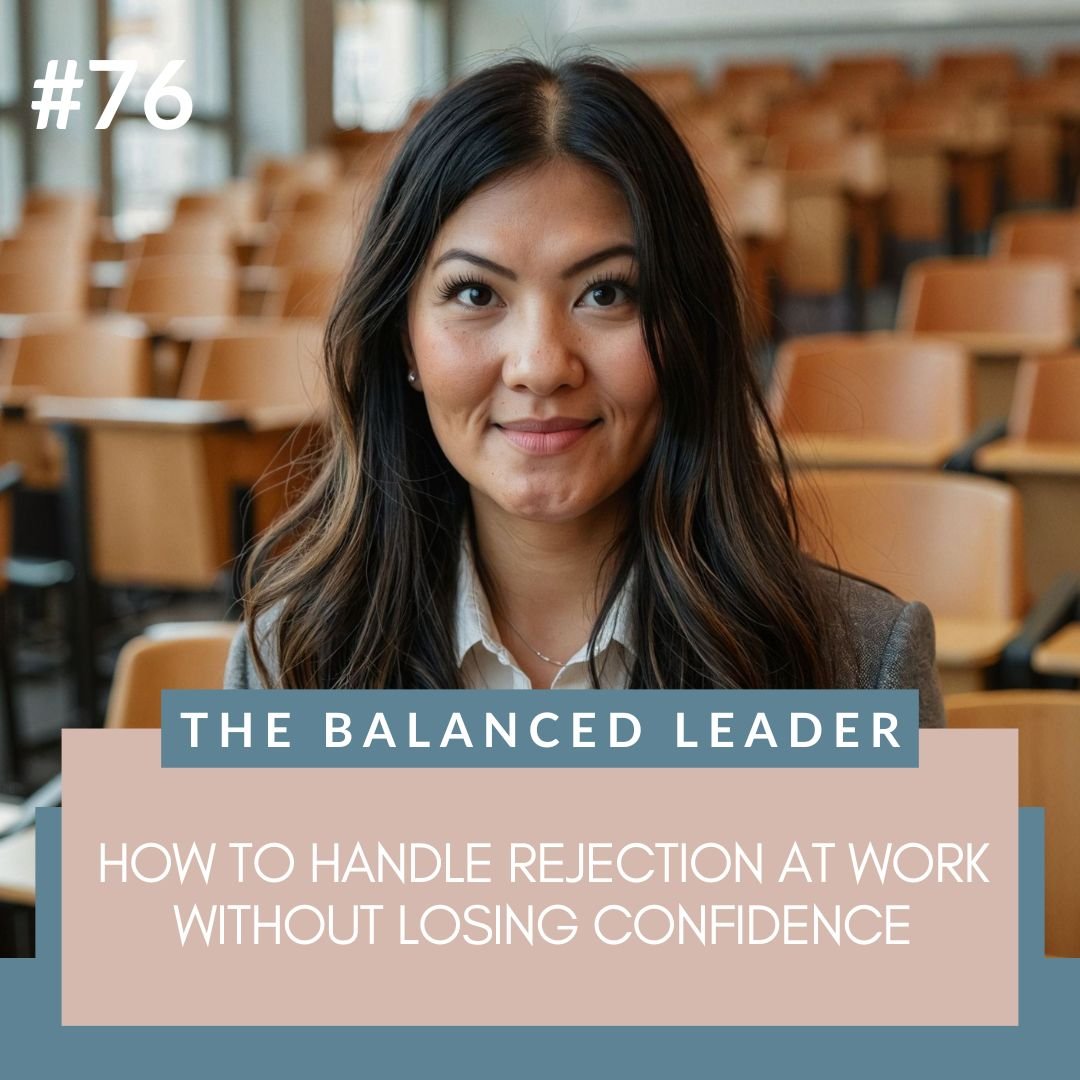
What if rejection isn’t what’s holding you back… but the meaning you’re making about it is?
In this episode, I’m challenging the way high-achieving women interpret rejection and sharing why it’s not the event itself that causes you to shrink, but rather the story you attach to it. Drawing from my own experience and the patterns I see in my clients, I’m breaking down how rejection shows up in real time.
Join me this week to learn how your brain processes rejection as a threat, the three ways high-achieving women unconsciously give their power away, and how to shift your response so you stay grounded, visible, and in command. If you’ve ever found yourself overworking, pulling back, or disconnecting after a setback, this episode will give you a practical framework to move through rejection without losing yourself.
Interested in working with me? Book a free 1:1 consultation here!
What You’ll Learn from this Episode:
Why rejection isn’t the real problem and what is.
The 3 default patterns high-achieving women fall into.
How these patterns quietly lead to burnout and loss of visibility.
The difference between fact vs. story (and why this distinction changes everything).
How to process the emotional impact of rejection without being controlled by it.
A 4-step framework to stay grounded and reclaim your power in the moment.
Listen to the Full Episode:
Featured on the Show:
If you haven’t already, please follow the podcast and leave a rating and review to let me know what you think. Find complete instructions here!
Watch my TEDx talk: Reclaiming anger: A woman’s birthright
Episodes Related to Handling rejection at work:
Full Episode Transcript:
Welcome to The Balanced Leader, hosted by Yann Dang, a Leadership and Life Coach with over 20 years of corporate experience. Drawing from her journey as a former global finance leader and second-generation immigrant, Yann understands the unique challenges women face in male-dominated workplaces.
Each episode offers insights on balancing masculine and feminine energies, mastering soft skills, and building emotional intelligence. Join us to transform frustration into empowerment and unlock your authentic leadership potential.
All right. Hey, podcast listeners. Welcome to today's show. I am here to talk to you about rejection and how to handle it in a way where you don't lose your power. I think this is a huge one, as I've been talking to so many women about visibility and velocity and how to actually take up more space in the corporate world. And why it is so hard for so many of us women to do that, right? And why it actually feels terrifying a lot of the time. And this is the reason. It's rejection, the fear of potential rejection.
And even before you get started to do something, you feel yourself being like pushing the brakes on yourself and being like, I can't do this because that fear of rejection comes up and it means so many things inside of us, and it carries a lot of weight when we are not really clear about how we're interpreting it. So, let me talk to you about what this is because it's something I'm experiencing in my business as I take up more space, as I'm more visible, as I launch my programs. And I know this is the same exact thing that happens to women in the corporate world as well when they are taking up more space.
I remember when I had a big strategic project that I made a big program. It wasn't just a little project on the side. I was like, if I'm going in, I'm going to go big. And I knew to do the things, but I still felt that fear. That fear, like this isn't going to work. I'm going to get rejected. I want you to know that this is a normal process of expansion. And the better relationship you have with rejection, the better you're going to be able to move through it and to use it for yourself and not make it mean something about you or your self-worth.
But this episode, I'm going to break it down. So, if you are somebody who is so fearful of rejection or if you know somebody who is really fearful of rejection, share this episode, listen to it again. I'm going to really walk you through what happens. And the better able you are to catch yourself in these moments and actually make different meaning out of them than what you historically have, the more powerful you are going to get. Like I said, I'm in this with you. It's something that I do. And I'm so much better at catching it in the here and now, and I'm so much better at reframing things, but I'm also so much better at giving myself some space to do it.
So, like I said, it's a practice. I'm much better at it than I was in the very beginning and it continues to be a lifelong journey and work. And this is work that will help you feel more and more powerful. The more and more you face and understand what rejection is.
So, here's what is actually happening. Your brain reads rejection as a threat. Belonging equals safety, right? Especially in our survival brain. We want to belong. We want to feel safe and comfortable with the people around us. We don't want people to disagree with us. Rejection equals risk because you don't belong in that tribe anymore and you are like on the outs, right? So, that spiral you feel, that's not you being dramatic. It's your nervous system actually doing its job. It's that limbic system trying to keep you safe. But here's the problem. You've been taught to trust that reaction. And that's exactly where you lose your authority. That's exactly where we lose our power when we allow that emotional reaction to rejection stop us from moving forward and has us spiraling out.
So, today we're going to talk about the three ways that you are losing power. Most high-achieving women respond to rejection in three ways. So I'm going to start with the first, right? Number one is to prove. You go into prove mode. I'll work harder. I'll be better. I'll fix it. Right? You avoid the emotion because you're like, whatever, I'm just going to keep going at it, right? I don't want to feel the rejection, so I'm going to double down. And now you're overworking, trying to earn something you already had. Maybe there's a part of you that feels like they said I couldn't do it, so I'm going to go do it.
I actually have a client. She is a CEO. And she felt like she really had to fight for the CEO role. And once she got it, she was like, now I have to work even harder because they are expecting so much more of me. And then she's working super hard and then she feels exhausted and burnt out. And she's going after this prove it. And it's a little bit ironic because they actually made her the CEO, so it wasn't like they were rejecting her. Although the rejection, I think came from history, right? She was expecting to have the CEO position. She felt like she had to fight for it. So she came into the role with already feeling rejected and a lot of resentment. And then on top of that, she feels like she has to prove herself because the board is testing her, right? So it's just interesting to see the way our mind works and then you feel powerless because you're up against so much.
The other thing that women do, and that I've caught myself doing as well, right? Is you pull back. You say less, you wait to be asked, you play it safe. This actually happens in dating too. You know, like when you're dating and you get rejected, you just sometimes you just want to be like, forget it. I don't need a partner. I don't need any of this, right? You hide, you pull back, you're like, if it'll happen, it'll happen. I actually have some girlfriends who have said this to me and I'm like, okay, well that's a choice, right? But oftentimes I'm like, I don't know if you're going to meet your partner just like out and about. I mean, it would be lovely if that's the truth, but for me, I was like, no, I got to go find my partner. I've got to go date. I've got to go do this. I got to put myself out there. And I've got to move beyond, right? Not go into prove it mode, but move beyond the feelings and move beyond the staying with rejection and just trying to protect myself, right? Because I knew that I wanted to have a family someday, right?
But the second thing that people do is they hide, right? And now the room doesn't see you. When you hide in a room, maybe you raised your hand and said something and you felt dismissed and you felt rejected in some way, right? And then you become like a ghost, right? You move back and you're like, oh, maybe I shouldn't take up so much space because I was rejected or dismissed. And it's not because you're not capable, but it's because you're not showing up, right? So when the room doesn't see you, they actually don't know your capability because you're not showing up for it. So then you lose more power as part of that hiding.
The next thing that can happen is the disconnection. You tell yourself you don't care. Maybe in that rejection, you feel so hurt and angry and you tell yourself you don't care. So you shut down, you stay logical, right? And you move on quickly. But you didn't move on. You just disconnected from yourself, your desires, your emotions, right? So those are the three things that typically happen when high-achieving women, this is how they respond to rejection in one of these three ways: proving it, hiding it, or disconnecting, right? And over time, this is actually what can cause burnout because you're actually not dealing with the emotion and you are kind of just coping with it.
This is the shift. I'm going to talk to you about this because rejection is not a verdict. It is not a verdict. Rejection is feedback, rejection is information, but you made it mean something about your identity, something about your worth. So I want you to notice that because oftentimes, right, you are making it mean something, like it's the wrong timing, it's the wrong audience, it's the perception that you are giving off, right? But you made it mean something about your identity, your self-worth, right? That's why it's hitting so hard because that rejection, those emotions that come up of maybe it's sadness, maybe it's fear and hurt, right? But if you intertwine that with your self-worth, your identity, that feels very scary. Like you don't know yourself. You don't really aren't clear about your identity. It can feel very shaky for yourself and your nervous system.
So we oftentimes are not actually zooming out enough to see a bigger perspective, to use it as information. And that information could be it's wrong timing, it's the wrong audience. Maybe the political environment can't handle it at this time, right? Or maybe there's a perception problem. I actually was dealing with this because I was launching a workshop recently and I was just so surprised that people weren't buying it. You know, I was like, there's obviously a lot of people on my newsletter clicking it. People are excited about it, the content. I knew in my bones was so smart and so good. I was like, this is genius. I'm so excited to share it with the world.
But people weren't buying it. And I was like, what is it? You know? And I probably did a couple times sit being like, maybe, maybe it's just not good enough. Maybe people don't like it. But part of me was like, no, this stuff is so important and I know the women that I coach love this type of stuff. So I had to, instead of using it against myself, like I'm not a good enough coach to figure this out, or this content must not be exciting for people, I started thinking about it as information. There must be something about this. And I actually dived into it and I was like, well, the title is very abstract. People actually don't know what I'm selling. And I'm not talking about the emotional side of things, which is my basically genius. I have always talked about the emotional side, but it's intertwined with the strategy.
So that really helped me shift into seeing it as information and troubleshooting. But if I'm stuck in, this is something wrong with me, I'm at this stage of my business and I should be able to do this and, you know, if you start seeing yourself that you made it mean like I'm not good enough, right? And you start thinking about why you're not good enough and it pushes you against like some self-worth issues. That's the moment you collapse. That's the moment when you lose power because you are making it mean something about your personal identity versus making it mean something broader and giving it more space and giving it more time and being like, this rejection is just what happened in the moment. How can I look at this moment? It's one moment in my very, very, very long life. How can I understand this moment better and use the data in it?
So, here's what I want you to do next time rejection hits. And for you high-achieving women, especially if you are stepping into more and more commanding spaces and taking on more power and visibility, I want you to expect rejection. Not like in a defensive way, but in a, I'm open, I get that this is part of the process. The bigger my frequency, the bigger the waves that I make, the more rejection is going to come, right? And that could just be pushback. We'll link in the episode about pushback as well because this is what naturally happens. And I know this, right? The bigger I get in my world, the bigger of a coach I get, the more rejection I'm likely to get. And the more offers I'm going to make, like this is just a natural progression.
So, this is steps to really support yourself when you're dealing with rejection. If you are like, I know rejection's coming because I'm a big leader, I'm going to take up more space and I am, going for it, you want to really learn these steps. So the first thing is to catch the thought. What am I making this mean? You'll probably get feelings automatically, right? Because usually we have some sort of sinking feeling in our body and it could be fear, it could be hurt, it could be sadness, it could even be anger, right? At the rejection. But you want to catch what am I making this mean? Catch the thought.
Because what we want to do in step two is separate fact versus story. Facts are I didn't get it. Story is I'm not leadership material. See the difference? This is so important to see the difference. For me, right? The facts are people aren't buying. The story could be they don't like me as a coach. Or the story could be, maybe I need to clear something up for them. Maybe this is a misunderstanding that I need to help troubleshoot, right? That totally changes my energy, it changes the way I problem-solve.
And then step three, this is where it's important, right? And you could do this in the beginning too. But step three is to feel it. Don't skip this step. You don't become powerful by pretending you're fine. You don't just push your emotions away. It is totally fine and actually so much better for your nervous system to actually name the feelings. I'm disappointed. I'm embarrassed. I'm angry. When you can feel your emotions, you stop being run by them, right? You stop avoiding them. You stop frantically doing other things. You can just sit and feel the emotion before making it mean anything. But oftentimes our brains and bodies work so quickly that we have to slow down and separate it, right?
So those are the steps. And the fourth step is you get to choose your identity. This is your moment. Who do I choose to be right now? What do I choose to believe? What story do I want to believe about myself in this moment? The version of me who shrinks or the version of me who stays in the room, right? So maybe you say something and you get dismissed. You can either decide, hey, you went for it. Go you. You went for it. You spoke up, you said something and you can learn from it. And yes, I still feel dismissed and sad, but I am happy that I went for it, right? You can still celebrate that piece of it. And you can choose to try it again and say, hey, maybe I need to try it a different way because I am a relentless person who goes after what she wants, right? That's you choosing your identity.
So this is super important to know that. Even for me, I'm like, am I the coach who's just, you know, can't troubleshoot and is thinking nobody wants what I have to offer, right? Or am I the coach that's willing to say it a thousand times until I get it right for the women who are out there that need my support, need my help and want to advance without burning out, right? That goes back to mission and identity and it really helps me get out of my own chacha and my own drama because I am so focused on who I'm becoming and not so focused on the stories that I know my mind tells me to protect me from advancing and protects me from rejection. But rejection is part of expansion, right?
The more we can just say that and normalize it and be less scared of it, the more we will learn how to deal with rejection and understand ourselves better. The women who advance are not the ones who avoid rejection. They're the ones who don't collapse because of it. They stay in the conversation, they stay visible, and they stay rooted in who they are and who they are becoming. Rejection only has power over you when you make it mean something about your worth. And that is a choice and that is a decision. But oftentimes it happens so quickly and women are not able to catch it.
But you've listened to this episode and I want you to listen to it again. You can catch it. You can catch those thoughts and you can separate the facts from the stories and you get to consciously choose to move into the direction of your expanded identity, to who you want to be in the future, and to take care of yourself. I'm not telling you to not feel your emotions, to not validate your emotions. They are all valid. But don't let it stop you. Don't let the story stop you. So the next time rejection happens, and it will, don't ask, why didn't they choose me? Ask, who am I choosing to be right now? All right? That is it.
If you know this is where you lose yourself in these moments, I want you to practice this again and again. And if you want a place to practice it with me, join me. I'd love to work with you inside my command program or one-on-one. If you're done shrinking after moments like this and you're ready to lead at that next level, this is the work and you can do it. It's simple and it's doable. It takes practice, but you can do it. I believe in you. Go after it. Get those rejections, catch them, learn from them, build that muscle. You've got this.
Thank you for being a part of The Balanced Leader community. We hope you found today's episode inspiring and actionable. For more resources and to connect with Yann, visit us at aspire-coaching.co. Until next time, keep leading with confidence and purpose.
Enjoy the Show?
Don’t miss an episode, follow the podcast on Apple Podcasts, Spotify, YouTube Music, RSS, or wherever you listen to podcasts!