69. Why Pushback Increases When Your Leadership Expands
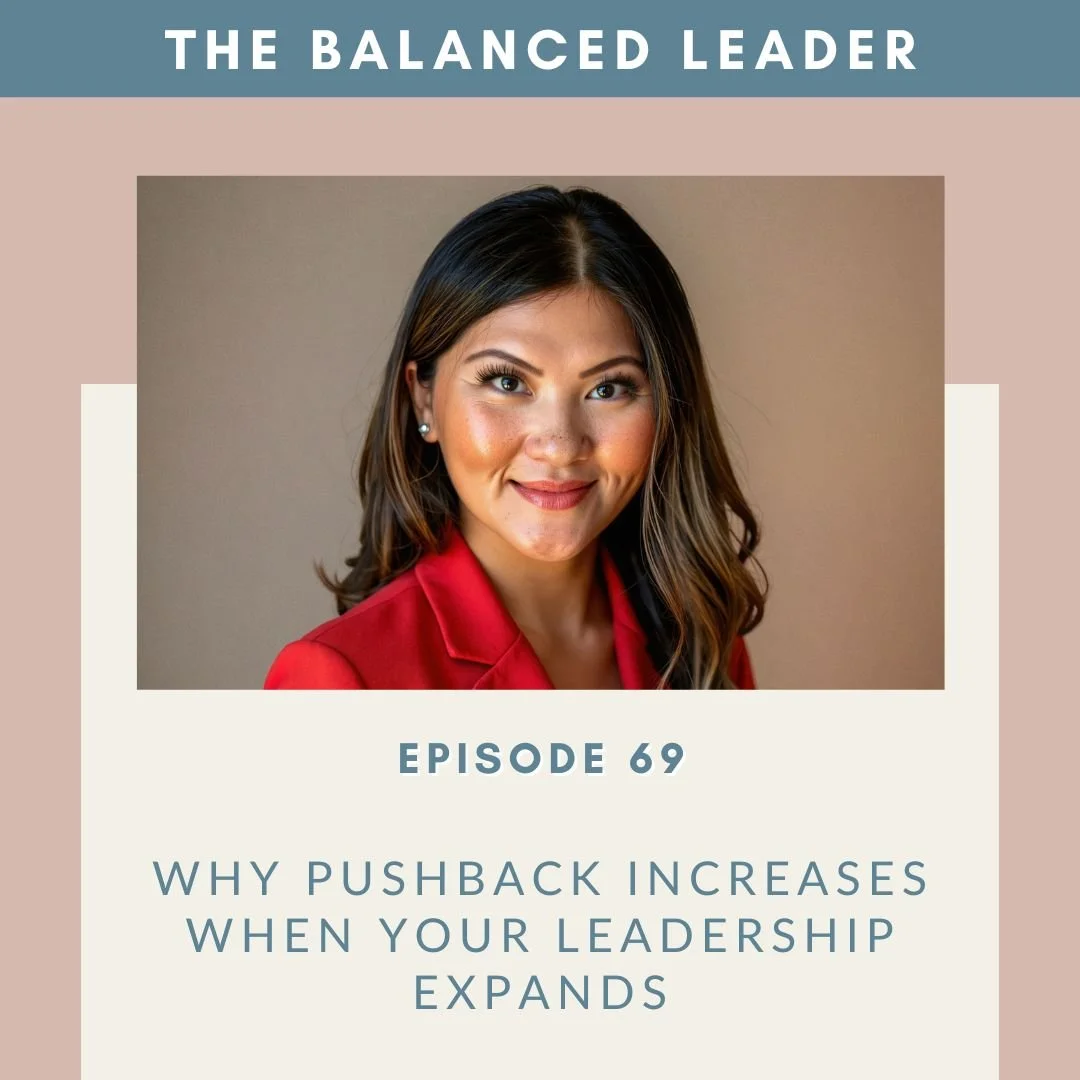
If you’re experiencing more pushback lately, more questioning, more resistance, or more polite disagreement, nothing has gone wrong. In fact, it may be the clearest sign that your leadership is expanding.
Many high-achieving women reach a moment where leadership suddenly feels heavier, not because they’re less capable, but because they’ve outgrown the version of themselves that relied on being agreeable, adaptable, and easy to work with. In this episode, I unpack why pushback often shows up precisely when women begin leading with more clarity, conviction, and presence.
Tune in this week to learn why pushback is often a signal of power and identity expansion, not leadership failure, what happens when you stop leading from the edges and start activating people, and why pushback is not something to manage away, but something to understand and meet without self-abandonment.
Interested in working with me? Book a free 1:1 consultation here!
What You’ll Learn from this Episode:
Why pushback is often a signal of power and identity expansion, not leadership failure.
How leadership feels heavier when you outgrow approval-based ways of leading.
The difference between pushback that activates growth and the self-abandonment that leads to burnout.
Why clarity becomes more valuable than likability as you advance.
How expansion creates contrast, discomfort, and resistance in others.
What it looks like to respond to pushback from grounded conviction instead of defensiveness.
A powerful reframe that turns pushback into a signal that you’re no longer leading from the edges.
Listen to the Full Episode:
Featured on the Show:
If you haven’t already, please follow the podcast and leave a rating and review to let me know what you think. Find complete instructions here!
Episodes Related to Why Pushback Increases When Your Leadership Expands:
63. How High-Achieving Women Can Build Internal Safety Through Self-Validation
65. How to Redefine Power as a Woman Leader (So You Stop Playing Someone Else’s Game)
Full Episode Transcript:
Pushback is a sign of power and identity expansion. And today, I want to talk about how to recognize that moment, stay grounded in it, and advance without burning out.
Welcome to The Balanced Leader, hosted by Yann Dang, a Leadership and Life Coach with over 20 years of corporate experience. Drawing from her journey as a former global finance leader and second-generation immigrant, Yann understands the unique challenges women face in male-dominated workplaces.
Each episode offers insights on balancing masculine and feminine energies, mastering soft skills, and building emotional intelligence. Join us to transform frustration into empowerment and unlock your authentic leadership potential.
Alright, hey podcast listeners, how are you all doing? It is so good to be here with all of you. If you're listening to this and thinking, why does leadership feel heavier right now? I want you to hear this clearly. Nothing has gone wrong. You're not less capable, you're not suddenly doing it wrong, and you're definitely not too much. What's likely happening is that you've outgrown the version of leadership that relied on being agreeable, adaptable, and easy to work with. As you expand, the room starts to respond differently.
I want to share this because when I was accelerating in my career, there became a point where I was like, wow, I am getting so much more pushback than I ever did. This is a pivotal moment because oftentimes, women internalize that. They're like, maybe I'm doing something wrong. People are pushing back on me. But here's the thing. And I was so grateful to have people in my life that was like, wow, you're getting more pushback because you are showing up more powerfully.
I want you to think about this because people who really show up in the world are usually people who have high frequencies, right? They have a conviction about themselves. They have a stand that they care about. And when you are in their frequency, you're going to be impacted in some way. You are going to feel activated in some way. And this is powerful leadership, right? Some people get activated and they're like, yes, I am on board. Let's do this. Let's go for it. And then other people are going to say, I don't know about this. I'm not sure. I feel scared about this. And you will get pushback from those people.
And there's nothing wrong. Nothing has gone wrong. You're actually activating them. So here's what I want you to know. When this happens, when you are noticing more and more pushback as you are showing up more powerfully in your role, in your life, in your leadership, I want you to hear this and know this. Because this is a really important point. This is what causes some people to shrink back and say, "Oh, I can't expand bigger than this because I can't deal with this pushback." Or it's what the women that I coach do to expand themselves, to embrace the discomfort, to say, hey, I understand that this pushback is a byproduct of how powerfully I am showing up in the world.
If I am powerful, if I have a strong presence, people are going to react to me. And here's the thing, mostly, I want to say like 80, 90% of people will react to you in a positive way. But because we have a survival brain in us, right, where we're always looking out for threats, we will unconsciously narrow in on that 10%, that 20% that don't like what we have to say because we feel scared, because we are getting new feedback. And you know, when somebody doesn't like what you're doing, it can give you an automatic response if you're not watching your mind or your emotions or connected to yourself to be defensive or to internalize it and say, whoa, I must have done something wrong. I've never gotten this response before.
But this is what I want you to hear. If you are getting lots of pushback and you're showing up differently and you're getting results in your life, I want you to know you're still competent, you're still thoughtful, you're still respected. And yet, there's more questioning, more resistance, more people asking you to explain, soften, or justify what you know to be true. This is the moment most high-achieving women quietly turn inward. You start reviewing your tone. You replay conversations. You wonder if you should have said something differently, more calmly, more gently, more strategically.
Here's the truth. I want to be super clear here and I want you to sit with this. The higher you go, the less you're rewarded for being agreeable, and the more you're tested for being clear. Nothing is broken. You haven't lost influence. You've expanded beyond the version of leadership that kept you safe through approval.
And when that happens, pushback isn't a sign that you should retreat. It's a sign you're no longer leading from the edges. Pushback is a sign of your personal power and leadership expansion. I want you to know this and hear this because so often when I am coaching women that are right on this edge, again, you can either retreat because you're like, whoa, this is too much. Or you can expand to meet the moment and you can celebrate the power that you have because you are actually getting pushback.
Oftentimes, if you are so diluted, if you are people pleasing, you're not going to get pushback. But what happens is you abandon yourself and you're not being super clear and your presence isn't as powerful. There's nothing to push back on when everybody's just like, oh, it's great, right? But leadership is about power and presence and activation. And when people are activated by what you say and how you say it and who you're being when you're saying it.
So let me talk about this distinction. Now, here's where I want to make this critical distinction because this is where burnout enters the conversation. Pushback does not cause burnout. Self-abandonment in response to pushback does. Burnout happens when you start editing yourself to stay acceptable, when you soften your message, when you start diluting it, when you overexplain to feel safe. You know, you want them so badly to understand, when you start carrying emotional labor that isn't yours.
Leadership itself isn't what exhausts women. Negotiating who you are while leading, that's where it drains you, right? I want you to understand this. And I want to share some of my own stories about this because if we don't embrace these challenges and we run away from them, then there is a limit to our expansiveness. There is a limit to how much we're willing to show up in our power and in our authority and in our conviction.
And all of you know that I did a TEDx talk recently. And I am getting some resistance. I'm getting some pushback on my message. And I'm mostly getting it from men, right, which is just interesting. But I'm also like, wow, I'm getting this resistance because this message is powerful. And I'm also getting it from the group of people that this talk really wasn't meant for, right? Like I love if men listen to the talk and they want to share it with other people in their lives and they get a lot out of it.
But really, this talk was a talk through the lens of me, a high-achieving woman in the corporate world, learning to reclaim her anger in a powerful and effective way. And by the way, talking about all of the ways that I was also scared of anger and how I used to push it away, both from myself internally and also externally from the conditioning and what we're told. And so I get this pushback and I can think two things. One, I can think, whoa, I did something really wrong because these men are really questioning my talk and they don't like the gender conversation that I'm adding to it. And they feel highly threatened by anger and what it actually means.
Somebody actually shared recently on a LinkedIn post that I did that anger is a psychologically damaging emotion. And I want to share, like, first part of me wants to be defensive and be like, whoa, that is a big thing to state. But there's another part of me that's like, yes, I get it. This is exactly why I did the talk. I actually believe the same thing, that anger is damaging, anger is dangerous, anger is destruction.
But the reality is actually understanding it, embracing it, going through it, this is the power of my message. It's actually totally in response to what this person is saying. And I was able to agree. I was able to honestly, genuinely say, "I hear where you're coming from. I felt the same way." And I kept doing the same thing and the same thing and ignoring my anger and it didn't work. And this is why I did this talk.
It's not from convincing him. It's not making him wrong and me right. It's really just being powerful in my words and my conviction to it. And so that pushback, instead of making myself smaller and be like, whoa, I can't talk about these things, they're too scary in the world, I'm making myself bigger. I'm standing and having my own back. And I'm like, this is a natural progression of me showing up powerfully in the world.
When you are powerful, when you are a big name, when there is visibility around you, you're going to activate people. You're going to again, activate people to cheer for you and you're going to activate people to criticize you. You get both. And oftentimes again, our brain goes to really looking at the critical factors. But look at any famous person, right? Look at Taylor Swift. People love her and a lot of people really hate her. This is just true, right? Look at our president, President Trump. I'm not going to make this a political podcast, but look at him. People are activated by him. They have strong emotions against him. His frequency is so powerful because he just does what he wants to do. I'm not saying if it's right or wrong. I'm not sharing about how I feel about him politically. I am just sharing with you that pushback is power and expansion.
And I want for you to listen to this and really understand why expansion creates resistance. Expansion creates contrast. Contrast creates discomfort. And discomfort often shows up as pushback. That doesn't mean you're off track. It means the system around you is adjusting to your expansion. They are activated by it. If leadership feels easy all the time, it usually means you're staying familiar, not expansive. You're not taking the risk, right?
And oftentimes people think pushback is punishment, but it's not. It's feedback that something has shifted. This is feedback, right? And even for me, as I'm getting, you know, these responses from people that anger is dysfunctional and anger is really not a gender issue, right, what's important for me is to understand, wow, my frequency and my power is expansive. And now people are reacting to it. And I'm going to embrace more and more of this because as I become more powerful and expansive and more visible, I'm going to get more pushback.
And so I'm ready for it. Not ready for it in a way that I am super armored up or that I'm, you know, ready for a fight, but really just ready for it in a very adult, grounded, powerful way. Like, let's go. This is part of life. If this is what it costs for me to show up powerfully and to help thousands of women, I am ready to do this, right? This is the conversation I want you to have with yourself as you get pushback from people.
I just was talking to one of my clients and she gets a lot of pushback from her board of directors. And I was sharing with her that like, listen, these board of directors want to be useful. They want to be relevant. And they only meet together not that often, right? And they want to come across powerful. So how do they do that? They have to push back. They react. They ask powerful questions. And she takes it oftentimes as an indictment of herself and her leadership.
But here's what I want you to know. Pushback means that she is showing up powerfully, and this pushback is just part of the natural progression. She's in a big role. You're the CEO. People expect this. People on a board of directors have their own journey, have their own way of feeling powerful, right? And this is part of the dance of power.
So I want you to notice this because when we have that feeling, when we feel, whoa, somebody is pushing back on me, somebody's angry with me, we oftentimes, we go to this moment to defend, to educate, to soften, or we can choose to stay rooted. This is the moment where leadership either becomes sustainable or it starts to cost you too much. This is where I see some women burn out, not because of pushback, but because they take responsibility for managing it, right? They try to prove, they try to explain, they make others comfortable. They dilute their own truth versus standing in their truth and their power.
Pushback doesn't drain you, managing it does, expecting an outcome does, expecting to go to a board meeting and get gold stars and to not get any criticism on your plan is draining because you have these high expectations, these unrealistic expectations. And when it doesn't go right, you blame yourself or you blame the people around you versus being and understanding that pushback is power and saying, wow, they have these questions and it's because my deck and my message is so powerful. They have these questions and I get to decide how I think about that pushback and how I respond versus react, right? Most people, when they're super triggered, will react in their survival mode.
But what I want to invite you into, and this is where pushback becomes expansion and becomes part of how you show up in the world, right? And it becomes part of how you stand by your own side when things get tough. Leadership is the ability to hold complexity without erasing yourself. It doesn't mean that you have to be all or nothing. It can be you sitting with what's so, what people are saying, and then choosing to respond in a grounded, commanding way, not convincing.
So here's the rule that changed everything. When pushback shows up, return to who you are, not who they need. I could look at these messages and say, "Oh, I have a really great corporate response to this." Or I can show up and say, "What's actually true? What's genuine? How do I want to respond in a way that's not managing their emotions, but being really convicted and grounded in what I have to say?"
You don't own likability. You don't own consensus. You own clarity. Clarity conserves energy. Justification burns it. I'm going to say it again. Clarity conserves energy, justification burns it. So if I'm like reading these messages and spending so much mental and emotional energy on how these people feel about me, versus be like, wow, this pushback and seeing, zooming out and seeing the bigger picture, I can actually feel more empowered, more in command, more clear on why I'm stepping into these spaces. And almost like pat myself on the back and say, "Wow, you're getting pushback because you're a badass and you're showing up powerfully."
Do you see how different that is versus I'm getting pushback, something must have gone wrong? This is the difference. This is the self-talk that I want for you to own because it is the difference between being on your own side versus burning out. So I want to leave you with this question. Who are you becoming if pushback is no longer a threat but a signal of power? You're not chasing pushback. You're walking a path that naturally includes it. Pushback is a sign of power and leadership expansion. And expansion is how you advance without burning out.
All right, that was today's episode. I want you to sit with it and if it was super powerful for you and other people in your life could use this message, go share it with them. Go share it widely and tell them what it means to you, right? If somebody is struggling, getting so much pushback in their life and they need this message, you can be the person to send it to them with love, with care, and with respect.
All right, go out there, if you get pushback, know you have a choice of how to embrace it, how to see it as a signal of power and expansion, and how to have a relationship with it so that you're not running away. Because this world needs you, it needs your leadership, it needs your care. All right, have an amazing week ahead. Take good care. Bye.
Thank you for being a part of The Balanced Leader community. We hope you found today's episode inspiring and actionable. For more resources and to connect with Yann, visit us at aspire-coaching.co. Until next time, keep leading with confidence and purpose.
Enjoy the Show?
Don’t miss an episode, follow the podcast on Apple Podcasts, Spotify, YouTube Music, RSS, or wherever you listen to podcasts!