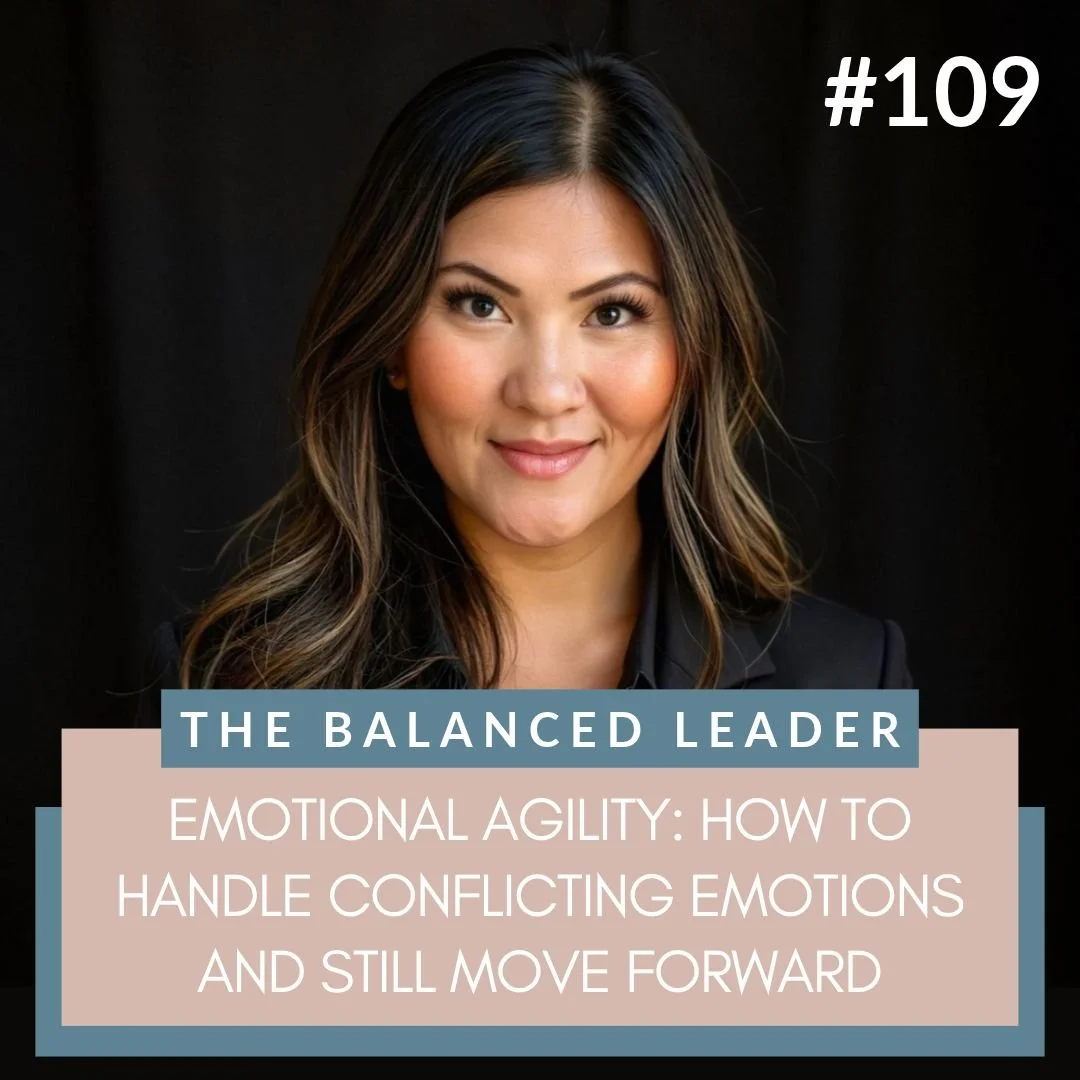
You can be confident and terrified at the same time. You can be deeply grateful for the life you've built and still desire more. You can love someone and be furious with them. So why do we feel like we have to choose one emotion over another? For so many high-achieving women, the discomfort of holding conflicting emotions can lead to questioning themselves, trying to resolve every feeling, or rushing towards a decision just to make the tension go away.
In this episode, I explore emotional agility and why the goal isn't to eliminate conflicting emotions, but to expand your capacity to hold them. I share why we get caught in the either-or trap, why we're so uncomfortable with emotional complexity, and how the power of and can help us make room for different feelings and truths without immediately needing to resolve them.
Tune in to learn how to hold conflicting emotions without making yourself wrong for having them, recognize what you actually want instead of getting caught up in needing validation, and make intentional choices even when you don't feel emotionally certain. Because you don't have to resolve every emotion before you can lead, and two things can be true at the same time.
learn more about command here
What You’ll Learn from this Episode:
Why feeling two opposite emotions doesn't mean something is wrong, and how to recognize the either-or trap.
How the discomfort of holding conflicting emotions can lead to reassurance-seeking, defensiveness, and premature decision-making.
How to use the power of “and” to make room for different feelings, desires, and truths at the same time.
Why you don't need emotional certainty to make an intentional choice or decide what you want to do next.
How to distinguish between wanting a particular outcome and wanting someone else to validate your feelings.
How to expand your emotional capacity without immediately trying to escape, fix, suppress, or react to what you're experiencing.
Listen to the Full Episode:
Featured on the Show:
Interested in working with me? Book a free 1:1 consultation here!
If you haven’t already, please follow the podcast and leave a rating and review to let me know what you think. Find complete instructions here!
Send me an email: connect@aspire-coaching.co
Watch my TEDx talk: Reclaiming anger: A woman’s birthright
Get the free guide, The 5-Minute Reset to Own the Room, here!
Episodes Related to EMOTIONAL AGILTY:
44. Emotional Resilience Isn't About Controlling Emotion – It's About Commanding It
100. The Anger Advantage: Why High-Achieving Women Need to Stop Avoiding
Full Episode Transcript:
Here's where I think so many high-achieving women get stuck. We think we have to choose. If I'm confident, I shouldn't feel afraid. If I'm grateful, I shouldn't want more. If I trust myself, I shouldn't feel disappointment. If I'm a powerful leader, I shouldn't feel so emotional. But who made that rule up? What if the goal isn't to eliminate the conflicting emotions? What if the goal is to become the woman who has the capacity to hold both? Because two things can be true, sometimes three, sometimes five. And here's what I've come to recognize. Your power isn't in having one clear emotion. It's in your capacity to hold the complexity of being human without abandoning yourself.
Today we're going to explore why we struggle to hold conflicting emotions and truths. How the need to resolve them can keep us stuck and four ways to expand your emotional capacity so that you can make powerful choices even when everything inside of you feels complicated. Because you don't have to feel one thing to know what you want. And you don't have to resolve every emotion before you can lead. Let's dive in.
Welcome to The Balanced Leader, hosted by Yann Dang, a Leadership and Life Coach with over 20 years of corporate experience. Drawing from her journey as a former global finance leader and second-generation immigrant, Yann understands the unique challenges women face in male-dominated workplaces.
Each episode offers insights on balancing masculine and feminine energies, mastering soft skills and building emotional intelligence. Join us to transform frustration into empowerment and unlock your authentic leadership potential.
All right, podcast listeners, welcome to today's episode. This is a topic that I've been talking to a lot of my clients about, especially in Command, being able to hold two conflicting emotions. And it's actually something I've been experiencing a lot in my business and even with my husband recently. And I am just noticing that we can have lots of different emotions and there could be different truths that are going on. And sometimes we feel confused and mixed up in this emotional trigger. I'm going to share with you four different things that I want you to really be thinking about when you feel like you have conflicting emotions. Because this is about building emotional capacity. This is about being able to broaden your emotional perspective within yourself and in relating to other people.
You may have two conflicting feelings within yourself, and the person that you're with may also have conflicting feelings that are coming up within them. You can love someone deeply and in a moment be super furious with them or feel super hurt with them. Your boss can really respect you and value you, but in a moment could be dismissing you because they have other things on their mind. Two things can be true. So I'm going to actually walk through these different ways of being able to expand your emotional capacity, which will expand your emotional agility, and will also support you in thinking more strategically and being more agile in your strategies when you are moving through emotions, moving through thoughts, getting things done, understanding yourself better.
The first one is the either-or trap. High achieving women think feeling two opposite things means something is wrong. If I'm ready for the promotion, why am I afraid? Right? Being afraid doesn't mean you're not ready. Being ready doesn't mean you won't feel afraid, right? Sometimes that's why I do a lot of coaching around confidence because people think if I feel confident, I will just feel like no fear. I won't hold back. I will just move forward. But it's not so much confidence. It's actually feeling unconflicted within yourself. And when you feel unconflicted, you can still go after something very deeply and powerfully, but still feel vulnerable, still feel on edge, still feel some fear because you're doing something, you're stretching, you're building your capacity, and you are stretching yourself.
So it makes sense when you're going for that promotion that you are ready and you feel fear. And you have the capacity to be in that role and do it. This is why I also talk about imposter syndrome is not something that happens to you. You can really think about it as an expansion of your identity. And learning how to expand into this new space as you calibrate to new ways of being, new leadership roles, new circumstances in your life, new roles that you're playing, right? I felt like when I got married, right, this is like either-or that you can hold that you're excited about getting married and you can also feel maybe not ready or feel a little bit like, wow, what is this going to entail? It's a new adventure. I have no idea.
So two things, feeling those two opposite things doesn't mean that something's wrong. It just means that we're having the ability and the capacity to hold these things, right? You can be afraid and brave at the same time. You can be grateful and deeply ambitious. You can be disappointed and hopeful. You can be vulnerable and powerful. You can hold these two things. It doesn't mean that something is wrong. We are just expanding our ability to hold them both.
The other thing is the discomfort of holding both, right? I think our brain wants one answer. It's like, what is the answer? Give me the answer. This person is wrong. I am right, right? It's like having that tug of war. Our desire to eliminate uncertainty, disappointment, anger, or fear can have us rush towards reassurance, defensiveness, or premature decision-making, right? This tension is about wanting certainty and allowing complexity. You don't have to solve every emotion you're experiencing.
I was actually just coaching somebody today who was having a very difficult conversation over text with somebody who is actually their vendor. And she was triggered, they were triggered, and she was back and forth with them. And it was difficult for her to let go of needing to feel validated by this person. I was basically at the end of the day coaching her to get satisfied in the clearest way possible for her. But she was really focused on wanting the person to understand that they were making her feel a certain way. And they were saying some things that may or may not have been correct and she wanted to correct them.
Although when we talked about the correction, it's like, is that actually moving you towards satisfaction or just satisfying an emotional need that you might have to feel heard and seen? Do you actually need this person to validate that or can you just validate yourself and say, hey, I didn't feel heard and seen in this moment. I could spend time having that other person understand it or I could choose to move towards satisfaction and get what I want. And focus on the outcome that I actually want versus rehash all of the emotional stuff that was coming up because the text message back and forth was highly triggered.
And so sometimes you just have to pause and be like, what am I playing here? Am I trying to get satisfied? And what is my outcome? Or am I wanting somebody else to accept me or to recognize my upset and my pain in this moment, right? Because they're two different things. And I like people to notice this because one can have you spending a lot of mental and emotional energy solving for the wrong thing or solving for the thing that's not actually going to get you satisfied in the end.
And I think as women, sometimes we want to tie things in a bow and it to feel a certain way, right? For example, I would love for my husband to love to go on vacations with me and just to enjoy it, right? The truth is, he doesn't like vacations. He doesn't like to be out of his routine. And he also loves and cares about our family. So wants us to experience a good vacation with him at the same time holding the tension that he's not going to like it, right? And so I could spend a lot of time hoping he likes it, hoping he will enjoy it and wanting him to act a certain way.
Or I can just be like, listen, he's doing this. This is not something he's totally comfortable with, but he's willing to stretch in this way. And I'm going to give him space, but we're still going to move on because I want to feel satisfied in this thing, in this vision of having this vacation with my family, right? So I don't need to solve for him feeling a certain way. I don't need to solve for him to act a certain way. Yes, would I like it? Yeah, it would make my life easier, but he's doing the best he can with what he has. So let's move on, right?
There is a discomfort though to holding both emotions. And I think this is why politics is so difficult to talk about. Because sometimes you're like, oh my gosh, I love this person. They're a great neighbor. But their political views are totally against what I believe. And so there's this cognitive dissonance and it makes us oftentimes want to go into this either-or trap to make life simpler for us, to make meaning simpler and for us to feel like there's a right way.
But the reality is there's a lot of different truths and people are much more complex. And values is something that is complex, right? Even within values, there are conflicting things. So we just need to also know that this is your ability to have more of this emotional agility, right? The discomfort of holding both. It can be true that you can deeply love and respect someone who has very different political views than you in other areas, right? Where you don't. So it's good to understand this because you don't have to solve every emotion you're experiencing, right?
The other thing is the power of and. I want you to know you can have both things, right? You can be deeply happy and satisfied in your life and want more. You can feel vulnerable and choose to be visible, step into that visibility. I have this all the time, especially as I'm getting bigger and bolder and braver and stepping more and more into my launch. I literally have to say to myself and I have it on a posted card here that I can hold desire and uncertainty. Because that's what it is. As I'm going out here, making offers, compelling people to work with me, I am holding both. I'm being visible, I'm being vulnerable, I am holding desire for people's transformation and their lives to change. And I'm also holding a lot of uncertainty. Both can be true.
Self-trust is not the absence of conflicting emotions. It's knowing you can handle them. It's knowing you can still have your back. It's knowing you can still understand yourself when you have these conflicting emotions. And it's knowing even for me, it's like sometimes I'm processing disappointments and celebrating at the same time. It's two things. They're both happening. The next thing is the capacity to choose. What am I feeling and what else am I feeling? What truths can coexist here? What do I choose to do while I'm holding all of this? This really helps me a lot because sometimes our brain's offer and as a busy working mom, an entrepreneur, and I know many of you listening, high achieving women, my brain offers me, you're tired, right? You're tired. And what I have been offering myself is, yes, I am tired and I have capacity and desire to do something.
So that whatever that something is, I'm going to get it done even when I feel tired. This is not about not having self-care. This is just about stretching your capacity. And it's about choosing to hold that capacity. It's choosing to feel certain things and choosing to know that two things can be true. I can love my husband deeply and I may have hurt him deeply in some way, saying something that I didn't mean to say, right? It's both.
And the thing about emotions is that they're impermanent, things move on. You don't need emotional certainty to make an intentional choice. You can still have that intentional choice even when having emotional uncertainty. Thinking about this, my boss has supported my career and I feel overlooked right now. Both can be true. My team is doing their best and their performance isn't meeting expectations.
Or, I understand why this person made that decision and I'm disappointed by it. Both things can be true. It's not just one or the other. The more you can have this expansiveness, the better you're going to be able to deal with different emotions that come up, conflicts that come up. It will widen your perspective and allow you to zoom out. And it will allow you to be a better friend to yourself. That is actually the truth because sometimes when I'm trying to push myself to feel a certain thing, I'm actually not validating my full experience and I'm not fully experiencing or accepting myself in that moment because there's a part of me that's suppressing something, an emotion that I may not want to feel. These aren't necessarily competing facts. They're just dimensions of the same complicated experience that we have in life.
The capacity to hold both without immediately invalidating one is where emotional maturity and strategic discernment meet. You can be brave and afraid. You can be vulnerable and powerful. These things can be true. You don't have to choose one part of yourself to be worthy of trusting the whole of yourself. What if instead of asking yourself which feeling is right, you just asked, can I make room for all of this? And still choose how I want to lead? Can I actually hold all these emotions myself and other person and still move forward? And particularly when I'm having conflict with my husband, I'm like, can we still hold all of these things that we are having on our plate because we have demanding careers, demanding lives and we deeply love our family and our children and they have their own lives and we're figuring it all out.
Can we hold all of this and still move forward in an aligned vision of growing, learning, and being together, being able to do these things? And it is, it's true, but we're not always going to be in the same direction and that's okay. I think sometimes with this perfectionist, people think we should all be aligned and in the same direction. Well, if we're all learning and growing and going for the things that we want, there's going to be conflict and there's going to be friction.
That friction and conflict doesn't need to be bad or wrong. It's just part of the process, right? And this is where that emotional maturity comes into play. People who aren't as emotionally mature, especially when they're executives, feel like there's just one way. And they're inflexible and they kind of dig their heels in. But this is your ability and learning your capacity to stretch and see lots of different ways of things being operating in different means and having more neutrality around them. And choosing consciously what you want to think and what you want to believe and trusting yourself and having your own back.
This is important because sometimes we are so focused on things being a certain way that we use so much of our energy trying to convince people versus lead with our own conviction, have our own back, make room for ourselves, accept ourselves, and move intentionally. We're learning to have this capacity. We're learning to build this capacity, the ability to experience emotional complexity without immediately needing to escape, fix, suppress, or react to it. We'll just notice, hey, both things can be true. And holding both things doesn't mean staying stuck between two truths. It means being able to make a deliberate choice without needing to erase one or the other.
Even for me as a daughter and as a mother, sometimes I'm like, both things are true and sometimes their roles conflict with each other. And then I get to choose what I want to do, where I want to go next and have my own back and connect to myself. I hope this episode gives you some bigger way of looking at your emotions and really as you're thinking about emotional agility, your emotional capacity, being able to hold two different truths, two different feelings, conflicting feelings, different perspectives is what the game is about.
The more perspectives you can understand and the more clarity you can bring to yourself as you're discerning what you want will allow you more freedom and greater agency to move through life, this complex life that we live. All right, have a beautiful week and I'd love to hear how this episode is hitting you, especially if you notice yourself jumping back and forth and negotiating with yourself and making yourself wrong for having maybe negative emotions. All right, have a beautiful week and I will see you soon. Bye.
Thank you for being a part of The Balanced Leader community. We hope you found today's episode inspiring and actionable. For more resources and to connect with Yann, visit us at aspire-coaching.co. Until next time, keep leading with confidence and purpose.
Enjoy the Show?
Don’t miss an episode, follow the podcast on Apple Podcasts, Spotify, YouTube Music, RSS, or wherever you listen to podcasts!