88. Bad Guy or Badass Leader? When Leadership Feels Like a Risk
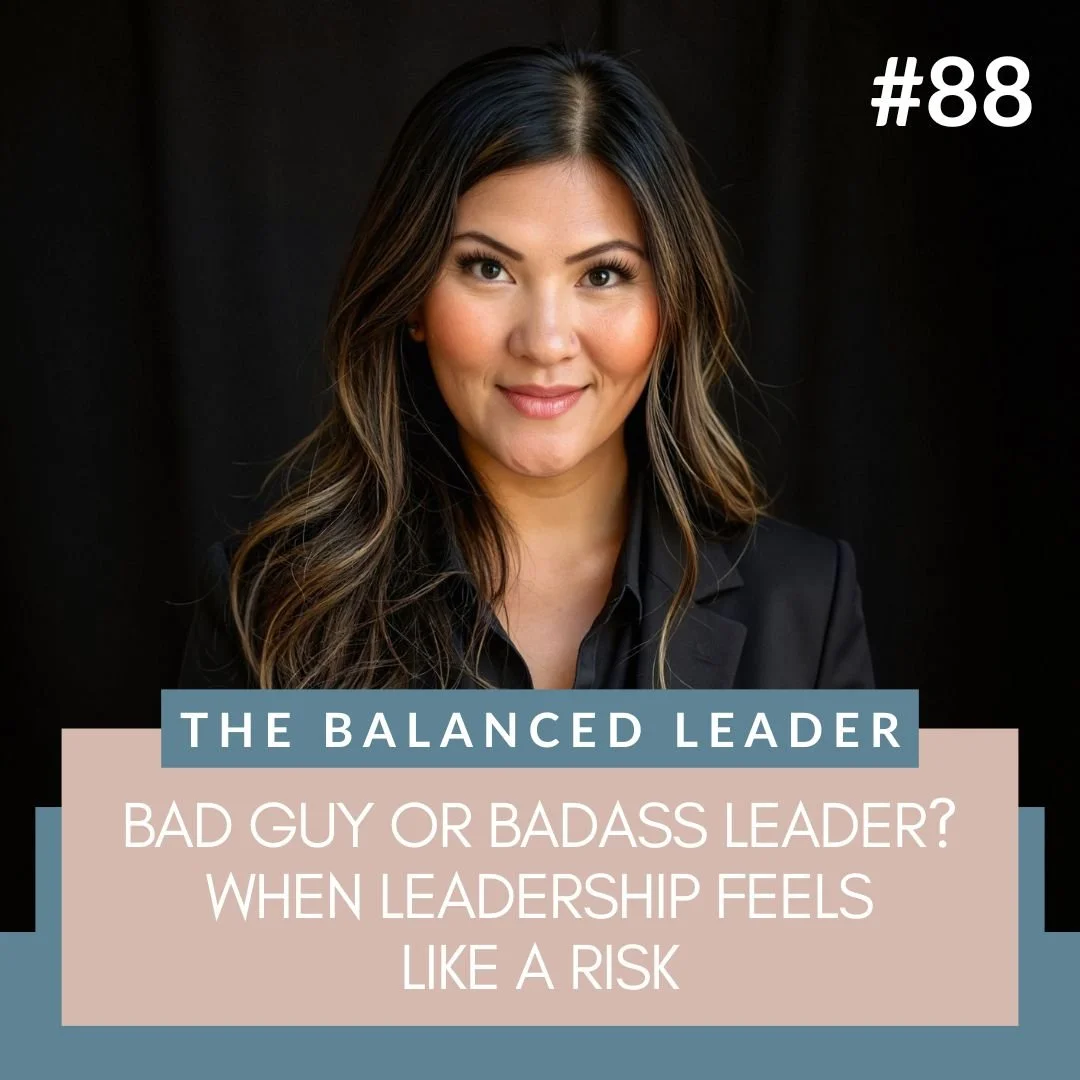
Are you scared of being labelled “the bad guy” at work?
Maybe you overthink difficult conversations, carry everyone else’s emotions, or hesitate to set boundaries because you fear disappointing others. Many high-achieving women unconsciously organize their leadership around avoiding that label, and it quietly drains your energy, undermines your authority, and keeps you from leading fully.
In this episode, I explore why women feel personally responsible for other people’s comfort, why leadership tension feels risky, and how the fear of being the “bad guy” shapes decisions and interactions. You’ll learn how to navigate discomfort, enforce boundaries, and shift from feeling like the bad guy to leading as a confident, badass leader.
Interested in working with me? Book a free 1:1 consultation here!
What You’ll Learn from this Episode:
Why fearing being labeled the “bad guy” quietly drains your energy and undermines your leadership.
How people-pleasing and over-carrying others’ emotions keeps you from stepping into authority.
How to shift from avoiding discomfort to leading with clarity, boundaries, and presence.
Why saying no or enforcing standards doesn’t make you the bad guy, it makes you a badass leader.
How to recognize the difference between protecting yourself and protecting everyone else’s comfort.
How to hold tension, conflict, and resistance without self-abandonment.
Strategies to lead boldly while maintaining emotional balance and self-trust in high-stakes moments.
Listen to the Full Episode:
Featured on the Show:
If you haven’t already, please follow the podcast and leave a rating and review to let me know what you think. Find complete instructions here!
Watch my TEDx talk: Reclaiming anger: A woman’s birthright
Get the free guide, The 5-Minute Reset to Own the Room, here!
Episodes Related to being the bad guy or a badass leader:
Full Episode Transcript:
Today, we're talking about why women fear disappointing people, why we overcarry emotionally, why leadership tension feels so personal, and how to stop abandoning yourself every time discomfort enters the room. Because this issue is costing women promotions, visibility, peace, confidence, and emotional freedom every single day. And this episode is an invitation for you to stop this right now for yourself. Let's dive in.
Welcome to The Balanced Leader, hosted by Yann Dang, a Leadership and Life Coach with over 20 years of corporate experience. Drawing from her journey as a former global finance leader and second-generation immigrant, Yann understands the unique challenges women face in male-dominated workplaces.
Each episode offers insights on balancing masculine and feminine energies, mastering soft skills and building emotional intelligence. Join us to transform frustration into empowerment and unlock your authentic leadership potential.
Hey podcast listeners, welcome to today's episode. We are talking about the label, the bad guy. Many women unconsciously carry this internal contract. I can lead as long as everyone else feels okay with me. This idea that we can lead if everybody's happy with us. And this is what creates overexplaining, over helping, emotionally monitoring, rescuing, softening our own authority, fear of being direct, and tolerating misalignment for far too long.
This actually came up recently because I was coaching a group of women in my Command cohort, and this thought of, "I always have to be the bad guy," came up. And somebody else said it too, "Yeah, I have to be the bad guy too." There were multiple women that were identifying with this, "I hate being the bad guy," almost. "I don't want to be the bad guy. Why do I always have to be the bad guy?" And it was almost coming up with this resentfulness.
And I want to give you examples of maybe where this thought might come up for you when you have to enforce a policy that people haven't been following, when you have to give hard feedback, when you are carrying work that belongs to other people, when you are feeling guilty about putting boundaries in place. I want you to notice this. It may even be when you have to let people go because they are not doing the job that they were hired to do.
Many women are not leading from truth. They're leading from emotional permission. And so this is why it feels hard and this is why that bad guy connotation comes up because they're like, if I'm the one that is causing disruption, if I am the one that is causing people to lose their jobs—this is a very, you taking it to another level—then I must be the bad guy. Why do I always have to be the bad guy? Why do I have to be? And it could be bad guy, it could be bitch too. But it's this thought that, why do I have to be the one instead of people seeing themselves as the leader?
Because we have this idea, this conditioning. Women are often rewarded for being easy, accommodating, relationally smooth, emotionally safe, and helpful. So being the bad guy goes against all of that. It goes against being, making sure everybody's okay and safe. And we've been taught for women, our value comes from not rocking the boat. Our value comes from peacekeeping, from unifying, from smoothing things over, from doing all of these things. But the reality is that leadership requires standards, friction, boundaries, accountability, prioritization. And our nervous system interprets this as danger or dangerous or bad, the bad guy.
The moment leadership requires discomfort, many women unconsciously feel like they're becoming bad people. We feel like because we are creating this disruption, we have to be the bad guy because this is what leadership requires of us. But I want you to know that our thoughts about it and our emotions in our body, we can actually shift them. We do not need to be feeling this way. Our conditioning does not have to have us go against ourselves.
Because the nervous system connection is that the body reacts before logic does. So we have these emotional feelings in our body. It feels dangerous. It doesn't feel good. So women confuse discomfort with wrongdoing, tension with failure, disagreement with rejection. We confuse all of these together. We don't need to do that. This is actually something I want to break here because we do not need to say that discomfort is wrongdoing and tension equals failure and disagreement equals rejection. That's just not true. And if we as women continue to live by these rules, our leadership journey will just feel not in alignment with us. It will feel like we have to sell ourselves out in some way because that's how we think about it.
But let's break it down because there is this sort of hero trap that high achieving often women become. We become the fixers, the helpers, the dependable ones, the emotional caretaker. But leadership at certain levels eventually requires letting people struggle, disappointing others, not rescuing people, saying no, and holding standards. This is the next level of leadership where you are not just getting things done or you are not just the glue for other people, you are expected to lead and to be the leader. And you cannot simultaneously protect everyone's comfort and fully protect your leadership, because your leadership is actually going to require you to do bigger things, to do bolder things, and to think about things in a different way.
The exhaustion comes from self-abandonment. It comes from you thinking you're selling yourself out because you are being the bad guy. When in reality, this is the conversation I really had with my clients. What does it mean to be the bad guy? Why do you think you're the bad guy? Some women aren't burnt out because they're weak. They're burnt out because they've spent years overwriting themselves and there is a thought error in how they're interpreting their emotions. And this is where I really led my group of women to think about this bad guy image in a totally different way.
What is a bad guy? And in their minds, it's the person who has to come in and tell the truth and rock the boat. And I'm like, but what's the difference between a bad guy and a badass leader? A badass leader comes into chaotic situations and creates certainty. A badass leader comes in and holds people accountable to what their job is needed. A badass leader is a steward for the financial sustainability of an organization. And so I really challenged the group to think about themselves in a different light. Instead of being the bad guy, what if you're the badass leader instead?
And by the way, my team when I was leading my finance group, they would call themselves the animals and this is an unclean version, and it would be called The Animals and underneath it we would say that we were badass motherfuckers. Because that's how we really thought about ourselves. We are bringing certainty and sustainability to what we're doing. People don't always like to hear our no, but we're in relationship with them and we're in rapport with them, and we're willing to have the hard conversations. And as a finance leader, we have to be really willing to have the hard conversations because there is not endless resources. There is not endless money. And people are going to want things and it's normal for people to want things.
But to have those conversations, if I thought I was a bad guy every single time I said no to somebody, well, I would be exhausted and I would be emotionally probably burnt out because every time I have to say no, my job was to say no. My job was to protect things. My job was also to ask really curious questions and to ask discerning questions. So, the difference between just being a bad guy is somebody that has no conscience, that doesn't care, that's not thinking about the greater good. And the badass leader is caring. The badass leader stays connected to herself. She's tolerating the discomfort. She's allowing misunderstanding temporarily.
Sometimes in finance, I couldn't tell people all of the things. I couldn't say, "Hey, you can't hire that person because we're about to acquire this whole company where you're going to have a huge team." Because we couldn't tell them. It's not open, it's highly confidential at that stage. So I had to sit with the misunderstanding, people misunderstanding me and not hold that against myself, not hold that against them, and just be open to that and stay grounded while others react and not collapse because tension exists.
Sometimes I would have to be the messenger to a lot of leaders. I would have to tell my CEO, "Hey, listen, we missed the sales target by a long shot." And they would be really angry and upset, but I wasn't holding that I'm the bad guy delivering the message. I'm just, hey, I'm delivering this message and we're badass leaders here, so we better get on it and figure out a mitigation plan or figure out what's next.
There's a way you hold yourself and this is really what I want to underline here because if your thought is I'm the bad guy, imagine how much energy you're putting into that and imagine how much you're fighting with yourself versus seeing yourself as that badass leader instead. So here are some things that you can do if you're noticing yourself in this story of really breaking it down, having yourself write down, what is a bad guy? And point by point, being clear with yourself how you are actually not that bad guy that you think you are. Because a bad guy, a bad person really doesn't live by any consequences, doesn't care about the greater good. But most of the time, especially with women, you care too much and you care so much that you think you're the bad guy.
This is a chance to really rewrite the story for yourself. Be really clear with yourself about it so that you can live with more emotional freedom, so that you can lead with more impact and more certainty and more conviction, and so that you can do the hard things but without making it harder on yourself.
Grounded leadership often feels uncomfortable before it feels empowering. So if you are even asking yourself, "Am I the bad guy?" chances are you are actually leading very well now. You are entering the discomfort. This is the next level of your leadership. To be a leader, especially in this corporate world that we live in, this global corporate world and be responsible for more and more, you need to have this relationship with yourself. You need to be able to take care of yourself. You need to be able to really ask yourself these hard questions, but not in a way where you are beating yourself up, undermining yourself, sabotaging yourself.
I will share with you my own story of having to let somebody go on my team. And actually, I didn't just let this person go. I gave him options. I said, "You can either stay here and do special projects or you can leave and here's a severance plan." And it is emotionally taxing. It is hard for anybody to fire anyone, even if they are clearly need to be fired for a lot of things because there's an emotional component to it.
And a CEO that I worked for often said, "This is an important thing for you to feel as somebody who is firing people because there's a responsibility." And there's a responsibility that is emotional. And you start clarifying for yourself the type of leader you are when you're really clear about why you're doing the thing you're doing. Because sometimes leadership feels great. Sometimes it's on a podium, everybody's cheering you on and you're just being celebrated. And sometimes it's these darker moments where you have to be the bad guy, where you have to deliver the hard message, where you are telling somebody else that their job is going away. But your ability to connect to yourself, stay attuned to yourself, and support yourself through the process while being there as the leader for this other person, this is where your leadership either expands or contracts.
If you see yourself in that moment as the bad guy, your leadership is not going to want to expand because you don't trust yourself to be the leader. But if you see yourself as the badass leader that is delivering hard messages with dignity, with respect, with responsibility, then your leadership will grow from there because you will trust yourself. And you will feel connected to yourself and you won't get burnt out because you are emotionally berating yourself. You are with yourself.
And so for me, of course, I felt so much emotion, fear of disappointing this person. This person had a couple of kids, fear of their livelihood. And also for me, this is better for the organization. I knew it. And I knew it was better for him in the long run. He was struggling. The whole reason why he was put underneath me, who I was his peer and then my boss put him underneath me, was because he was having leadership challenges. He couldn't see the weeds in front of him to the trees. He couldn't see the bigger picture. And he got some coaching and he was trying to make some moves, but he kept reverting back. And sometimes the organization needs somebody there and now and we can't wait on that person. And so it was a hard conversation. It was so difficult.
But did I feel proud of myself for doing it? I don't know if proud's the word. Did I feel aligned with myself? Yes, I felt aligned. I felt that this needed to happen. And I did feel proud in that I was trying to look out for the best in the situation, the best for him as much as possible, the best for the organization as much as possible, and the best for me. I actually asked my peers for support and help with this. I told them I'm going to have a hard conversation and many of them reached out to me that day to ask me how I was doing. And I literally remember feeling like I punched him in the stomach and he punched me and it was painful.
And that was a true story because leading is human and leading involves emotion and leading is uncomfortable. But we can get support from people and we can support ourselves. And we can see ourselves as righting the ship, as being the ones that are steering it in this way. And the moments might not feel prideful, but they will feel grounded when we're really clear about what we're doing.
So, this is that episode to really have a conversation with yourself if you're noticing that you're calling yourself the bad guy, if you're berating yourself for truly leading and holding people accountable. This is my invitation for you to see yourself as a badass leader versus the bad guy. So I want you to just ask yourself, where are you still protecting your image instead of protecting your energy, clarity, and leadership? vAnd by the way, protecting your image in this bad guy analogy, it's a conditioning because this is where you are thinking about being liked and how important being liked is and how having people see you as the good guy is more important than leading with conviction, with clarity, with purpose.
The women who command the rooms are not the women who keep everyone comfortable. They are the women who stay connected to themselves even when the room gets uncomfortable. So remember, you have a choice here. You have a choice to think about yourself and feel about yourself in a very different way than how you've been conditioned as a woman.
All right. So, go out there my badass leaders. Let me know how this episode landed with you. I'd love to hear from you. This is about taking back your authority, about you protecting your energy and you leading with more grounded clarity and conviction. All right, have a beautiful day. I will see you next week. Take really good care.
Thank you for being a part of The Balanced Leader community. We hope you found today's episode inspiring and actionable. For more resources and to connect with Yann, visit us at aspire-coaching.co. Until next time, keep leading with confidence and purpose.
Enjoy the Show?
Don’t miss an episode, follow the podcast on Apple Podcasts, Spotify, YouTube Music, RSS, or wherever you listen to podcasts!