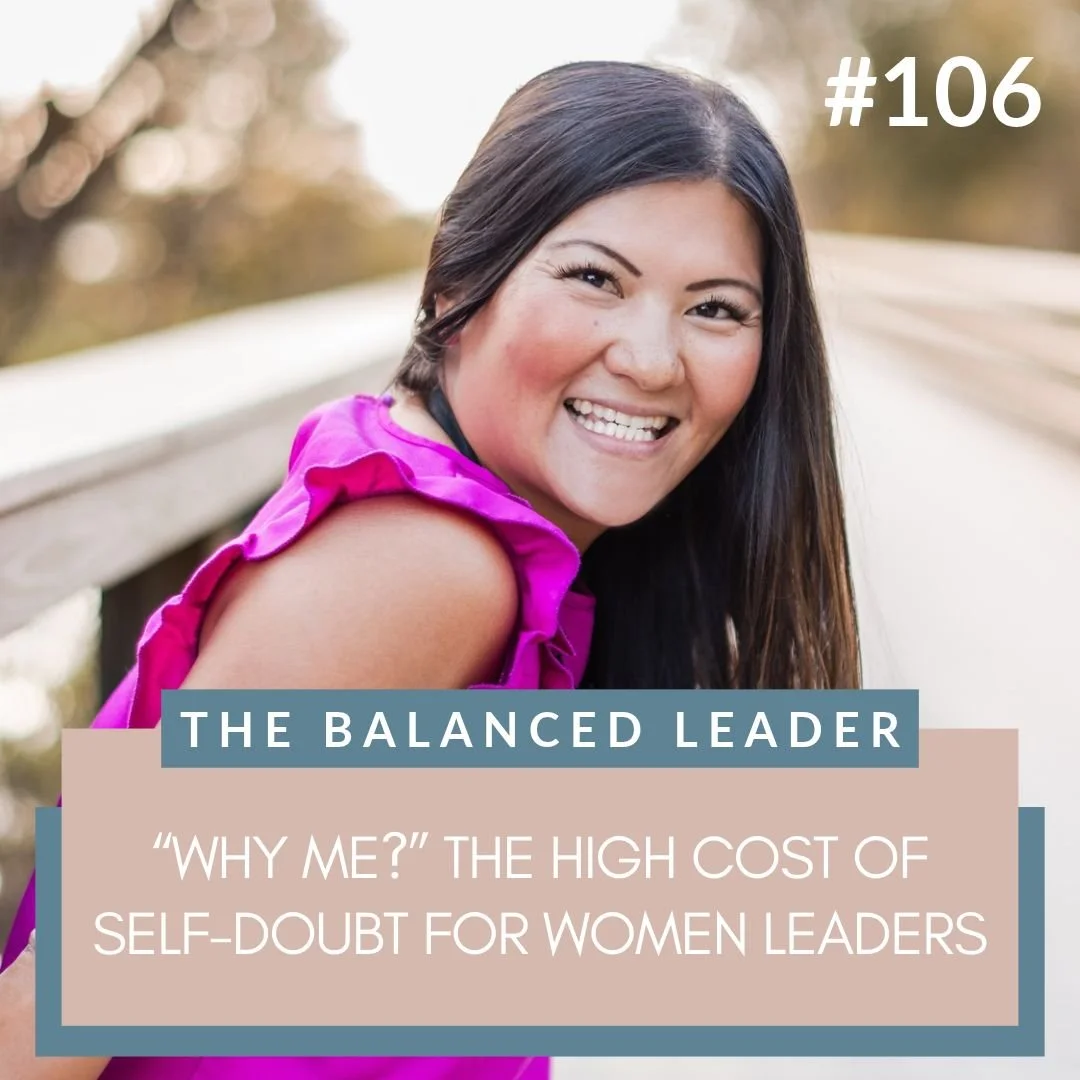
The shift from “Why me?” to “Of course, it would be me.”
You’ve worked hard, earned the opportunity, and built a track record. So why do you start questioning yourself when you step into a bigger role or a room full of people with more experience? Self-doubt can make you focus on everything you think you lack instead of recognizing the evidence of what you bring.
In this episode, I’m exploring the high cost of self-doubt for women leaders, from missed opportunities to second-guessing decisions and spending hours replaying conversations. I’ll explain why self-trust matters more than confidence when you’re navigating uncertainty, and why you don’t need to know everything to lead well.
Tune in this week to learn how to shift from “Why me?” to “Of course, it would be me.” I’ll show you how to draw on your experience, accomplishments, judgment, and ability to learn so you can stop building a case against yourself and start leading from the authority you’ve already earned.
learn more about command here
What You’ll Learn from this Episode:
The three major costs of self-doubt.
Why self-trust matters more than confidence when you’re navigating uncertainty.
How to stop building a case against yourself and recognize the evidence of what you bring.
Four questions to help you recognize your experience, knowledge, accomplishments, and ability to learn.
How to trust your judgment without needing to know everything or control how others respond.
Why self-trust allows you to stay connected to your authority, even when things don’t go as planned.
How to shift from “Why me?” to “Of course, it would be me” without relying on empty affirmations.
Listen to the Full Episode:
Featured on the Show:
Interested in working with me? Book a free 1:1 consultation here!
If you haven’t already, please follow the podcast and leave a rating and review to let me know what you think. Find complete instructions here!
Send me an email: connect@aspire-coaching.co
Watch my TEDx talk: Reclaiming anger: A woman’s birthright
Get the free guide, The 5-Minute Reset to Own the Room, here!
Episodes Related to The High Cost of Self-Doubt for Women Leaders:
63. How High-Achieving Women Can Build Internal Safety Through Self-Validation
95. Why Brilliant Women Struggle to Advocate for Themselves (Self-Advocacy Isn’t Selfish)
104. Lost Your Confidence? How Accomplished Women Can Reclaim Their Power
Full Episode Transcript:
Here's what I want you to understand: self-doubt is expensive. It costs you far more than the opportunities you don't pursue. It costs you your ability to make decisions, influence others, trust your judgment, own your seat at the table, speak up, and enjoy the success you've already earned. And the higher you rise, the more expensive that self-doubt becomes, because you will increasingly find yourself in rooms where other people know things you don't, have experiences you haven't had, or carry titles you haven't held.
You cannot wait until you're the most experienced person in the room to trust yourself. Today, I'm going to teach you one of the most important practices behind my leadership philosophy and the foundation of Command. It's the shift from asking yourself, why me, to answering, "Of course, it would be me." And by the end of this episode, you'll know how to use the evidence of your own experience to stop building a case against yourself and start leading from the authority you've already earned.
Welcome to The Balanced Leader, hosted by Yann Dang, a Leadership and Life Coach with over 20 years of corporate experience. Drawing from her journey as a former global finance leader and second-generation immigrant, Yann understands the unique challenges women face in male-dominated workplaces.
Each episode offers insights on balancing masculine and feminine energies, mastering soft skills and building emotional intelligence. Join us to transform frustration into empowerment and unlock your authentic leadership potential.
All right, hey podcast listeners, welcome to today's podcast episode. It is great to be here with all of you. I am having such a great fall. I hope you are all enjoying this fall weather. I was just in the Poconos with my daughter and I really loved it there. And as I was traveling, I was thinking about this masterclass that I just completed called “How to Be Powerful in Rooms Full of Powerful People.” And as I was on the plane thinking about all of my past experiences where I was with powerful people, with more powerful people, and how I experienced myself and how I used my own tools that I teach today to support myself.
And one of the thoughts and one of the memories that came up for me was when I was in my early 30s- I was going to say late 20s, early 30-ish- and I was moving from London. I had been in London for three years, and I was moving to Singapore. And I was getting promoted from a finance manager to finance director. I had negotiated very well for myself because I was like, if I'm going to move to Singapore, I'm going to make it worth my while.
And I remember thinking about my new job. My new job was actually going to be the head of the M&A process for the Asia region, which is a process I knew well because of my corporate experience and because of the experiences that I had with some M&A activity before that. And the other part of my job, which I didn't love, but it was part of the package, and I couldn't really negotiate my way out of it, was to be the leader of the business systems.
And I had worked with business systems in the past, so I wasn't super intimidated. I'd worked with other people who ran those business systems, especially from a finance standpoint. And so I was kind of like, well, if it's part of the deal, I'll handle it. And there was a person that was in charge who would just be reporting to me, or a person that was leading their business processes and their business systems. And so I was like, I can handle this. I'll figure it out.
So when I landed in Singapore to take on this role, I just found myself thinking about the people that I was leading and how much older they were than me and how much more experienced they were than me, right? And how much of the work that they've done that I've never ever done before, right? It was out of my remit. And I thought about what I did know. And I also noticed that, you know, there was a fear of like not knowing things. I know I was stepping into greater responsibility, visibility, and expectations.
It would have been so easy for my brain to ask, "Why me?" And it did. Of course, my brain said, "Why me? Why would I be the person to lead these people, especially if these people have been around for a while?" But instead of using that question to build a case against myself, instead of, sometimes we hear this voice like, "Why you?" Like, "Who do you think you are?" That's kind of like the voice that comes to my mind. But we can choose to hear that voice differently. We can choose to hear that voice softer and more compassionate and more open versus as an indictment, as a punishment, as a "How dare you? Who do you think you are?" right? We can actually use that question more like, “Who are you?” with curiosity, with openness, with possibility.
So I slowed down and asked myself, "Why me?" And I paused and I grounded and I connected to myself and I took a deep breath. And I remember answering myself, "Of course, it would be me." I had that conversation with myself, and not only did I have the conversation, I found evidence.
I reminded myself, you spent three years at corporate headquarters. You understand this business. You know how to get things done, especially from an M&A perspective. You just spent another three years in London working on the second largest part of the portfolio and the biggest investment there was in the organization.
The Asia CEO and CFO knew your work. They actually asked you. The CFO actually asked me to come interview for this role. She actually asked me to meet her in Singapore so we could talk about it, so she could show me around. She had me come to Singapore to see where I would live, who would I work with, and what it would be like to work for her.
And I understood the business across the globe. I knew how to build relationships across the markets, and I knew that I was the type of leader that could get stuff done. I knew I didn't have to know every single thing about business systems, but I knew what was important and critical to the business. And most importantly, I trusted my ability to learn what I didn't know yet. I trusted my ability to lead myself and to lead others.
And so that was really my sort of turning point where I spent more time focused on self-trust and why I would trust myself and why me instead of self-doubt. You can spend a lot of your mental and emotional energy convincing yourself on why you're not the one that should be taking the responsibility, or you're not the one that should have been chosen for X, Y, and Z, or you're not good enough for X, Y, and Z.
Or you can use your mental and emotional capacity to build self-trust, to decide, of course, it's going to be me. And that's not from an ego standpoint; it's from a grounded, like, let me find evidence in my life, in myself, of why this is true. And why I'm the best person to do this. But that takes you getting connected to yourself. That takes you seeing yourself clearly.
You see, I didn't need to know everything my team knew. That's not why I had been hired, and I was really clear on that. So it no longer scared me that I didn't know everything. My job was to bring my judgment, my experience, my leadership, my relationships, my willingness to learn to the table. I knew I was a good leader, so I deliberately decided and chose to lead like one. I wanted to show up as the boss because I knew I was the boss. I knew that I wanted to be firm but also friendly, clear but curious, open to learning without waiting for permission.
And then I remember something that one of my bosses in New York said to me when I was doubting myself in front of him. He looked at me straight in the eye and told me, "Yann, never doubt yourself. There's a world of people who will do that for you."
And it was something I still remember to this day. Actually, his name was Seth Felsman. If he's there, I'm going to send this episode to him because I want him to hear this. I remember him saying that to me, and I remember, I thought, whoa, he is serious. And this is important. You know, I remember kind of logging it in my head like, he's right. I really need to watch this. This is very expensive to me and my career to allow my own self-doubt to undermine myself and my authority and my power and my experience.
What I understood then, and what I've seen repeatedly in the women I coach today, is that you can have extraordinary accomplishments and still be very skilled at arguing against yourself. And it's typically from a place of protection, and it doesn't help you. It actually has a very, very high cost, which is what I want to go into.
The high cost of self-doubt. This is real, tangible cost, and it is very expensive, and it gets more and more expensive the higher you rise. What is it costing you to keep questioning what you've already earned? Self-doubt doesn't always look like a woman who lacks confidence. Sometimes it looks like the most accomplished woman in the room. She's successful, she's highly regarded, trusted with significant responsibilities, but internally, she's spending an enormous amount of energy managing how she's perceived.
So, I want to share with you sort of three examples of how tangible this is, because if you can start noticing yourself in this self-doubt cycle and how expensive it is for you and your leadership, then that's when you could break the cycle. We can't change what we don't name. So part of this podcast episode is really helping you name what is causing you to be in self-doubt and the cost of that self-doubt.
The first is the cost of your influence. You have something valuable to say in a meeting, but before you speak, you start evaluating whether it's intelligent enough, strategic enough, or whether someone else knows more than you. By the time you've decided it's safe to contribute, the conversation has moved on. I've heard this hundreds of times when I coach women. They are like waiting to talk, they are waiting to share their idea, and then John or Tom or someone else speaks their idea.
And what happens in that moment that self-doubt while you were waiting to speak is that somebody else spoke, right? You didn't lack the perspective; you lacked trust in your ability to contribute valuably without first guaranteeing the outcome. You were waiting for certainty to trust yourself, and that cost you your influence.
And then the second cost is the cost to your decisions. You make a decision, then you revisit it repeatedly. You ask three other people what they think. You wonder whether you miss something, not because additional perspectives are necessarily valuable, but because you don't trust yourself to make a decision without certainty. And so again, that self-doubt, that questioning, that price isn't just the time; it's the authority you keep handing away.
And actually, people are doing this more and more with AI. Instead of trusting their gut, they are going to AI and saying, "What do you think the best way to do this is?" And listen, I use AI all the time. The difference is I use AI not to discount my own thoughts. I use it as a thought partner. And I say, "Help me think through this." And I, at the end of the day, decide how I want to proceed because I want to increase my self-trust, not my self-doubt by using AI and outsourcing my thinking and my creativity to AI. I want to, of course, use AI to support me in expanding my thinking and to help me get clearer on things, but I'm not using it to make decisions for me.
And that's super important because when you use AI to make decisions for you, you start undermining your own self-trust. This is super important. Again, the price isn't just the time; it's the authority you keep handing away when you go to other people or other AI or other stuff to make decisions for you.
And then lastly, the cost to your emotional energy. There are other examples, but I wanted to give you three clear ones: the cost to your influence, the cost to your decision-making, and lastly, the cost to your emotional energy. You have a difficult interaction with a boss, for example. You remain professional, deliver your message, and move the work forward. But afterwards, you spend hours wondering what they thought of you. You're no longer in the meeting, but mentally and emotionally, you're still there. You're replaying that. And actually, one of the things I love about Command is it really helps you to command yourself in the moment so that you trust yourself and you say the thing.
Instead of questioning yourself hours later to say the thing, you're like, "I said it. I did it. I showed up for myself." Because the women in the container are learning how to trust themselves. And one of them even said, "I sleep better at night because I'm not ruminating over these thoughts again and again and questioning myself. I just know I did the best I could in the moment and I trusted myself to do so."
The most expensive part of self-doubt is that it shifts your attention away from what you're capable of doing, how you're capable of leading, and towards everything you fear might be wrong with you. Think about the cumulative cost. One meeting, one decision, one conversation, one opportunity.
Now, multiply that across weeks, months, and years of leadership. That is why self-doubt is not simply a confidence issue; it becomes a leadership issue. And it becomes a capacity issue as well, because it takes a lot of mental and emotional capacity to keep convincing yourself to, you know, not trust yourself, to doubt yourself.
And so here's why it is so important to me that women learn to trust themselves. And I tell the women that I coach all the time, I'm not here to teach you tactics. I'm not here to teach you scripts. I truly believe if you are able to be mentally and emotionally present and clear in the moment in whatever room you're in, you are going to be the best at knowing what to say, knowing how to lead, because you are present. You have that power within you. You're an expert on your organization, on the people in it, and on yourself. So this is why self-trust is so important.
There's a reason self-trust is the foundational work inside Command. It's because you can have the best communication strategies in the world. You can learn how to be more assertive. You can learn how to navigate conflict, advocate for your ideas, and build powerful relationships. But what happens when you're about to use those skills and you don't trust yourself?
This is what undermines everything. You hesitate, you overexplain, you soften your message, you second-guess yourself, you look around the room for reassurance that you're doing it right, and then you give away your power. The problem isn't that you don't know what to say, it's that you don't trust yourself to say it without controlling how everyone else responds. And when we're focused on controlling how everybody else responds, we're already out of our power and out of our leadership because we are externally focused and not internally focused on what we can contribute.
So I really want you to understand this. And there's a big distinction between confidence and self-trust, and I want you to understand the difference. Firstly, confidence says, "I believe I can do this. I know what I'm doing. I feel ready." Self-trust is different. This is self-trust: "I trust myself to navigate whatever happens." This deepens through having your own back, especially when things are uncertain. I can figure out what I don't know. I can take action even when I don't feel ready.
Again, this is why self-trust is so much more important than confidence. If you are to be powerful in rooms full of powerful people, you have got to embrace the uncertainty and the not knowing what's going to happen next, because if you did know, you'd be really confident, and you wouldn't feel scared. But the reality is when you're invited to these rooms, you're going to feel fear. You're going to have a human experience.
And here's another distinction that's super important. Confidence can make you feel powerful when things are going well. Self-trust allows you to remain connected to your power even when things aren't going the way you expect. You can still say, "I have my own back. I'm here for whatever is coming next." You don't abandon yourself because things don't go the way that you want them to.
So, when you trust yourself, when you learn to trust yourself, you don't need everyone else to agree with you. You don't need to know everything before contributing to a conversation. You don't interpret someone else's disagreement as evidence that you're wrong. You don't need the room to give you permission to lead. And when you make a mistake, you don't use this mistake to punish yourself or to say you're not worthy as a leader. You learn, you adjust, you move forward.
Self-trust is not believing you'll always get it right. It's knowing you can have your own back even when you don't. That is so, so much more important than just confidence. That is foundational. Because you're no longer leading from the need to prove yourself, you're leading from the decision to trust yourself.
And that is the practice. This is the number one thing I want you to take away from today, is if that question comes up, "Why me," I want you to choose the answer, "Of course, it would be me." And take it seriously and find the evidence, right? This week, if you notice it, I want you to take this as a practice. This is what I want you to practice this week. The next time your mind offers you the question, "Why me," I want you to resist the temptation to immediately answer it with everything you lack. And instead, I want you to take a deep breath, and I want you to, instead, answer it with evidence. And I want you to say to yourself, "Of course, it would be me."
And here are some questions you can ask yourself so that you can find that evidence and mind it in your mind and be able to use it, right? Here are some of the pieces that will help you.
Number one, what have I already done? Your experience, your accomplishments, your demonstrated capabilities. Listen, I told you about Singapore. I have a whole bunch of other stories in my mind because I think about this stuff and I go to school on myself.
Number two, what do I know? Your judgment, your perspective, your strengths, your expertise. What do you know about yourself?
And three, what have I earned? The trust, the responsibility, the opportunities, the relationships you've already built.
And lastly, what am I capable of learning? So many women discount their ability to learn, especially when they're looking for jobs. They're like, "I haven't done this yet." And I'm like, "Who cares if you haven't done this yet? You have the ability to learn how to do it. You've done things like it before. You know how to adapt. You know how to figure things out and grow into that next level of yourself."
I really want you to take this seriously, because I'm going to share an example of a person that I've been coaching. She walks into an executive meeting and realizes that almost everyone has more tenure than she does. And so, of course, her mind goes to, "They know so much more than I do. What if I say it wrong?"
Now, watch what happens when she calibrates to her own answer to that. Instead of saying, "Here's all of the things that I believe are wrong with me," she really talks about this. And this is how she had answered when I asked her, like, what do you know? And she said, "I've spent 15 years building expertise in this industry. I've led complex initiatives. I've made difficult decisions. I've built relationships and delivered results. And I was chosen for this role for a reason. Will I know everything? No. Will I need to learn? Absolutely. But I know how to lead. Of course, it would be me." That is what is so important, that self-talk. The power is in connecting with yourself, believing them because you've taken the time to recognize the evidence, right? And there's an energy and a conviction that happens when you truly believe it.
This is not empty affirmation. It's not pretending your limitations don't exist. It's choosing not to use your limitations to invalidate everything else you've accomplished.
And so, this is my invitation to you. When you or a friend of yours says, "Why me?" I want you to really ask yourself, where in your life or leadership have you been asking, "Why me?" when the evidence has been telling you, of course, it would be me. Think of the role you're in, the opportunity you're considering, the conversations you've been avoiding. What would change if you stopped questioning whether you belonged and started deciding how you wanted to lead instead?
I want to leave you with this: the higher you rise, the more often you're going to find yourself in rooms with people who have more expertise, more experience, bigger titles, stronger opinions. That's not evidence that you don't belong. It's evidence that you're expanding. It's evidence that you're growing to bigger, more powerful rooms. And every time you enter one of those rooms, you start questioning the value you bring. You're going to spend an enormous amount of energy in your career and in your life trying to earn confidence you've already earned and have evidence for. That is not a good use of your time, energy, or emotional capacity, or mental capacity for that matter, right? You don't need to know everything, especially in this world of AI. You don't need to be the smartest person in the room, and you certainly don't need to be free from self-doubt. You need to become the woman who knows how to trust herself even when self-doubt appears.
That's the work we do inside Command. We develop your ability to know yourself, trust yourself, express yourself, and lead from your own authority, especially when the pressure rises. Because when you trust yourself, you stop making other people's reactions the measurement of your own worth, your capability, or your power. And you begin operating from something much more powerful: your own conviction.
All right. That is today's episode. I want you to go to school on yourself, and I want you to ask yourself, "Why me?" and answer, "Of course, why me," and then have the evidence for yourself. This is the single most important thing you can do to support yourself before you enter a room with very powerful people. You need to up-level your own power. You need to calibrate to your own power in that room and give yourself evidence of why you belong, why you were meant to be there, why this is the pivot in your career, why this is the moment for you to show up with your leadership.
All right, have a beautiful week and tell me how this episode landed with you. I'd love to hear from you directly at connect@aspire-coaching.co. You can leave me a review. You can find me on LinkedIn as well. All right, have a beautiful week. Take good care. Bye.
Thank you for being a part of The Balanced Leader community. We hope you found today's episode inspiring and actionable. For more resources and to connect with Yann, visit us at aspire-coaching.co. Until next time, keep leading with confidence and purpose.
Enjoy the Show?
Don’t miss an episode, follow the podcast on Apple Podcasts, Spotify, YouTube Music, RSS, or wherever you listen to podcasts!